TL;DR
An enterprise procurement framework to evaluate an offshore engineering partner: weighted scorecard, the questions that expose body shops, RFP red flags, and exit terms.
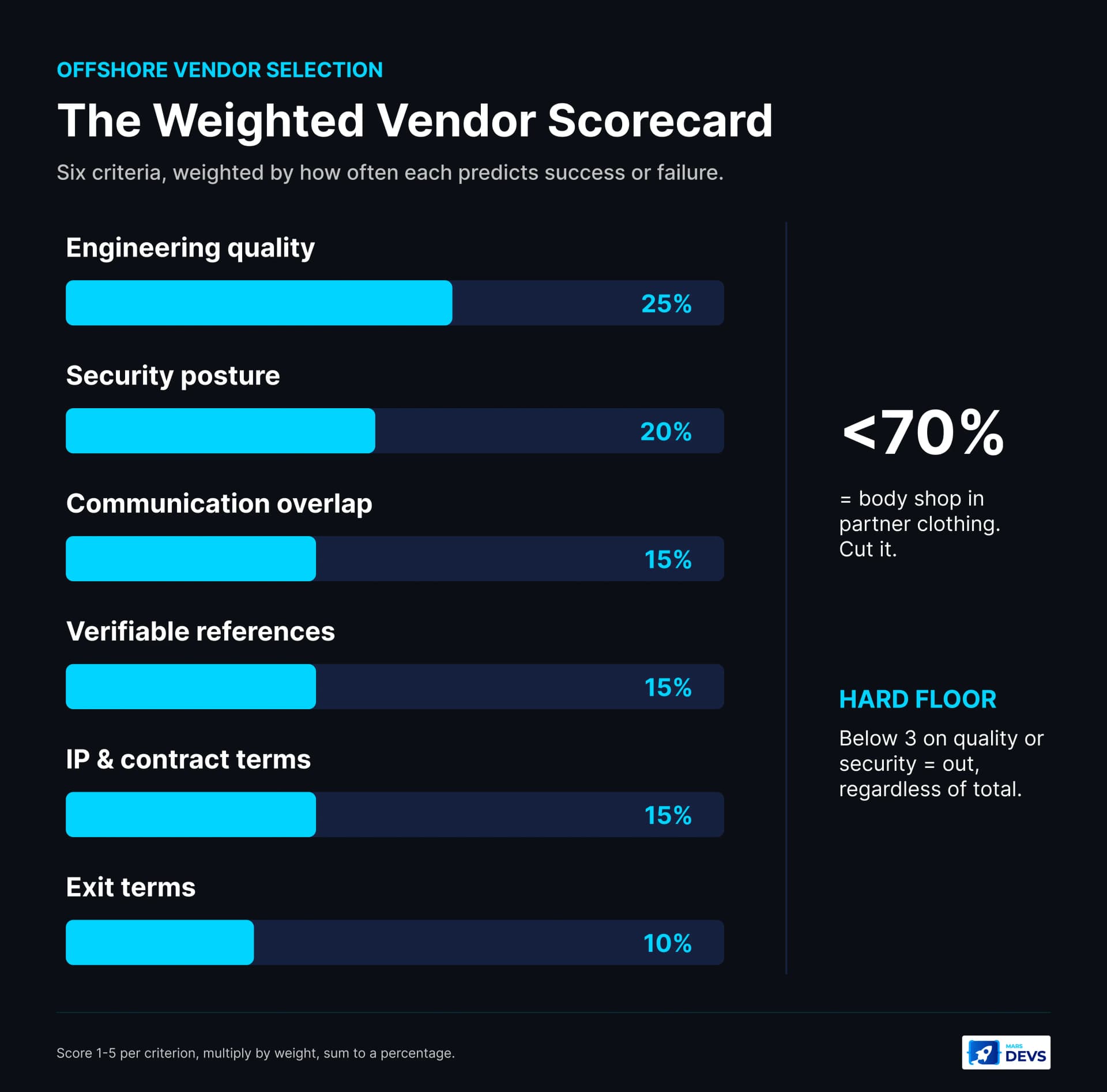
TL;DR: Evaluate an offshore engineering partner against six weighted criteria: engineering quality (25%), security posture (20%), communication overlap (15%), verifiable references (15%), IP and contract terms (15%), and exit terms (10%). Score every vendor on the same scorecard, weight the answers, and treat anything below 70% as a body shop in partner clothing. The global software development outsourcing market reached an estimated $564B in 2025, which means the supply of plausible-looking vendors is enormous. A rigorous framework, not a sales call, is what separates a real partner from a staffing desk.
Most failed offshore engagements were predictable at the evaluation stage. The signals were there in the RFP response and the first three calls. The buyer just had no structured way to weigh them, so a confident sales pitch outvoted a weak technical answer.
A formal evaluation framework fixes that. It forces every vendor through the same questions, scores them on the same scale, and makes the trade-offs visible to procurement, engineering, and security at once. Gartner's own guidance is blunt on this point: successful organizations rate vendors against a prioritized set of criteria rather than rank them on impression, and they define scoring objectives before the first demo (Gartner, "How to Evaluate Technology Vendors Properly").
The stakes are not small. The software development outsourcing market reached roughly $564 billion in 2025 and is forecast to keep compounding at about 9.6% a year through 2031 (Mordor Intelligence, 2026). That growth means more capable partners and far more vendors who have learned to sound like one. Your job in evaluation is to tell those two groups apart before you sign.
This article gives you the scorecard we would hand a procurement lead, the questions that expose a body shop, the red flags buried in a polished RFP response, and the exit terms that protect you if the relationship sours. It is written buyer-side. MarsDevs is a product engineering partner, and we will be candid about where we set our own bar, but the framework works regardless of who you ultimately choose.
Related: Hiring for an AI build instead? See how to vet offshore AI developers for the questions that apply when models are in scope.
The scorecard below is the spine of the whole evaluation. Six criteria, weighted by how often each one predicts success or failure, scored 1 to 5, multiplied by weight, summed to a percentage. Score every shortlisted vendor on the identical sheet so the comparison is honest.
| Criterion | Weight | What "good" looks like (score 5) | What "poor" looks like (score 1) |
|---|---|---|---|
| Engineering quality | 25% | Senior-led teams, code review on every change, CI/CD and tests from day one, named architects you can interview | Resumes you never meet, no review process, "we follow best practices" with no specifics |
| Security posture | 20% | ISO/IEC 27001 certification or audited equivalent, documented access controls, data-handling policy, named security owner | No certification, shared logins, "we take security seriously" and nothing else |
| Communication overlap | 15% | Committed daily overlap hours in your timezone, async-first written culture, direct access to engineers | All contact routed through a sales-side account manager, minimal timezone overlap |
| Verifiable references | 15% | 2-3 reference calls with clients on similar work, public case studies with outcomes, Clutch or G2 history | "References available on request" that never materialize, only logo walls |
| IP and contract terms | 15% | Full IP assignment from day one, clear work-for-hire language, no background-IP traps | IP transfers "on final payment," vague ownership, reused proprietary frameworks |
| Exit terms | 10% | Knowledge-transfer clause, documented handover, no source-code hostage risk, defined notice period | No offboarding plan, code in vendor-controlled repos, punitive exit penalties |
Two rules make the scorecard work. First, weight before you score, never after, so you cannot reverse-engineer a favorite into first place. Second, set a floor: a vendor that scores below 3 on either engineering quality or security posture is out regardless of total, because those two failures are the ones you cannot patch with a good contract.
We have run engagements for enterprise and growth-stage buyers who arrived after a previous partner scored well on price and badly on everything else. The repair work always cost more than the original build. A weighted scorecard front-loads that pain into the evaluation, where it is cheap, instead of into production, where it is not.
Engineering quality is the single highest-weighted criterion because it is the one a polished sales process hides best. A body shop and a real engineering partner can produce identical decks. They cannot produce identical answers to specific technical questions, which is why you ask them.
Start with team composition. Ask who exactly will write your code, and insist on interviewing them, not a pre-sales engineer who disappears after signing. A partner staffs senior engineers who own outcomes. A body shop staffs whoever is on the bench and bills by the seat. The tell is simple: ask to meet the named architect and two engineers before contract, and watch whether they can.
Then probe the process. The questions that work:
There is no certificate for engineering quality the way ISO 27001 covers security, which is exactly why the interview matters. The practical test is whether the vendor's answers contain nouns. Real engineers name their tools, their review cadence, and their failure modes. Body shops speak in adjectives.
We staff senior engineering pods, and we will say plainly what that means: the people in the sales call are the people on the build. If a prospective enterprise buyer wants to interview the architect and engineers before signing, that is the expected request, not an unusual one. Hold every vendor to that standard. The ones who resist are telling you something.
For a deeper look at how a senior pod is structured and why composition matters more than headcount, see the product engineering pod.
Security posture carries 20% weight because a breach or a data-handling failure can cost more than the entire engagement. For an enterprise buyer, this criterion is often where legal and procurement hold a hard veto, and rightly so. You are about to give an external team access to source code, infrastructure, and frequently customer data.
The baseline credential to ask for is ISO/IEC 27001 certification. ISO/IEC 27001 is the international standard for information security management systems, and its 2022 revision added controls specifically for cloud security and data privacy, with 93 controls across organizational, people, physical, and technological categories (ISO/IEC 27001:2022). A certified vendor has been audited against that framework by a third party. An uncertified vendor is asking you to take their word for it.
Certification alone is not enough. Ask these and require documented answers:
The quotable rule for procurement: a vendor that cannot describe its access controls in concrete nouns does not have access controls. Treat "we take security seriously" as a non-answer and score it a 1.
This matters even more when AI is in scope, because model access, training-data handling, and third-party API keys all expand the attack surface. If your build involves AI, our notes on hiring offshore AI developers cover the additional security questions that apply.
Communication overlap is the criterion buyers under-weight and later regret. It carries 15% because a brilliant team you cannot reach in your working hours behaves, in practice, like a mediocre one. Distance is not the problem. Lack of overlap and a sales layer between you and the engineers is the problem.
Ask two things. First, how many committed hours of timezone overlap will your team and theirs share each working day, and is that number in the contract or just in the pitch? A vague "we're flexible" tends to evaporate after signing. Second, do you talk to the engineers directly, or does every message route through an account manager whose job is to manage you, not to ship?
The strongest offshore partners run an async-first written culture. Decisions, status, and blockers live in writing, in shared tools, so that a timezone gap becomes a feature (work happens while you sleep) rather than a bug (you wait a day for an answer). The weak ones depend on synchronous calls and a single relationship owner, which means progress stalls whenever that person is unavailable.
A practical test during evaluation: send a moderately technical question by email and see who replies. If an engineer answers with substance, that is the working relationship you will get. If a salesperson replies with reassurance, that is also the relationship you will get. We commit to defined daily overlap hours in writing because a commitment you cannot point to in a contract is not a commitment. Hold every vendor to a number, not an adjective.
References carry 15% because they are the only criterion where someone other than the vendor is talking. The catch is that "references available on request" is one of the oldest stalls in procurement, and a logo wall proves nothing about how the work actually went.
Insist on live reference calls, not written testimonials, with clients who did work similar to yours in scope and stage. Two to three is enough if you run them well. The questions that surface real risk:
Cross-check the reference calls against public signals. Clutch and G2 reviews, published case studies with actual outcomes (not just "delighted client"), and named contributors on public work all add credibility. A vendor with a long verifiable history is harder to fake than a deck.
MarsDevs has shipped 80+ production systems across 12 countries since 2019, including replatforming projects and multi-year SaaS builds, and we offer prospective enterprise clients up to two reference calls with comparable engagements. The point for your evaluation is the standard, not our number: any partner worth signing can put you on the phone with someone who did work like yours. If they cannot, score it low and move on.
For benchmarking what you should expect to pay relative to quality across regions, global developer rates in 2026 gives the context that keeps a reference call honest about value.
IP and contract terms carry 15% because a build you do not fully own is a liability dressed as an asset. This is where buyers who skipped legal review get hurt, often months later when they try to bring the code in-house or switch vendors and discover the ownership was never clean.
The non-negotiable is full IP assignment from day one, not "on final payment" and not "on project completion." Those conditional clauses give the vendor leverage and give you a hostage situation if a dispute arises. The contract should use clear work-for-hire language assigning all deliverables, source code, and documentation to you as they are created.
Watch for three specific traps in an RFP response or draft contract:
The quotable standard: you should be able to terminate the contract tomorrow and walk away owning every line of code without paying a ransom. We assign IP from day one as a default, and any vendor unwilling to do the same is structuring the deal to keep you dependent. That is a sourcing decision disguised as a legal nuance, and procurement should treat it as such.
Exit terms carry 10%, lower than the rest, because you hope never to use them, but they are the criterion that protects you when everything else has already gone wrong. The right time to negotiate your exit is before you sign, when you have leverage, not during a dispute, when you have none.
A strong exit clause covers four things. A defined notice period on both sides. A knowledge-transfer obligation, where the vendor documents the system and walks your team or your next vendor through it. Source code and infrastructure held in repositories and accounts you control, never vendor-controlled environments you cannot access. And no punitive exit penalties that make leaving more expensive than staying with a failing partner.
The single most common offboarding failure is the source-code hostage: code living in the vendor's GitHub organization or cloud account, with your team holding read access at best. When the relationship ends, so does the access. Require day-one repository and infrastructure ownership in your name, and verify it during the engagement rather than at the end.
Ask the exit questions early: "What does offboarding look like, step by step?" and "If we part ways, what do we walk away with and in what state?" A partner answers with a documented process. A body shop improvises, because they never expected you to ask before signing. We design the handover before the engagement starts because a build you cannot take with you was never fully yours. The same logic applies when you are consolidating vendors rather than replacing one, which we cover in vendor consolidation for an engineering partner.
The lowest hourly rate is the most expensive number on the page more often than not, and a mature procurement process prices in that risk rather than chasing the cheapest seat. Rate is an input, not an outcome. What you actually buy is shipped, maintainable, secure software, and the cheapest rate frequently delivers the most expensive version of that.
Here is the mechanism. A low rate usually signals junior staffing, weak review processes, or a body-shop model that bills hours rather than owning outcomes. The visible price drops. The hidden costs rise: rework when the first version fails review, security remediation when controls were skipped, rebuild costs when the architecture cannot scale, and the management overhead of supervising a team that needs supervision. Add those and the cheap vendor often costs more than the partner who quoted higher.
Evaluate rate qualitatively against the scorecard, not in isolation. A vendor scoring 5 on engineering quality and security at a higher rate frequently has a lower total cost of ownership than one scoring 2 at a lower rate. The right question is not "what is your hourly rate" but "what is the fully loaded cost of getting this shipped, owned, and stable, including the rework I am not seeing in your quote."
A useful discipline borrowed from Gartner's vendor methodology: score on prioritized criteria first, then bring price in as a final comparison among vendors who already cleared the quality and security floor (Gartner). Price should break ties between qualified vendors. It should never qualify a vendor that failed the floor. For a regional view of how rates map to capability, global developer rates in 2026 is the reference we point buyers to.
Running the evaluation is a six-step sequence, and the order matters as much as the criteria. Weight first, score second, apply the floor third, and only then let price break ties. Here is the process we hand a procurement lead.
Run every vendor through the identical six steps and the comparison stays honest. Skip a step, especially the floor or the weighting order, and a confident sales pitch will quietly outscore a better engineering team.
The most dangerous RFP responses are the polished ones, because polish is cheap and substance is not. A strong evaluator reads for what the response avoids saying, not just what it claims. Below are the red flags that separate a confident pitch from a capable partner.
| Red flag in the RFP response | What it usually means | What to do |
|---|---|---|
| Adjectives where nouns should be ("robust, agile, world-class") | No specific process to point to | Ask for the concrete mechanism behind each claim |
| Resumes of engineers you are never allowed to meet | Bait-and-switch staffing | Require interviews with the named team before signing |
| "Best practices" with no named tools or cadence | Process exists on paper only | Ask them to walk through a real recent example |
| IP transfer conditioned on payment | Built-in dependency leverage | Demand assignment on creation, in writing |
| "References on request" never delivered | Weak or unrepeatable track record | Make live reference calls a gate, not a formality |
| Single account manager as the only contact | Sales layer between you and engineers | Require direct engineer access in the contract |
| Security answered with reassurance, not controls | No real security program | Score security low and involve your security team |
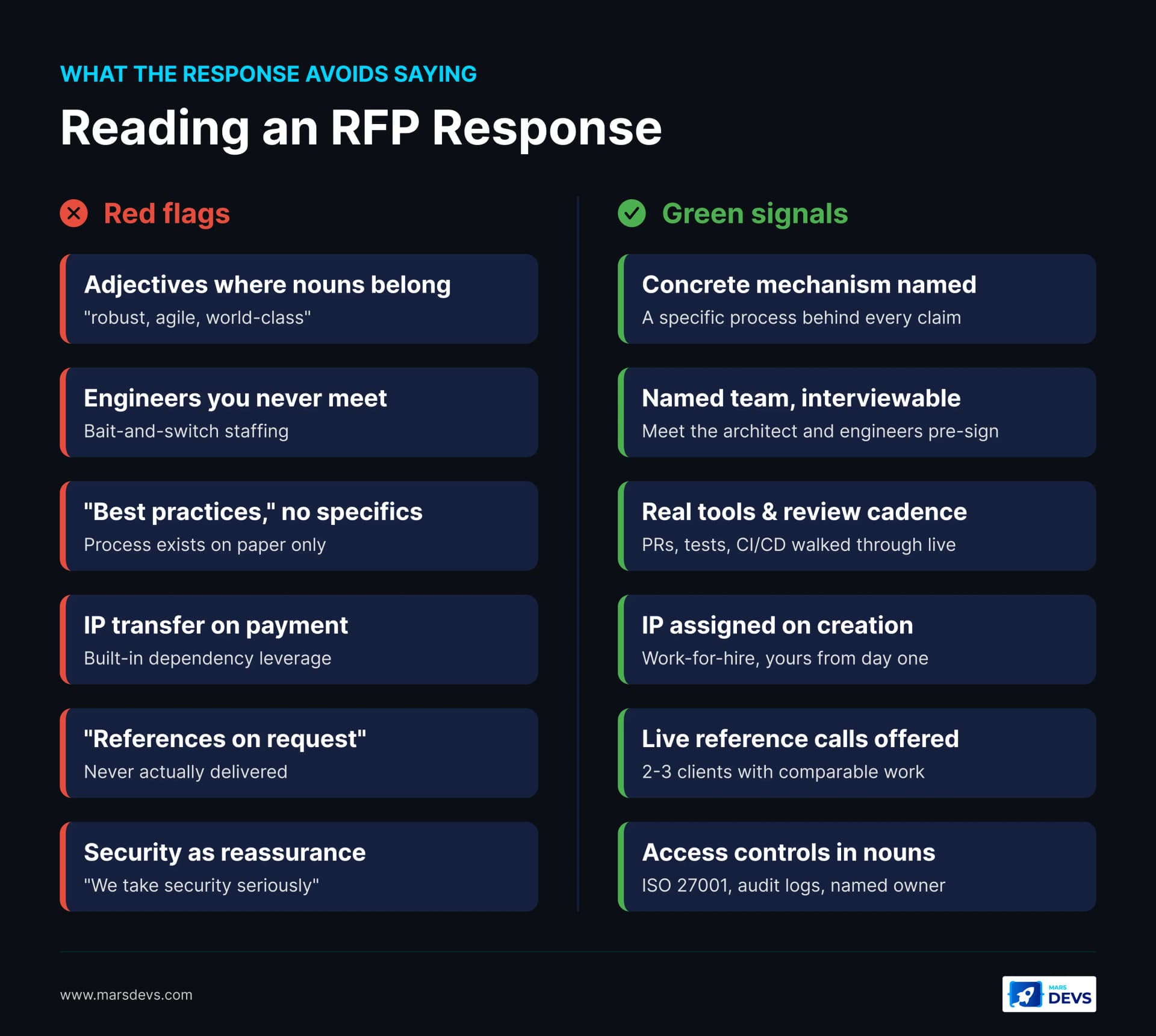
The pattern across every row is the same: vagueness is the tell. A capable partner answers procurement questions with specifics because specifics are what they actually do. A body shop answers with reassurance because reassurance is what they actually sell. When in doubt, ask the follow-up question that forces a noun, and watch whether one arrives.
One more structural red flag: a vendor that pushes hard to skip a paid pilot or proof-of-concept before a large commitment. A confident partner welcomes a small first engagement because it is the fastest way to prove the relationship works. We can begin enterprise relationships with a scoped pilot before a multi-quarter engagement, precisely because it de-risks the decision for the buyer. Resistance to that structure is worth noticing.
MarsDevs is a product engineering partner for early- and growth-stage businesses. We embed senior engineering pods that scale software from MVP to platform: multi-quarter engagements, outcome ownership, AI-native by default. Founded in 2019, MarsDevs has shipped 80+ production systems across 12 countries, including replatforming projects, multi-year SaaS builds, and AI integrations into existing products.
We put that here for one reason: every standard in this framework is a standard we hold ourselves to, and we think you should hold every vendor to it. Senior engineers on the build, not just in the pitch. IP yours from day one. Security you can audit, not just trust. References you can call. An exit you designed before you onboarded.
If you are running a formal evaluation and want a partner who will answer every scorecard question with a noun, talk to our engineering team. If you are still building your shortlist, run this framework against everyone on it first. The goal is not to choose us. The goal is to choose well.
Running a vendor evaluation right now? Talk to our engineering team and we will answer every scorecard question with a noun. Book a free strategy call → marsdevs.com
Six: engineering quality, security posture, communication overlap, verifiable references, IP and contract terms, and exit terms. Weight engineering quality and security highest, since those failures are the hardest to fix after signing. Score every vendor on the same scorecard.
Ask to interview the engineers who will build your product, not the pre-sales team. Real partners name their tools, review process, and architecture decisions. Body shops answer in adjectives and route everything through an account manager. Specifics versus reassurance is the tell.
At minimum, ISO/IEC 27001 certification or an audited equivalent, plus documented access controls, a data-handling policy, and a named security owner. Treat "we take security seriously" with no specifics as a disqualifier, and involve your own security team in scoring.
A low rate usually signals junior staffing or a bill-by-the-hour model with weak review. The visible price drops while rework, security remediation, and rebuild costs rise. Evaluate fully loaded cost of ownership, not rate in isolation, and score price only after quality clears the floor.
Full IP assignment from day one with clear work-for-hire language, not transfer conditioned on final payment. Confirm no part of your deliverable is built on proprietary vendor frameworks you would have to license. You should be able to terminate tomorrow and own every line of code.
Two to three live calls with clients who did work similar to your scope and stage. Ask what went wrong and how the vendor handled it, and whether the people who sold the work stayed on it. Cross-check against Clutch, G2, and public case studies.
A defined notice period, a knowledge-transfer obligation, source code and infrastructure held in accounts you control, and no punitive exit penalties. Negotiate these before signing, when you have leverage. The most common failure is code living in the vendor's repositories, not yours.
Usually yes. A scoped paid pilot or proof-of-concept de-risks the decision and tests the working relationship cheaply. A confident partner welcomes it. A vendor that pushes hard to skip straight to a large commitment is a red flag worth noticing.

Co-Founder, MarsDevs
Vishvajit started MarsDevs in 2019 to help founders turn ideas into production-grade software. With deep expertise in AI, cloud architecture, and product engineering, he has led the delivery of 80+ software products for clients in 12+ countries.
Get more insights like this
Join founders, CTOs, and engineering leaders who receive our engineering insights weekly. No spam, just actionable technical content.


