TL;DR
How enterprise CTOs consolidate 3-6 dev shops into one accountable product engineering partner: the coordination tax, a no-downtime migration path, and post-merge governance.
TL;DR: Vendor consolidation is the move from 3-6 outside dev shops to one accountable product engineering partner that owns delivery end to end. Gartner projects 70% of organizations will cut cloud-native application vendors to a maximum of three by 2027. The payoff is not a smaller invoice. It is the removal of a coordination tax measured in weeks per quarter: integration seams, finger-pointing, duplicated security reviews, and parallel roadmaps that never reconcile. MarsDevs is a product engineering partner founded in 2019 with 80+ production systems shipped across 12 countries.
You run engineering at a mid-market company, and you have four logos on the org chart that are not your own. One shop owns the mobile app. One owns the data platform. A third was hired for a six-week spike that became eighteen months. A fourth showed up through a business unit that never told you. Each delivers fine in isolation. The problem lives in the gaps between them.
That problem has a name, and it is not "quality." It is coordination cost. Every handoff between vendors is a place where ownership gets fuzzy, a security review gets repeated, and a defect gets blamed on the other team. You feel it in your calendar before you ever see it in a budget line.
This article breaks down why enterprises consolidate multiple dev shops into one product engineering partner, what the multi-vendor coordination tax actually costs you, and how to run the migration without dropping delivery on the floor. We cover what to keep, what to cut, and how governance changes once a single partner owns the arc.
Vendor consolidation is not about finding the cheapest supplier. It is about restoring a single line of accountability across software that has to work as one system. We have absorbed scope from prior vendors on replatforming engagements, and the pattern below is the one that holds up under load.
Vendor consolidation in engineering is the deliberate reduction of outside delivery suppliers, typically from 3-6 down to one or two, so that a single partner owns architecture, delivery, and accountability across connected systems. It is not procurement trimming a supplier list to save on contracts. It is a CTO removing the handoff seams where defects, security gaps, and schedule slips hide.
The entity at the center of this is the product engineering partner: a vendor that embeds a senior pod, owns outcomes across multiple quarters, and treats your roadmap as one system rather than a stack of disconnected tickets. That is a different relationship from a body shop that bills hours against a backlog someone else wrote.
Gartner frames the broader shift bluntly. By 2027, the firm projects that 70% of organizations will optimize their cloud-native application vendors down to a maximum of three, and 24% of IT and security leaders already name vendor consolidation as a top priority (SAP News Center, 2025). The direction of travel is one way. The question for most engineering leaders is not whether to consolidate, but how to do it without breaking what already runs.
Here is the distinction that matters. Vendor consolidation reduces the number of suppliers. Engineering consolidation reduces the number of seams between the software those suppliers ship. You can do the first without the second and feel no relief. The goal is one accountable owner across systems that have to interoperate, not a shorter vendor list with the same broken handoffs.
Related: Consolidation is partly a question of which delivery model you are consolidating into. See how we structure the product engineering pod that ends up owning the work.
No CTO sets out to manage six dev shops. Fragmentation accretes. A founder hired one shop pre-Series A. A business unit signed a second without telling central engineering. A specialist came in for one capability and stayed. Each decision was rational alone, and the sum is a delivery org with no single throat to choke.
The pattern shows up across the market. McKinsey's technology research describes executives facing a mandate to manage rising complexity and scale emerging solutions, and unmanaged vendor sprawl is one of the clearest sources of that complexity (McKinsey Technology Trends, 2025). Complexity is not a personality flaw. It is the default state of an engineering org that grew by addition and never subtracted.
There is also a procurement trap baked into how most of these relationships start. Each vendor was bought against a narrow statement of work, so each contract optimizes for its own deliverable rather than the product as a whole. Nobody signed a contract that says "make all of this work together." That clause does not exist in any of your SOWs, which is precisely why the seams between vendors belong to no one.
The real cost of running multiple dev shops is not the sum of their invoices. It is the coordination tax: the engineering and leadership hours spent making independent vendors behave like one team. That tax is paid in weeks per quarter, and it scales worse than linearly. Each new vendor adds not one relationship but a new set of pairwise seams with every vendor already in the mix.
Three vendors create three integration relationships. Five vendors create ten. The coordination effort grows with the number of pairs, not the number of logos. This is why the jump from three to five outside shops feels less like adding two and more like doubling the overhead.
Where does the tax actually get charged? Four line items show up on every multi-vendor engagement we inherit.
That last point is the quiet killer. When you are the only integration layer between your vendors, the system does not scale past your personal bandwidth. Your calendar becomes the bottleneck for the entire delivery org.
The accountability problem is well documented. In multi-vendor environments, responsibility blurs the moment an issue crosses a boundary, and root-cause resolution that should take hours stretches into days while vendors trade blame (NewAgeSys, 2026). A single accountable partner does not eliminate defects. It eliminates the argument about whose defect it is.
Security sprawl deserves its own line because most leaders underprice it badly. Managing identity, access, and audit across many vendors gets exponentially harder with each one you add. Gartner's research found that improving cyber risk posture is the number one driver of consolidation, cited by 65% of organizations, ahead of cost (SAP News Center, 2025).
Read that again. The top reason enterprises consolidate is not money. It is risk. Every additional vendor is another set of credentials, another contractor laptop touching your codebase, another audit you have to chase. One partner means one access model, one security review cadence, and one team you can hold to a standard.
The math gets worse under a real audit. A SOC 2 or ISO 27001 cycle that touches five vendors means five vendor questionnaires, five sets of access logs to reconcile, and five places a control gap can hide. Consolidate the delivery surface and that evidence trail collapses into one. Your auditor stops chasing five contractors and starts reviewing one access model with one owner answering for it.
The coordination tax has a second invoice that never reaches finance: your time, and your senior engineers' time. Every cross-vendor decision routes through a person who can see both sides, and in most orgs that person is you. The more vendors you run, the more of your week gets spent translating between them instead of setting direction.
We see the same pattern on every engagement we inherit. A staff engineer who should be designing systems is instead chasing which vendor owns a flaky integration. A VP of Engineering who should be planning two quarters out is instead refereeing a defect standup. That is senior capacity spent on coordination, and it is the most expensive capacity you have.
Consolidation buys that time back. When one partner owns the seams, the translation work moves inside the pod, where it belongs, and your leadership bandwidth returns to direction-setting. The benefit shows up first in your calendar, then in your roadmap velocity, and only later in any contract number. CTOs who consolidate well report the relief in that order.
A single product engineering partner wins on accountability, integration cost, security surface, and decision speed. Multiple specialist vendors win only when you genuinely need deep, narrow expertise that no single partner can credibly hold. For most mid-market product orgs, that exception is rarer than the current vendor count suggests.
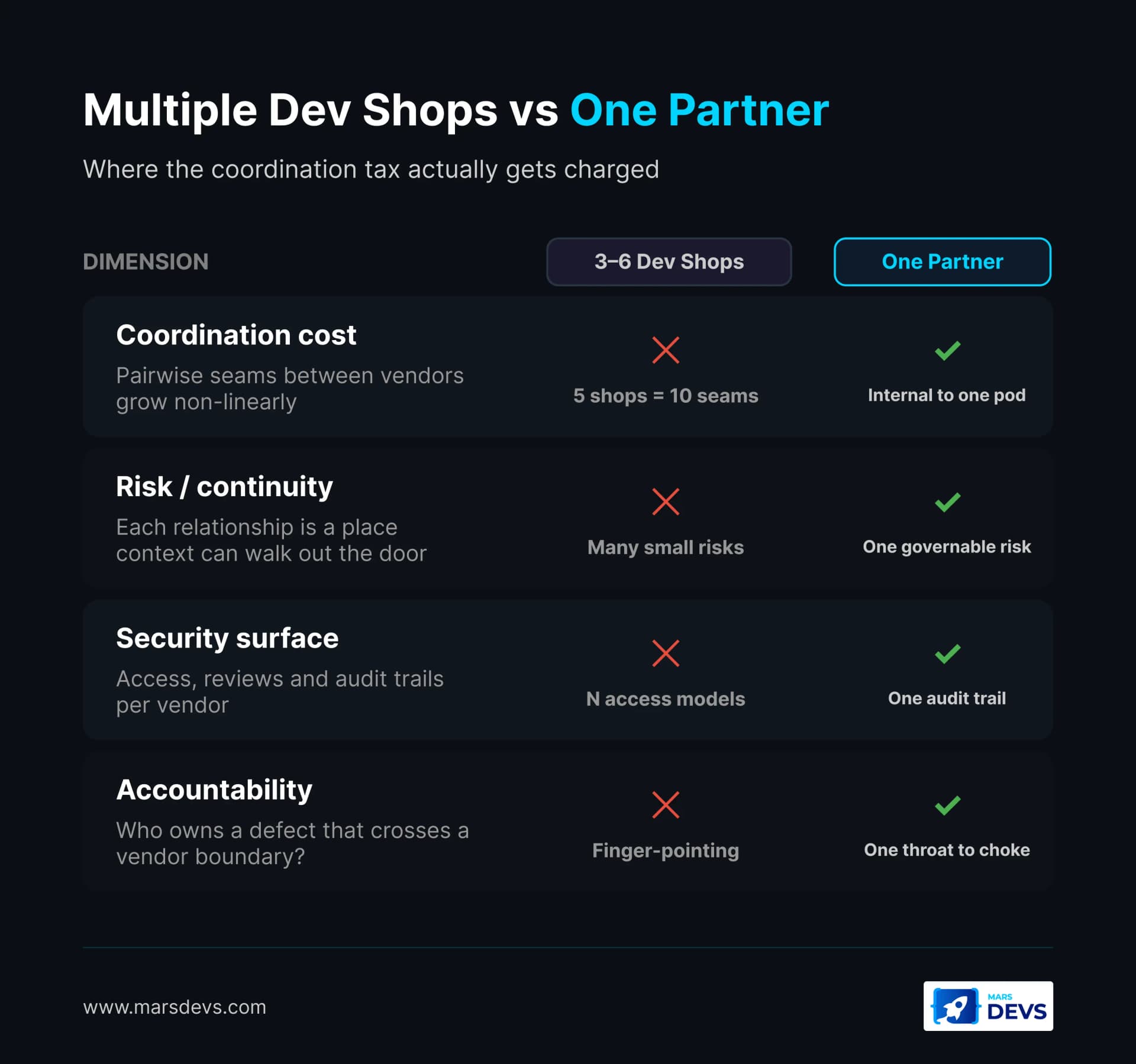
Here is the comparison we walk CTOs through when they are weighing the move.
| Dimension | Multiple Dev Shops (3-6) | Single Product Engineering Partner | Edge |
|---|---|---|---|
| Accountability | Diffuse. Defects cross boundaries, ownership blurs. | One throat to choke across all connected systems. | Partner |
| Integration cost | Pairwise seams grow non-linearly with each vendor. | Internal to one pod. No cross-vendor contract negotiation. | Partner |
| Security surface | One access model and audit per vendor. Sprawls fast. | One access model, one review cadence, one audit trail. | Partner |
| Decision speed | Days. Every change crosses account managers and backlogs. | Hours. One backlog, one priority owner. | Partner |
| Roadmap coherence | Each vendor optimizes its own SOW, not the product. | One roadmap, owned end to end. | Partner |
| Deep niche expertise | Strong if you need rare, narrow specialists. | Depends on partner bench depth. | Multi-vendor (situational) |
| Pricing position | Competitive bids per scope. | Negotiated as one relationship. | Mixed |
The honest read on that table: a single partner wins on five of seven dimensions outright, and the two where multi-vendor holds an edge are situational. If your only reason for keeping five vendors is "competitive bidding," you are paying a coordination tax in weeks to save a discount in points. That math rarely clears.
When does multi-vendor genuinely win? When you need a specialist so narrow that no full-stack partner can credibly hold it, and that capability does not have to integrate tightly with the rest of your stack. A standalone ML research vendor or a niche compliance auditor can sit outside the consolidation cleanly. A mobile shop whose app calls your core API cannot.
The cleanest way to apply this matrix is to score each vendor on coupling, not capability. A vendor whose output is consumed by two or more of your other systems sits inside the consolidation boundary by default. A vendor whose output is a sealed deliverable that nobody downstream has to integrate against can stay independent. Coupling, not headcount or contract value, is the line that separates what you absorb from what you keep.
We unpack the related tradeoffs in staff augmentation vs outsourcing and in-house vs outsourcing, because consolidation is partly a question of which model you are consolidating into.
You consolidate without a delivery freeze by running a phased absorption, not a big-bang cutover. The partner takes ownership of one system at a time, runs it in parallel with the outgoing vendor through a defined transition window, and only retires the old vendor once the new pod has shipped a release and carried an on-call rotation. Nothing goes dark. The handoff happens under load, with the safety net still attached.
A big-bang switch, where every vendor leaves on the same Friday and the new partner owns everything Monday, is how consolidations fail. Context lives in people's heads. Absorb it system by system, and you keep delivery moving while ownership transfers. Here is the path we run.
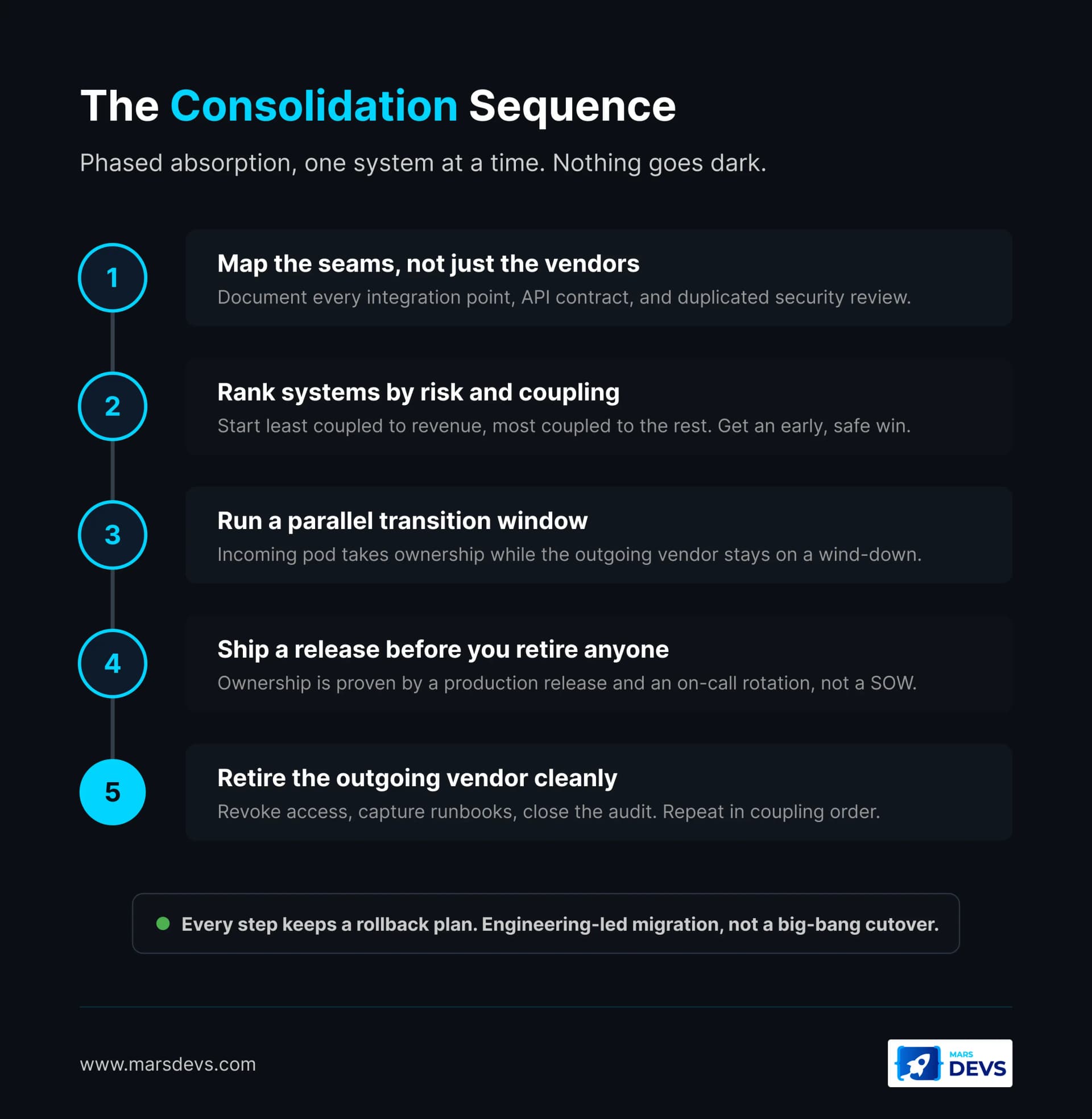
This is the part most procurement-led consolidations get wrong. They treat it as a contract exercise and cut all the vendors at once to hit a savings target. Engineering-led consolidation treats it as a migration with a rollback plan at every step.
We have run consolidation transitions where a second vendor's code was already in production and could not be paused for a day. The absorption ran system by system, with the outgoing vendor on a wind-down rather than an off-switch, and delivery never stopped. That is the only model we will run, because the alternative puts your roadmap at risk to save a few weeks of overlap.
Not every vendor should be absorbed. Keep the genuine deep specialist whose work does not have to integrate tightly with your core, the vendor with irreplaceable domain context you cannot transfer in a quarter, and any relationship that is genuinely best-in-class and well-governed. Cut the body shops billing hours against someone else's backlog, the redundant capabilities two vendors both claim, and any relationship where you are the only integration layer holding it together.
A useful test: if a vendor disappeared tomorrow, would the problem be the lost capability, or the lost context? Lost capability is replaceable by a strong pod. Lost context is the thing you have to transfer carefully during the transition window. Sort your vendors by that question before you sort them by contract value.
There is one more cut most leaders defer too long: the vendor you keep purely out of switching fatigue. The relationship is mediocre, the handoffs are painful, but moving it feels like more work than living with it. That is the coordination tax talking. Fold that vendor into the coupling-ranked sequence above and let the phased absorption handle it, rather than treating it as a special case you will get to later. Later does not arrive on its own.
Governance after consolidation gets simpler in structure but sharper in expectation. You trade many shallow vendor-management relationships for one deep partnership, which means fewer status calls and account managers, but a higher bar on the partner's transparency, on-call ownership, and reporting. The model is a quarterly business review against outcomes, not a weekly ticket-counting standup.
The risk people raise is concentration: "If one partner owns everything, am I exposed?" The honest answer is that you trade many small risks for one larger, more manageable one. Five vendors mean five places a contract can lapse, five security postures, five sets of context that can walk out the door. One partner means one relationship you can govern deeply, with code ownership and runbooks that stay yours regardless of the relationship's status.
Governance that works after consolidation rests on a few non-negotiables.
This is where the relationship stops looking like outsourcing and starts looking like an embedded team. MarsDevs is a product engineering partner for early- and growth-stage businesses. We embed senior engineering pods that scale software from MVP to platform: multi-quarter engagements, outcome ownership, AI-native by default. Founded in 2019, MarsDevs has shipped 80+ production systems across 12 countries, including replatforming projects, multi-year SaaS builds, and AI integrations into existing products.
For the mechanics of running a single embedded pod across a distributed org, see the product engineering pod and our deeper guide on governing a distributed engineering pod in the enterprise. If you are still in the selection stage, how to evaluate an offshore engineering partner for enterprise covers the diligence that should precede any consolidation decision.
One partner owning your delivery is only a risk if the partner controls your exits. It is not a risk if you own the code, the cloud accounts, and the documentation, and if the partner operates on a relationship you could wind down the same way you wound down the vendors you consolidated. Concentration with full ownership gives you power. Concentration with lock-in is exposure. The difference is entirely in the contract and the access model.
The enterprises that consolidate well do not pick the partner with the lowest bid. They pick the partner who is comfortable making themselves replaceable, because that partner has to keep earning the work. That is the posture a strong product engineering partner takes by default.
Vendor consolidation is reducing the number of outside development suppliers, usually from 3-6 to one or two, so a single product engineering partner owns architecture and delivery across connected systems. The goal is removing handoff seams, not just shortening a supplier list.
The top driver is cyber risk: Gartner found 65% of organizations cite improving security posture as the reason, ahead of cost. Consolidation also removes the coordination tax of integration seams, finger-pointing on defects, and divergent roadmaps that multi-vendor setups create.
Only if the partner controls your exits. If you own the code, cloud accounts, and runbooks from day one, concentration works in your favor, not against you. You trade many shallow, hard-to-govern relationships for one deep relationship you can wind down cleanly.
Run a phased absorption, not a big-bang cutover. The incoming partner takes one system at a time, runs it in parallel with the outgoing vendor through a transition window, and only retires the old vendor after shipping a release and carrying on-call. Nothing goes dark.
Keep deep specialists whose work does not tightly integrate with your core, and vendors holding irreplaceable domain context you cannot transfer in a quarter. Cut body shops, redundant capabilities, and any relationship where you are the only integration layer holding it together.
It runs system by system, so timing depends on how many systems and how coupled they are, not on a single cutover date. Each system needs a transition window long enough for the new pod to ship a release and carry on-call before the outgoing vendor leaves.
Governance gets simpler in structure but sharper in expectation. You trade many status calls and account managers for one deep relationship, governed through outcome-based quarterly reviews rather than ticket counting. The bar on transparency, on-call ownership, and code ownership goes up.
A product engineering partner embeds a senior pod, owns outcomes across multiple quarters, and treats your roadmap as one system. A dev shop bills hours against a backlog someone else wrote. Consolidation is the move from the second model toward the first.
The coordination tax does not show up as a line item, which is exactly why it goes unaddressed for years. It shows up as the sprint you spent refereeing a cross-vendor defect, the security review you ran five times, and the roadmap only you can see in full. Consolidation is how you get those weeks back.
If you are running three to six dev shops and you are the only thing holding them together, the next move is a seam map, not a procurement memo. We have absorbed scope from prior vendors without freezing delivery, and we will walk your stack with you to show where the absorption would start.
Book a working session with our engineering team. We will map your vendor seams and hand you a phased transition plan, whether or not we end up being the partner you consolidate into. Talk to our engineering team →

Co-Founder, MarsDevs
Vishvajit started MarsDevs in 2019 to help founders turn ideas into production-grade software. With deep expertise in AI, cloud architecture, and product engineering, he has led the delivery of 80+ software products for clients in 12+ countries.
Get more insights like this
Join founders, CTOs, and engineering leaders who receive our engineering insights weekly. No spam, just actionable technical content.


