TL;DR
Run an external engineering pod like an internal team: access control, security boundaries, reporting cadence, SLAs, IP, and escalation.
TL;DR: Governing a distributed engineering pod means running an external team through the same controls you apply to an internal one: identity inside your own SSO, least-privilege access scoped per repository, a fixed reporting cadence (weekly written, monthly steering, quarterly business review), DORA metrics instead of hours logged, and IP that vests with you on creation. We govern multi-quarter enterprise pods this way at MarsDevs, founded in 2019, with 80+ production systems shipped across 12 countries. The operating model below covers access, security boundaries, metrics, change management, and escalation.
The contract is signed. A senior pod starts on your platform next week. Now your security team wants to know who gets access to what, your CFO wants to know how you will measure value, and your board wants to know who owns the code if the relationship ends.
These are the right questions, and most engagements answer them too late. The governance model gets improvised after access is already granted, after the first sprint ships, after a metric dispute has already cost trust. By then you are retrofitting control onto a moving system, which is the hardest possible time to do it.
This article hands you the operating model up front. It covers the access and security architecture for external engineers, the reporting rhythm that keeps executives informed without micromanaging, the metrics that actually predict delivery (and the vanity metrics to ignore), and how decisions and intellectual property stay with you the whole way through.
We use MarsDevs' own governance model as the worked example throughout. The abstract version is easy. The specifics are where engagements succeed or fail.
A governance operating model for an external engineering pod is the set of access, reporting, metric, and decision-rights controls that let an outside team operate like an internal one without you losing control of security, direction, or IP. It has five layers: identity, access, reporting, metrics, and ownership. Each layer has a mechanism, a cadence, and a named owner on your side and the pod's side.
Most enterprises treat governance as a contract clause instead of an operating system. That is the mistake. A clause sits in a PDF. An operating system runs every week and produces evidence.
Here is the model as a single table. The rest of the article expands each row.
| Governance layer | Mechanism | Cadence | Owner (you / pod) |
|---|---|---|---|
| Identity | Pod engineers provisioned inside your SSO and identity provider, not the vendor's | At onboarding, reviewed quarterly | Your IT/security · pod lead |
| Access | Least-privilege, scoped per repository and environment; no standing production access | Granted per task, reviewed monthly | Your platform team · pod lead |
| Reporting | Written weekly update, monthly steering, quarterly business review | Weekly / monthly / quarterly | Your eng director · pod lead |
| Metrics | DORA delivery metrics plus scope-burn, not hours logged | Tracked continuously, reviewed monthly | Your eng director · pod lead |
| Ownership | IP vests with you on creation; decision rights documented in a RACI | Defined at contract, audited quarterly | Your legal/CTO · pod principal |
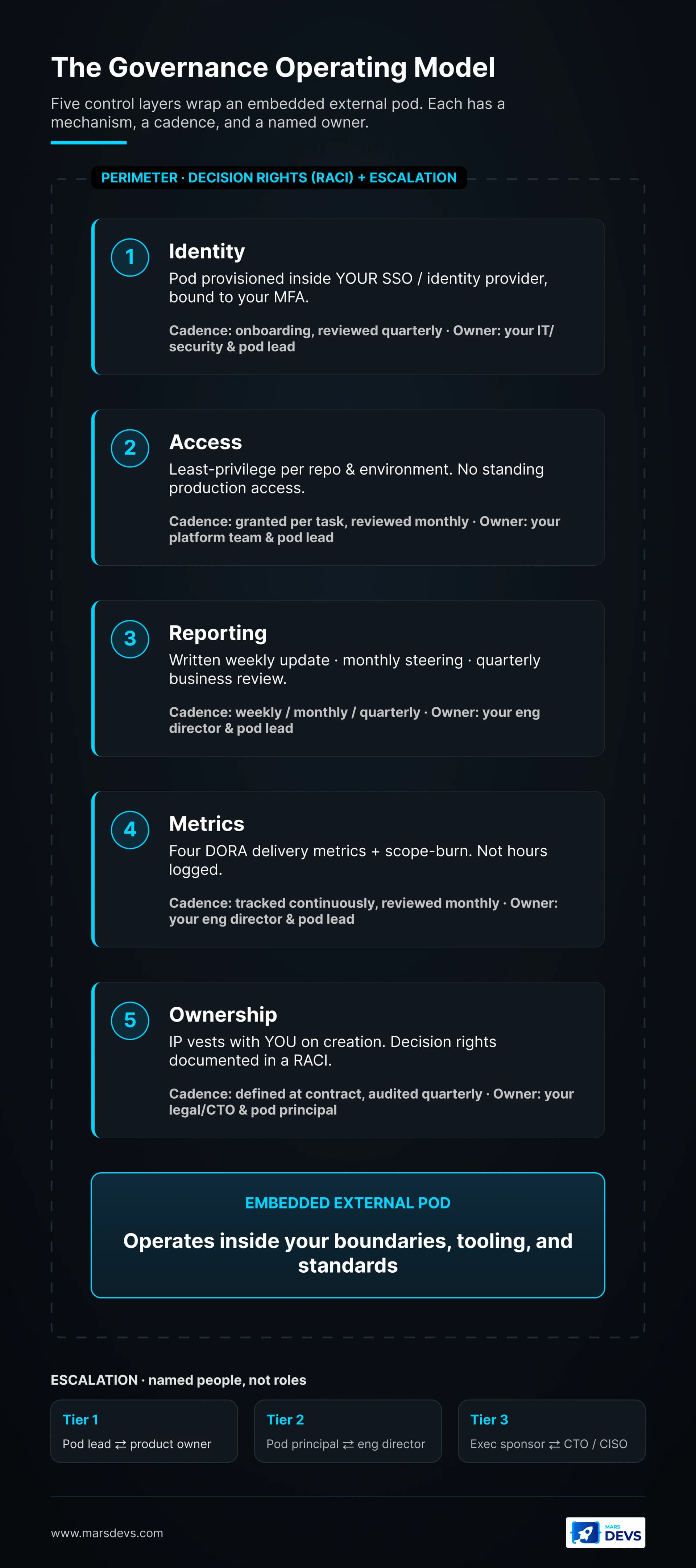
The principle underneath all five layers is the same. The pod operates inside your boundaries, on your tooling, against your standards, with your IP. Distribution is a logistics detail. Control is not.
We govern multi-quarter enterprise engagements with exactly this model. The sections below walk each layer in the order you should stand them up.
Stand up the five governance layers in a fixed order before the pod writes a line of code: identity first, then access, then change management, then reporting, then metrics, then decision rights, then escalation. Each step depends on the one before it, so the sequence is not optional. A pod that gets access before identity is wired into your SSO is already a shadow engagement on day one.
This is the runbook we follow when we onboard a MarsDevs pod into an enterprise environment. It takes most clients one to two weeks of setup before the first sprint, and that week pays for itself across the entire engagement.
Stand these up in order and the engagement starts governed. Skip the order and you spend the first quarter retrofitting control onto a pod that is already shipping.
External engineers should authenticate through your identity provider, not the vendor's, and hold least-privilege access scoped per repository and environment with no standing production credentials. This single decision, putting the pod inside your SSO, is the difference between a governed engagement and a shadow one. Every action becomes attributable, every credential is revocable in one place, and offboarding takes minutes.
The NIST zero-trust access control model for cloud-native applications is the right reference here. It assumes no implicit trust based on network location or who employs the engineer, and it evaluates every access request against identity, device posture, and resource sensitivity. An external pod is precisely the case zero trust was designed for. NIST SP 800-207A, A Zero Trust Architecture Model for Access Control in Cloud-Native Applications in Multi-Cloud Environments lays out the runtime controls.
Pod engineers get accounts in your identity provider (Okta, Entra ID, Google Workspace), tied to your MFA policy and your conditional-access rules. They do not log in through a vendor tenant you cannot audit. When the engagement ends, or when one engineer rolls off, you disable one account and every downstream permission collapses with it.
This also keeps attribution clean. Every commit, every deploy, every console action carries an identity you own and can trace. That matters for SOC 2 evidence, for incident forensics, and for the simple question of who changed what.
We default to operating inside the client's identity provider rather than our own on enterprise engagements.
Grant the pod access to the repositories and environments the current work requires, and nothing else. A pod building a payments service does not need read access to the HR data warehouse. Scope by repository, by namespace, by environment, and review the grants monthly.
Production is the line that matters most. Standing write access to production for an external team is rarely justified and almost never necessary.
We treat CI/CD as the access boundary, not just a deployment tool. When the pipeline is the only path to production, you do not have to trust individuals with production credentials. You trust the gates, the tests, and the review rules you control.
Give the pod its own development and staging environments, seeded with synthetic or masked data, not a copy of production records. The pod builds and tests against realistic shapes of data without ever touching real customer information.
This is where compliance posture and engineering velocity stop being in tension. Masked data lets the pod move fast in lower environments while your sensitive records never leave the boundary they are supposed to. If your engagement touches regulated data, this segmentation is the foundation everything else sits on. We design pods to slot into SOC 2 and HIPAA-ready environments rather than forcing you to relax controls to accommodate an outside team.
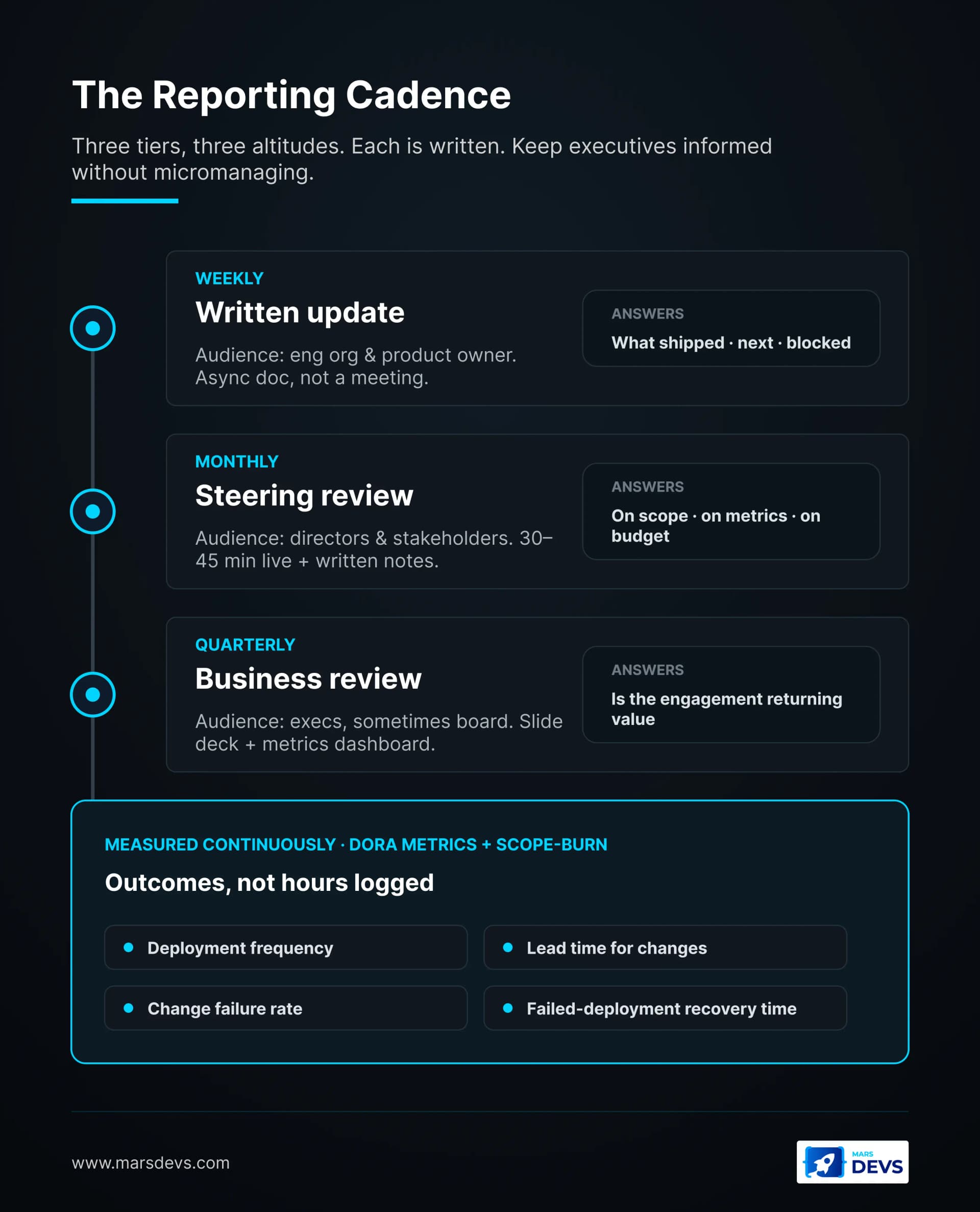
The reporting cadence that works for an external pod has three tiers: a written weekly update for the engineering org, a monthly steering review for directors and stakeholders, and a quarterly business review for executives and the board. Each tier answers a different question at a different altitude, and each is written, not improvised in a meeting.
The failure mode here lives at one of two extremes. Either the pod disappears for a sprint and resurfaces with a demo nobody expected, or the pod sits in so many status meetings that senior engineers spend their week reporting instead of building. The cadence below keeps executives informed while keeping engineers building.
| Tier | Audience | Format | Cadence | Answers |
|---|---|---|---|---|
| Weekly update | Eng org, product owner | Written async (doc or channel) | Weekly | What shipped, what's next, what's blocked |
| Steering review | Directors, stakeholders | 30–45 min live + written notes | Monthly | Are we on scope, on metrics, on budget |
| Business review | Execs, sometimes board | Slide deck + metrics dashboard | Quarterly | Is this engagement returning value |
Send a written weekly update covering what shipped, what is in flight, what is blocked, and what the pod needs from you. Written, not a meeting. It takes ten minutes to read, creates a durable record, and lets stakeholders in different time zones stay current without a 7 a.m. call.
The pod still runs its own daily standups internally. Those are for the team's coordination, not for your oversight. Your oversight lives in the weekly artifact, which is auditable and searchable months later when someone asks why a decision was made.
Run a monthly steering review with your directors and the pod lead to check three things: are we on scope, are the delivery metrics healthy, and are there decisions to escalate. This is where scope drift gets caught early, while it is still a conversation and not yet a crisis.
The steering review uses the same metrics dashboard every month. No new slideware, no curated highlight reel. Consistency is what lets you see trend lines instead of snapshots.
We default to weekly written updates, monthly steering, and quarterly business reviews as the contractual reporting baseline.
The quarterly business review answers one question for executives: is this engagement returning value relative to its cost. It pairs delivery metrics with outcomes, what the pod shipped and what those shipments moved, so the board sees results, not activity.
A good QBR is short and evidence-led. It shows the DORA trend, the roadmap delivered against the roadmap planned, the incidents and how they were handled, and the next quarter's commitments. If you cannot fill that deck from data you already collect, your governance model has a gap.
Measure an external pod on delivery outcomes using the four DORA metrics plus scope-burn, not on hours logged, lines of code, or tickets closed. The DORA metrics (deployment frequency, lead time for changes, change failure rate, and failed-deployment recovery time) are the most validated predictors of software delivery performance available, and they apply to an external pod exactly as they apply to an internal team. The 2024 Accelerate State of DevOps report from DORA is the current reference for how these are defined and benchmarked.
Here is the thing about external teams. The temptation is to measure effort because you cannot see the team in the building. Resist it. Effort metrics reward looking busy. Outcome metrics reward shipping working software, which is the only thing you are paying for.
| Metric | What it measures | Why it matters for a pod |
|---|---|---|
| Deployment frequency | How often code reaches production | Reveals whether the pod ships continuously or batches risk |
| Lead time for changes | Commit to production duration | Shows real cycle time, end to end |
| Change failure rate | Percent of changes causing a fault | Catches velocity bought with instability |
| Failed-deployment recovery time | Time to recover from a bad deploy | Tests operational maturity, not just speed |
Read these together, never alone. Deployment frequency without change failure rate rewards reckless shipping. Lead time without recovery time hides fragility. The point of the set is that throughput and stability stay visible at the same time, so a pod cannot trade one for the other quietly.
We instrument these metrics from the first sprint and review them in every monthly steering. We run governed pods against DORA Elite and High targets: lead time for changes under a day, a change failure rate in the 5 to 10 percent range, and failed-deployment recovery under an hour.
Track scope-burn alongside the DORA metrics: how much of the agreed roadmap the pod has delivered against the plan, by week. DORA tells you the pod ships well. Scope-burn tells you it ships the right things in the right order.
Scope-burn is also your early-warning system for the two most common engagement problems. If burn runs ahead of plan but priorities feel wrong, you have a direction problem. If burn runs behind plan with healthy DORA numbers, you have a scoping or dependency problem, often something blocked on your side.
Stop measuring hours logged, lines of code written, and tickets closed. These three feel like accountability and deliver none of it.
If a metric can be gamed without delivering customer value, it is a vanity metric. Replace it with an outcome you actually care about.
Intellectual property created by the pod vests with you on creation, and decision rights stay with your team through a documented RACI, so the engagement never becomes a dependency you cannot exit. Enterprises under-specify this layer most often, and it carries the highest cost when it is wrong. You should be able to end the relationship and keep everything: the code, the knowledge, the right to make every call.
The contract should assign all work product to you at the moment of creation, with a clear license-back only if the pod reuses generic, non-client tooling. Avoid any structure where IP transfers only on final payment or only at project end. Those hand the vendor a hold over you and create ambiguity if the relationship ends mid-stream.
Two specifics to get right in the contract:
Every line a MarsDevs pod writes for a client is the client's from creation. There is no version of our engagement where you do not own your platform.
Decide up front who is Responsible, Accountable, Consulted, and Informed for each class of decision, and write it down. Architecture choices, hiring within the pod, vendor selection, security exceptions, and roadmap priority each need an explicit owner. The default that works: the pod is Responsible for execution, you remain Accountable for direction.
| Decision class | Responsible | Accountable | Consulted | Informed |
|---|---|---|---|---|
| Roadmap priority | Your product owner | Your eng director | Pod lead | Pod team |
| Architecture | Pod lead | Your CTO/architect | Pod team | Stakeholders |
| Security exceptions | Your security team | Your CISO | Pod lead | Pod team |
| Pod composition | Pod principal | Your eng director | Pod lead | You |
The principle: the pod owns how, you own what and why. When that line is documented before work starts, escalations stay rare and stay calm.
Require the pod to document as it builds: architecture decision records, runbooks, and onboarding docs that let your team or a future team pick up the system. Knowledge that lives only in the pod's heads is a liability disguised as convenience.
We treat documentation as part of the deliverable, not an afterthought. Here is the test we hold ourselves to. If our pod disappeared tomorrow, your team should be able to run and extend the system from what we have written down. That is also what makes consolidating fragmented vendors onto one accountable engineering partner safe rather than risky.
Change management for a pod runs through your existing pipeline and approval gates, SLAs are defined for response and resolution rather than for hours of presence, and escalation paths name specific people at each tier before any incident happens. The goal: nothing about working with an external pod requires a different process than working with an internal team. Same pipeline, same gates, same on-call expectations.
All production changes from the pod go through your CI/CD pipeline, your code review rules, and your deployment approvals. The pod proposes changes the same way your own engineers do, through pull requests, automated tests, and gated deploys. No side channels, no manual production edits.
This is the practical payoff of the access architecture from earlier. Because the pipeline is the only path to production, the system enforces change management, not trust. Your standards apply to external code automatically.
Write SLAs around response time, resolution time, and delivery commitments, not around hours of availability or headcount. An SLA that says "four engineers online from 9 to 5" measures the wrong thing. An SLA that says "P1 incidents acknowledged within 30 minutes and roadmap commitments delivered each sprint" measures what you actually need.
Tie SLAs to the compliance frameworks you already run under. SOC 2's security and availability criteria and ISO 27001's incident-management controls both expect documented response and resolution commitments, and a well-governed pod fits inside them rather than asking for exceptions. AICPA's SOC 2 Trust Services Criteria and ISO/IEC 27001:2022 are the two reference frameworks most enterprises hold their pods against.
Define a three-tier escalation path with named people, not roles, before anything goes wrong. When a P1 hits at 2 a.m., nobody should be searching a contract for who to call. The chain should be obvious and rehearsed.
| Tier | Trigger | Pod side | Your side |
|---|---|---|---|
| Tier 1 | Routine blocker, sprint question | Pod lead | Product owner / tech lead |
| Tier 2 | Scope, metric, or quality dispute | Pod principal | Engineering director |
| Tier 3 | Relationship, security, or contract issue | Pod founder/exec sponsor | CTO / CISO |
The healthiest engagements use Tier 3 almost never. But naming it up front is what keeps Tier 1 and Tier 2 working, because everyone knows there is a clear path if a problem cannot be solved at their level. Calm escalation is a feature of good governance, not a sign of trouble.
Provision the pod inside your own SSO, scope access least-privilege per repository, run changes through your CI/CD pipeline, report on a fixed weekly/monthly/quarterly cadence, measure DORA metrics rather than hours, and assign all IP to yourself on creation. Same tooling, same gates, same standards.
Yours. Provision pod engineers inside your own SSO and identity provider so every action is attributable to an account you control and offboarding takes one click. Vendor-tenant logins you cannot audit are the single most common governance gap in external engagements.
Use the four DORA metrics (deployment frequency, lead time for changes, change failure rate, failed-deployment recovery time) plus scope-burn against the agreed roadmap. Ignore hours logged, lines of code, and tickets closed. Those measure effort, which is gameable, not delivered customer value.
You do, from creation, if the contract is written correctly. Assign all foreground work product to your organization at the moment it is created, not on final payment or project end. The pod's generic background tooling is licensed to you, never blended into your codebase as a dependency.
Three tiers: a written weekly update for the engineering org, a monthly steering review for directors, and a quarterly business review for executives. Written weekly updates replace status meetings, and the QBR pairs DORA metrics with outcomes to prove value to the board.
Require documentation as a deliverable: architecture decision records, runbooks, and onboarding docs written as the pod builds. Combined with IP that vests with you on creation and a documented RACI, this means you can end the engagement and keep the code, the knowledge, and every decision right.
Yes. A well-governed pod operates inside your SOC 2 and ISO 27001 controls rather than around them: identity in your IdP, least-privilege access, masked data in lower environments, change management through your pipeline, and documented incident response. The pod should fit your audit scope, not force exceptions to it.
Plan for one to two weeks of setup before the first sprint: SSO provisioning, access scoping, pipeline wiring, the reporting cadence, DORA instrumentation, the RACI, and named escalation contacts. Standing the seven steps up in order means the engagement starts governed instead of retrofitted.
The engagements that work are the ones where the operating model is decided before the first credential is issued. Identity in your IdP, access scoped tight, a reporting rhythm that informs without smothering, DORA metrics over vanity counts, and IP that is yours from the first commit. Set those five layers up front and a distributed pod runs like an internal team with a clearer paper trail.
If you are about to onboard an external engineering pod, or you are already running one and the governance got improvised, we can show you the operating model we use across multi-quarter enterprise engagements. Talk to our engineering team about how we embed inside your controls, not around them.
Want to see how a governed pod fits your SOC 2 or ISO 27001 scope before you commit? Scope a partnership with our engineering team and we will walk your security team through the access architecture line by line.

Co-Founder, MarsDevs
Vishvajit started MarsDevs in 2019 to help founders turn ideas into production-grade software. With deep expertise in AI, cloud architecture, and product engineering, he has led the delivery of 80+ software products for clients in 12+ countries.
Get more insights like this
Join founders, CTOs, and engineering leaders who receive our engineering insights weekly. No spam, just actionable technical content.


