TL;DR
Offshore vs nearshore vs onshore development compared. Real rates, time zone trade-offs, talent pools, and a decision framework for founders. 2026 data.
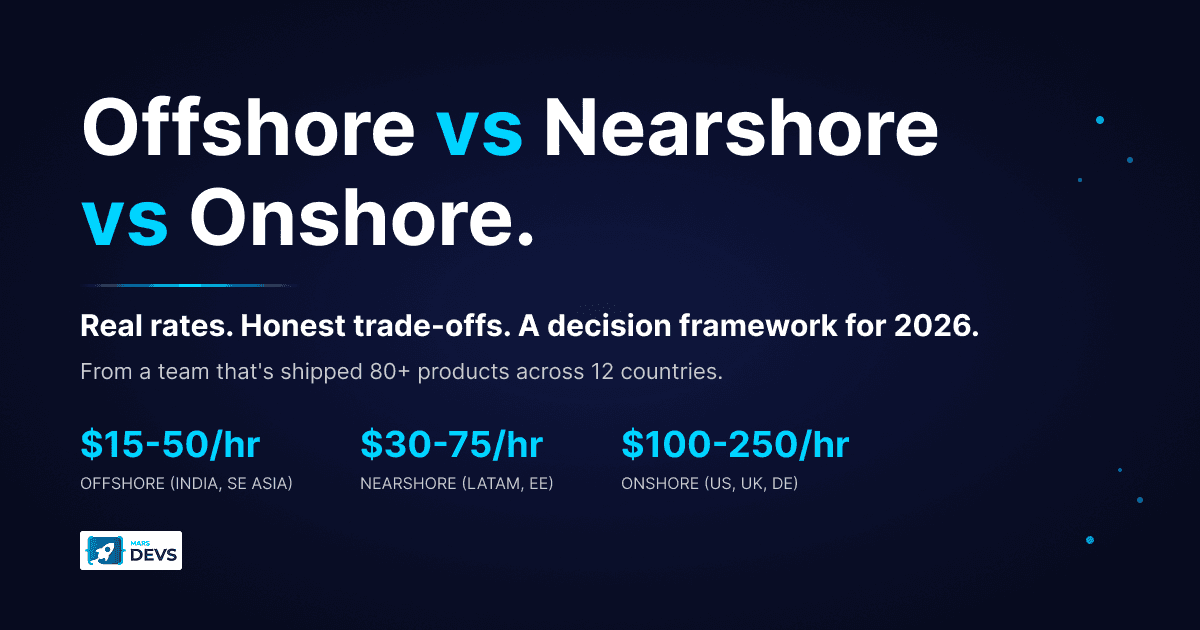

Offshore vs nearshore vs onshore development comes down to three variables: budget, communication needs, and speed-to-ship. Offshore development (India, Southeast Asia) gives you the lowest rates ($15-50/hr) and the deepest talent pools, but you need async workflows and strong documentation. Nearshore development (Latin America, Eastern Europe) splits the difference with moderate rates ($30-70/hr) and better time zone overlap. Onshore development (your home country) maximizes communication ease but costs 3-5x more ($100-200/hr). Most startups in 2026 get the best results with offshore teams that have proven delivery processes, strong English proficiency, and a track record of shipping real products.

You just raised a seed round. Your investors want a working product in 90 days. Hiring four full-time engineers in the US will burn $80K-$120K per month before a single feature ships. That math kills most early-stage startups.
Where your engineering team sits geographically determines what you pay, how you communicate, and how fast you ship. The global software development outsourcing market hit $564 billion in 2025 and is projected to reach $618 billion in 2026, according to Mordor Intelligence. Over 76% of IT leaders already use offshore teams.
MarsDevs is a product engineering company that builds AI-powered applications, SaaS platforms, and MVPs for startup founders. We operate as an offshore partner from India, and we have shipped 80+ products across 12 countries since 2019. We know what works (and what fails spectacularly) when founders choose between offshore vs nearshore vs onshore development.
This article breaks down the three development outsourcing models with real rates, honest trade-offs, and a decision framework you can use today.
Offshore development is a software outsourcing model where a company hires an engineering team in a distant country, typically with an 8-12 hour time zone difference. For US-based companies, that typically means India, the Philippines, Vietnam, Poland, or Ukraine. For European companies, it often means India or Southeast Asia.
Here's the thing: offshore is the most popular outsourcing model for a reason. It gives you access to the largest global talent pools at the lowest developer rates by region.
Offshore developer rates vary by country and seniority:
| Country/Region | Junior Dev | Mid-Level Dev | Senior Dev |
|---|---|---|---|
| India | $10-20/hr | $20-35/hr | $30-50/hr |
| Philippines | $12-22/hr | $22-35/hr | $35-55/hr |
| Vietnam | $15-25/hr | $25-40/hr | $35-55/hr |
| Poland | $25-40/hr | $40-60/hr | $55-80/hr |
| Ukraine | $20-35/hr | $35-55/hr | $50-75/hr |
Sources: DistantJob 2026 Rates, Qubit Labs 2026 Guide
India alone produces over 1.5 million engineering graduates per year. That talent availability means you can find specialists in niche technologies (AI/ML, blockchain, embedded systems) without paying Silicon Valley premiums.
The 8-12 hour time zone gap is real. You will not get instant Slack responses at 3 PM your time.
But here is where most articles get it wrong: async communication is not a bug. It is a feature. Your offshore team works while you sleep. You wake up to completed pull requests. Companies that master async workflows get 24-hour development cycles that onshore teams simply cannot match.
The actual risks? Communication barriers from accent differences (solvable with strong documentation and video calls). Cultural alignment gaps on project management expectations (solvable with a good delivery lead). And attrition rates of 20-30% annually at commodity outsourcing shops.
We have shipped 80+ products as an offshore team from India. The key is not the geography. It is the process: senior engineers, 100% code ownership from day one, and a delivery culture that treats your deadline like our deadline. That is what separates a reliable offshore partner from a cheap labor arbitrage play.
Nearshore development is a software outsourcing model where a company partners with engineering teams in neighboring countries or the same broad time zone. For US companies, that is Latin America (Mexico, Brazil, Colombia, Argentina). For Western European companies, it is Eastern Europe (Poland, Romania, Czech Republic).
Nearshore has become the fastest-growing outsourcing segment, with projected growth of 13.95% CAGR through 2031. The appeal? Time zone overlap without onshore prices.
| Country/Region | Junior Dev | Mid-Level Dev | Senior Dev |
|---|---|---|---|
| Mexico | $25-40/hr | $40-60/hr | $55-85/hr |
| Brazil | $22-35/hr | $35-55/hr | $50-75/hr |
| Colombia | $20-35/hr | $30-50/hr | $45-70/hr |
| Argentina | $20-35/hr | $35-50/hr | $50-75/hr |
| Romania | $25-40/hr | $40-55/hr | $55-80/hr |
Source: Accelerance 2025 Global Software Outsourcing Rates Guide
Nearshore rates run 30-50% less than onshore. Significant savings. But still 2-3x higher than India-based offshore rates for equivalent seniority.
Nearshore solves the time zone problem. But it introduces a cost problem.
A senior full-stack developer in Colombia at $55/hr costs nearly double what the same-level engineer in India costs ($30/hr). Over a 6-month project with 3 engineers, that is roughly $75,000 in additional spend. If you are a pre-Series A founder watching every dollar of runway, that gap matters.
The talent pool is also smaller. Latin America produces excellent developers, but the total talent availability is a fraction of what India and Southeast Asia offer. For specialized skills like AI/ML engineering or specific framework expertise, you may wait longer to fill roles.
Onshore development is a software outsourcing model where your outsourced team works in the same country as you. A US company hiring a US-based development agency. A UK company working with a UK dev shop.
Easiest model to manage. Most expensive model to run.
| Country | Junior Dev | Mid-Level Dev | Senior Dev |
|---|---|---|---|
| United States | $75-120/hr | $120-175/hr | $150-250/hr |
| United Kingdom | $60-100/hr | $100-150/hr | $130-200/hr |
| Germany | $55-90/hr | $90-140/hr | $120-190/hr |
| Australia | $60-100/hr | $100-150/hr | $130-200/hr |
Source: DistantJob 2026 Developer Rates
At $150-250/hr for a senior US developer, a three-person team burns $72,000-$120,000 per month. For a startup with $500K in seed funding, that is your entire runway in 4-6 months. Nothing left for marketing, operations, or pivots.
You get zero time zone friction and maximum cultural alignment. But the cost premium is brutal.
A US-based agency charges 5-10x what an Indian offshore partner charges for equivalent technical output. Unless regulatory or contractual requirements force your hand, the ROI math rarely favors onshore for startups and SMBs.
The talent shortage also hits harder locally. The US faces a projected shortage of over 1.2 million software engineers by 2026. Onshore agencies compete for the same limited pool, which drives rates higher and shrinks your options for specialized skills.
Here is what a real 6-month project looks like across all three development outsourcing models, assuming a team of 1 senior + 2 mid-level developers working full-time:
| Factor | Offshore (India) | Nearshore (LATAM) | Onshore (US) |
|---|---|---|---|
| Avg. Senior Rate | $30-45/hr | $55-75/hr | $150-200/hr |
| Avg. Mid-Level Rate | $20-35/hr | $35-55/hr | $120-175/hr |
| Monthly Team Cost | $11,200-$18,400 | $20,000-$29,600 | $62,400-$88,000 |
| 6-Month Total | $67,200-$110,400 | $120,000-$177,600 | $374,400-$528,000 |
| Time Zone Overlap (US) | 2-4 hrs | 6-8 hrs | Full overlap |
| Talent Pool Depth | Very large | Moderate | Limited |
| Avg. Attrition Rate | 20-30%* | 10-20% | 10-15% |
| IP Protection Strength | Moderate | Moderate | Strong |
*Attrition rates vary dramatically by vendor. Premium offshore firms like MarsDevs maintain significantly lower attrition through senior-only hiring and competitive compensation.
The cost difference is stark. The same project that costs $67K-$110K offshore could cost $374K-$528K onshore. That is a 3-5x multiplier. For most startups, offshore development delivers the strongest ROI when paired with a mature delivery partner.

| Pros | Cons |
|---|---|
| Lowest cost (60-70% savings vs onshore) | Time zone gap (8-12 hours) |
| Largest talent pool globally | Communication requires more structure |
| 24-hour development cycles possible | Cultural differences in work style |
| Easy to scale up or down | Harder to vet quality remotely |
| Access to niche specialists | IP enforcement varies by country |
| Pros | Cons |
|---|---|
| Strong time zone overlap (1-3 hours difference) | 2-3x more expensive than offshore |
| Cultural similarity to home market | Smaller talent pool than Asia |
| Easier real-time collaboration | Popular regions getting more expensive |
| Same or similar legal frameworks | Limited AI/ML specialist availability |
| Lower attrition than offshore commodity shops | Fewer options for niche technologies |
| Pros | Cons |
|---|---|
| Zero communication friction | 3-5x more expensive than offshore |
| Strongest IP protection | Severe talent shortage |
| Same legal jurisdiction | Slowest to scale |
| Easiest stakeholder buy-in | Highest opportunity cost for startups |
| In-person collaboration possible | Rates rising due to talent scarcity |
Stop thinking about this as a binary choice. Think about it as a matrix of four questions.
The MarsDevs recommendation for most startups: Offshore with a senior-only team that has a proven delivery process. You get 60-70% cost savings, access to the world's deepest talent pool, and (if you pick the right partner) the same quality output as a local team.
Founded in 2019, MarsDevs has shipped 80+ products across 12 countries for startups and scale-ups. Our rates start at $15-25/hr, we cap active projects at 4 to ensure focus, and you get 100% code ownership from day one. We start building within 48 hours.

The model matters less than the execution. Here are five practices that work regardless of geography.
1. Start with a paid pilot project. Never commit to a 12-month engagement upfront. Run a 2-4 week pilot with clear deliverables. This costs $2K-$8K and saves you from $50K+ mistakes. If you have been burned by an agency before (missed deadlines, bloated invoices, sloppy code), a paid pilot is your insurance policy.
2. Demand 100% code ownership from day one. Your code should live in your repos, on your infrastructure, from the first commit. If a vendor pushes back on this, walk away. MarsDevs gives you full code ownership. No exceptions.
3. Require senior engineers, not juniors. The biggest risk in offshore development is getting junior developers billed at mid-level rates. Ask for LinkedIn profiles. Review their GitHub. Conduct technical interviews. If you are a non-technical founder, bring a technical advisor to the eval. Thirty minutes of vetting saves months of rework.
4. Set up async-first communication. Even with nearshore teams, do not assume real-time availability solves communication barriers. Document decisions in writing. Use Loom videos for complex explanations. Write clear specs.
5. Define IP protections contractually. NDAs, IP assignment agreements, and data processing agreements are non-negotiable. Make sure the contract specifies that all intellectual property created during the engagement belongs to you. Choosing between staff augmentation and outsourcing also affects how IP ownership gets structured.
Many growing companies run a hybrid setup: onshore product managers and architects paired with offshore development teams. You get the strategic control of onshore with the cost efficiency of offshore. Around 40% of companies already combine nearshore and offshore teams on the same project.
Here is a common configuration that works well:
The onshore leads define what gets built and review quality. The offshore team does the heavy lifting. This structure cuts your monthly spend by 50-60% compared to a fully onshore team while keeping strategic decisions close to the business.
If you are weighing whether to build in-house or outsource entirely, the hybrid model is often the right middle ground. You retain institutional knowledge while accessing global talent at offshore rates.
MarsDevs provides senior engineering teams for founders who need to ship fast without compromising quality. We work within hybrid structures daily: your PM sets the direction, our senior engineers ship the code. We only take on 4 active projects at a time, so your product gets our full attention. Our remote team structures are built for exactly this kind of integration.
Offshore development is the cheapest outsourcing model. Rates run 60-70% lower than onshore. India offers the most competitive developer rates by region globally, with senior developers available at $30-50/hr compared to $150-250/hr for equivalent onshore talent in the US. For a 3-person team over 6 months, offshore can save you $250K-$400K compared to onshore. MarsDevs offers senior offshore engineers starting at $15-25/hr from India with 100% code ownership from day one.
Not necessarily. Offshore hubs like India actually have deeper AI/ML talent pools than most nearshore regions. India produces more AI engineers annually than all of Latin America combined, and Indian engineers lead major AI research at Google, Microsoft, and OpenAI. If real-time pair programming on AI models is critical, nearshore helps with time zone overlap. For most AI development work, offshore gives you better talent availability at lower cost.
India offers lower rates ($15-50/hr vs $30-75/hr), a larger talent pool (1.5M+ engineering graduates per year), and deeper specialization in AI/ML and enterprise systems. Latin America offers better time zone overlap for US companies (1-3 hours vs 10-12 hours), cultural alignment, and easier travel for on-site visits. Choose India for cost efficiency and technical depth. Choose Latin America for real-time collaboration and cultural fit.
Four main risks, all manageable. Communication barriers from time zone differences (mitigate with async workflows and documented specs). Quality inconsistency from junior developers (mitigate by demanding senior-only teams). IP protection challenges in certain jurisdictions (mitigate with strong contracts and code escrow). Vendor attrition disrupting project continuity (mitigate by choosing firms with low turnover and remote team structures that retain talent). Pick the right partner and process, and none of these are dealbreakers.
Yes. Most growing companies do exactly this. The hybrid model pairs onshore product leaders (PMs, architects) with offshore development teams. This cuts engineering costs by 50-60% while keeping strategic decisions local. The key: shared tools (same repos, same Jira, same Slack), daily async updates, and weekly video syncs. MarsDevs integrates into hybrid structures with 100% code ownership and shared project management tools from day one.
Offshore development means hiring a team in a distant country with an 8-12 hour time zone gap (India, Philippines, Vietnam for US companies). Nearshore development means partnering with teams in neighboring countries with 1-3 hours of time zone difference (Latin America, Eastern Europe). Onshore development means your outsourced team works in the same country. The three models differ primarily in cost (offshore is cheapest at $15-50/hr, onshore most expensive at $100-250/hr), time zone overlap, and talent pool depth.
Offshore development rates in 2026 range from $10-80/hr depending on country and seniority. India is the most cost-effective at $10-50/hr (junior to senior). The Philippines and Vietnam range from $12-55/hr. Eastern European countries like Poland and Ukraine cost $20-80/hr. For comparison, onshore US developers charge $75-250/hr. MarsDevs offers senior offshore engineers from India starting at $15-25/hr.
Protect your IP with offshore teams through five measures: sign NDAs before any technical discussions, include explicit work-for-hire and IP assignment clauses in contracts, require all code to live in your repositories from the first commit, use role-based access controls, and choose a jurisdiction-appropriate data processing agreement. MarsDevs gives clients 100% code ownership from day one with no escrow or transfer clauses required. The contract structure matters more than the geography.
The offshore vs nearshore vs onshore development decision matters. But it matters less than the team you pick. A great offshore partner will outperform a mediocre onshore agency every time.
Here is what to optimize for: senior engineers who have shipped products like yours, a delivery process that does not depend on constant hand-holding, 100% code ownership, and transparent pricing. The geography is secondary.
MarsDevs builds MVPs, SaaS platforms, and AI-powered applications for founders who need to ship before their runway runs out. We do it from India at $15-25/hr, with a 4.9 rating on Clutch, and a portfolio of 80+ shipped products to prove it.
Want to see if offshore works for your project? Book a free strategy call and get a scoping estimate within 48 hours. We take on 4 new projects per month. Claim an engagement slot before they fill up.

Co-Founder, MarsDevs
Vishvajit started MarsDevs in 2019 to help founders turn ideas into production-grade software. With deep expertise in AI, cloud architecture, and product engineering, he has led the delivery of 80+ software products for clients in 12+ countries.
Get more insights like this
Join founders, CTOs, and engineering leaders who receive our engineering insights weekly. No spam, just actionable technical content.


