TL;DR
15-country hourly rate table (junior to AI-ML). US $100-$250/hr, India $15-$65/hr, Poland $50-$110/hr. AI/ML premium +30-90%. TCO framework, timezone matrix.
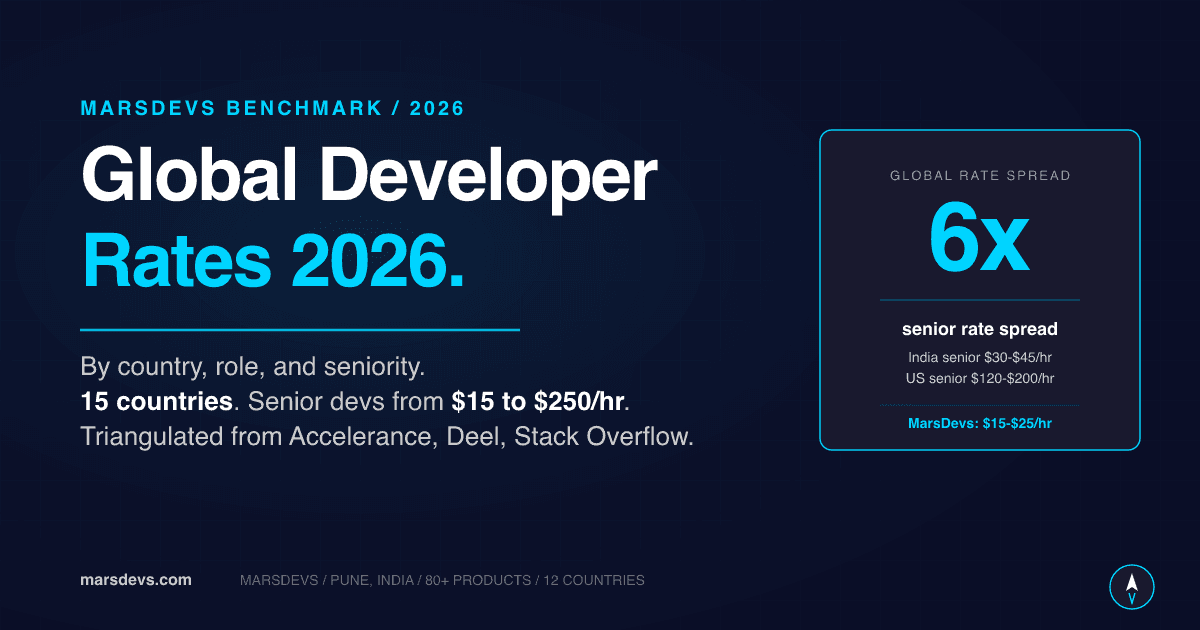
Software developer rates by country in 2026 span $8/hr (junior in Vietnam) to $250/hr (senior in the United States). Senior developers cost $30–$45/hr in India, $55–$75/hr in Poland, $50–$80/hr in Mexico, and $120–$200/hr in the US, according to Accelerance, Deel, and Stack Overflow 2025 data. AI/ML engineers carry a 15–50% premium in every region. MarsDevs charges $15–$25/hr for senior engineers from Pune, India, and we have shipped 80+ products across 12 countries since 2019.
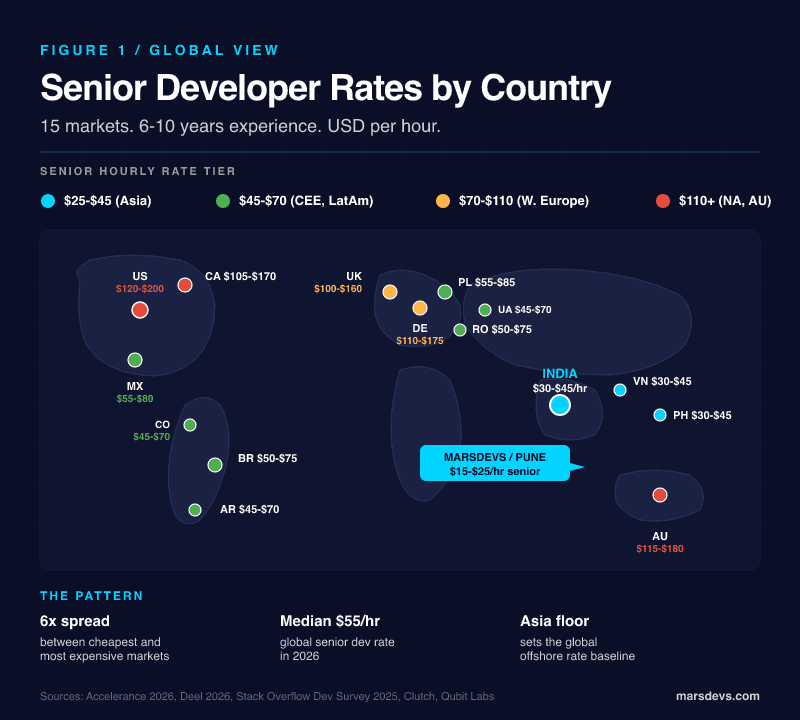
The global median senior developer rate sits at $55/hr in 2026. That median hides a 6x spread between the cheapest and most expensive markets. Senior engineers in Southeast Asia start at $25/hr. The same seniority tier in the United States starts at $120/hr. Rates have bifurcated in 2026: junior and mid-level rates edged down single digits as AI-augmented productivity compressed the low end, while senior and AI/ML rates held firm or climbed.
Here is the primary table. Every cell shows USD per hour. Every range is triangulated from at least two independent sources (Accelerance 2026, Deel 2026, Stack Overflow Developer Survey 2025, Clutch Pricing Guide, PayScale, Glassdoor, Qubit Labs, and regional vendor surveys).
| Country | Junior (0-2 yrs) | Mid (3-5 yrs) | Senior (6-10 yrs) | Staff / Principal (10+ yrs) | AI/ML Senior |
|---|---|---|---|---|---|
| India | $15-$22/hr | $22-$35/hr | $30-$45/hr | $45-$75/hr | $50-$85/hr |
| Vietnam | $15-$25/hr | $20-$35/hr | $30-$45/hr | $40-$65/hr | $45-$80/hr |
| Philippines | $15-$25/hr | $22-$35/hr | $30-$45/hr | $40-$65/hr | $45-$80/hr |
| Ukraine | $22-$35/hr | $30-$50/hr | $45-$70/hr | $65-$95/hr | $65-$105/hr |
| Romania | $25-$38/hr | $35-$55/hr | $50-$75/hr | $70-$100/hr | $75-$115/hr |
| Poland | $30-$45/hr | $40-$65/hr | $55-$85/hr | $80-$115/hr | $90-$135/hr |
| Argentina | $22-$35/hr | $32-$50/hr | $45-$70/hr | $65-$90/hr | $70-$105/hr |
| Colombia | $25-$38/hr | $35-$55/hr | $45-$70/hr | $65-$90/hr | $70-$105/hr |
| Brazil | $25-$40/hr | $38-$58/hr | $50-$75/hr | $70-$100/hr | $80-$120/hr |
| Mexico | $30-$45/hr | $40-$60/hr | $55-$80/hr | $75-$110/hr | $85-$130/hr |
| United Kingdom | $45-$70/hr | $70-$110/hr | $100-$160/hr | $140-$220/hr | $140-$250/hr |
| Germany | $50-$80/hr | $80-$125/hr | $110-$175/hr | $160-$240/hr | $160-$275/hr |
| Canada | $50-$80/hr | $75-$120/hr | $105-$170/hr | $145-$220/hr | $150-$250/hr |
| Australia | $55-$85/hr | $80-$130/hr | $115-$180/hr | $150-$230/hr | $155-$260/hr |
| United States | $65-$95/hr | $95-$140/hr | $120-$200/hr | $175-$275/hr | $180-$300/hr |
Sources for the table: Accelerance 2026 Global Software Development Rates & Trends, Deel State of Global Hiring Report 2026, Stack Overflow Developer Survey 2025, Clutch Pricing Guide April 2026, Qubit Labs Offshore Rates 2026, PayScale country medians, Glassdoor country bands. Cell ranges represent typical market rates for engineers engaged through agencies or staff-augmentation partners. Freelancer rates run 30-50% lower. Full-time loaded cost runs 20-40% higher.
A few patterns jump out of the table. Southeast Asia is the cheapest senior tier globally. Central and Eastern Europe sits between Asia and the West. Latin America clusters closer to Eastern Europe than to Asia. North America and Western Europe compress into the same top-tier band because contractor rates equalize across the English-speaking West. AI/ML rates are 15-50% above general senior dev rates in every region without exception.
Regional blended averages for senior software engineers in 2026 run $160/hr in North America, $130/hr in Western Europe, $70/hr in Central and Eastern Europe, $65/hr in Latin America, and $38/hr in South and Southeast Asia. Africa's commercial offshore markets (Egypt, Nigeria, Kenya, South Africa) cluster at $25-$55/hr but sit outside the 15-country table because sourcing depth and contracting infrastructure are still building out.
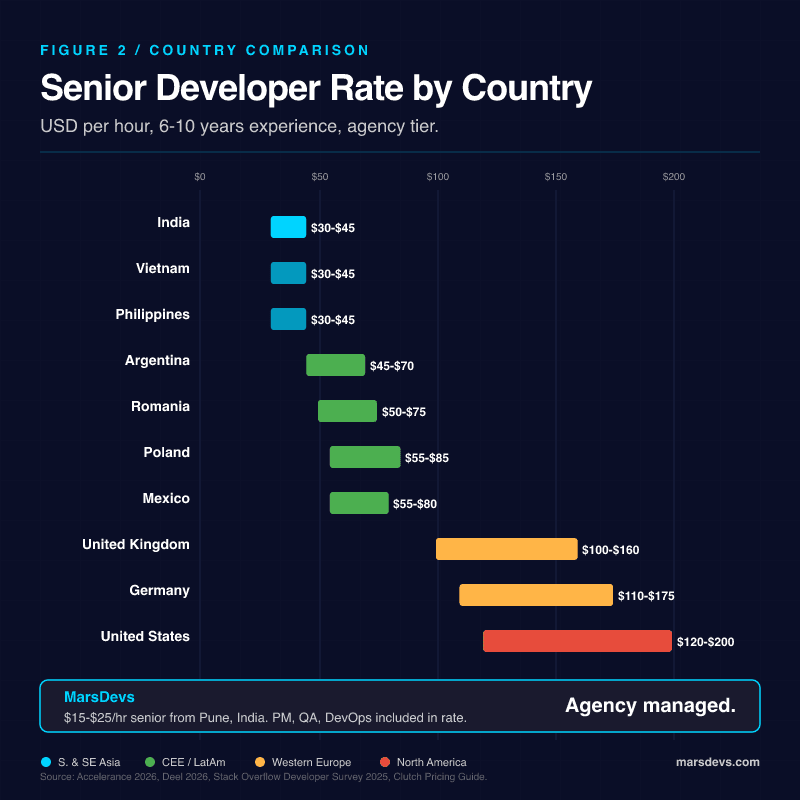
North America ($110-$250/hr senior): The US sets the global ceiling. Canada runs 10-15% below the US for equivalent seniority. Both markets are dominated by full-time W-2 salaries at $150K-$300K fully loaded, which translates to $95-$180/hr blended. Contractor rates climb another 30-50% above full-time loaded cost.
Western Europe ($100-$180/hr senior): UK, Germany, the Netherlands, and the Nordics sit close. Germany has the widest contractor multiplier: senior freelancers bill $140-$200/hr while the same engineer full-time lands at $75-$110/hr loaded. The UK skews slightly lower on full-time salary but higher on contractor day rates.
Central and Eastern Europe ($45-$85/hr senior): Poland leads, then Czech Republic, then Romania, then Ukraine (currently rate-compressed due to the war). Per Accelerance's CEE data, typical CEE developer rates sit between $37 and $101 per hour. English proficiency is uniformly high. Timezone overlap with the US is thin (2-3 hours); with Western Europe, it's full-day.
Latin America ($45-$80/hr senior): Mexico and Brazil lead on rate, Colombia and Argentina follow. The region trades at a 15-25% discount to Eastern Europe but wins decisively on US timezone overlap (6-8 hours vs 2-3 hours). Buyers explicitly pay the LatAm premium over Asia for that overlap.
South and Southeast Asia ($25-$60/hr senior): India, Vietnam, and the Philippines. The three markets cluster within a $15 band at senior level. India has the deepest senior talent pool. The Philippines has the strongest English. Vietnam has the lowest rate at every tier. This is the global offshore floor.
Africa ($20-$55/hr senior): Egypt, Nigeria, Kenya, and South Africa are the largest commercial offshore markets. Rates are India-adjacent. Sourcing depth is 5-10 years behind India. Pick partners with strong Western references.
Every country below includes rate ranges, English proficiency (EF EPI 2025 score), timezone band for US East Coast buyers, and the known friction point. These profiles matter because the table tells you the rate; the profile tells you whether the rate will hold up in practice.
Senior rate: $30-$45/hr. AI/ML senior: $50-$85/hr. EF EPI: High Proficiency (Band 2). US East Coast overlap: 2-4 hours.
India is the largest software engineering talent pool outside the US, with 5M+ developers and 1.5M+ CS graduates entering the workforce annually per NASSCOM. Senior engineers in Bengaluru, Pune, Hyderabad, and Gurgaon routinely have 8-12 years of production experience across fintech, SaaS, healthtech, and e-commerce at real scale. The hiring friction is signal-to-noise on freelancer marketplaces and junior talent passed off as senior on rate cards. Vet the engineer, not the country.
Time zone overlap with the US East Coast is the honest tradeoff: 2-4 hours of daily overlap versus 7-8 hours with Latin America. Teams that run async-first (PR reviews, Loom walkthroughs, written standups) compound well with India. Teams that expect live-pairing for 6 hours a day will be friction-heavy. That workflow routes better to Mexico or Colombia.
Rates held flat to slightly up for senior tiers and AI/ML specialists in 2026. India's AI/ML senior band ($50-$85/hr) is the best rate-to-depth ratio globally right now. MarsDevs charges $15-$25/hr for senior engineers from Pune, India, operating under a managed agency model with PM, QA, and DevOps loaded into the rate.
Senior rate: $45-$70/hr. AI/ML senior: $65-$105/hr. EF EPI: Moderate-High. US East Coast overlap: 2-3 hours.
Ukraine was historically the #2 offshore hub globally behind India, with especially deep senior bench for complex backend, blockchain, and fintech work. The war that started in February 2022 compressed supply, distributed engineers across EU relocation hubs (Poland, Portugal, Germany), and dropped rates 10-15% from pre-war peaks as vendors competed for fewer stable engagements.
Timezone overlap with Western Europe is full-day. Overlap with US East Coast is 2-3 hours. English proficiency remains high among mid and senior engineers. Buyers should ask vendors where engineers physically reside, what the business continuity plan is, and whether payroll routes through a non-Ukrainian entity for FX and compliance stability.
Senior rate: $55-$85/hr. AI/ML senior: $90-$135/hr. EF EPI: High (Rank 15, score 600 in 2025). US East Coast overlap: 2-3 hours.
Poland is the premium Central European tier and the default nearshore destination for EU-headquartered buyers. Warsaw, Kraków, and Wrocław host mature engineering scenes with senior-heavy profiles in fintech, SaaS, and embedded systems. English proficiency is among the highest in Europe. Rates are 25-40% above Romania and Ukraine but still 30-50% below German contractor rates for equivalent seniority.
Polish vendors ran single-digit rate increases in 2026, consistent with Qubit Labs' 3-6% CEE rate forecast. The main buying risk is overpaying. Poland sits on a rate plateau where a senior Polish dev and a senior Dutch dev look similar on a CV but price 2x apart. Validate the seniority, not the Warsaw address.
Senior rate: $50-$75/hr. AI/ML senior: $75-$115/hr. EF EPI: High. US East Coast overlap: 2-3 hours.
Romania has ridden the Ukraine disruption to become the fastest-growing EE offshore hub in 2024-2026. Bucharest and Cluj-Napoca carry strong embedded, automotive, and backend engineering depth inherited from the pre-EU outsourcing boom. EU membership gives buyers GDPR simplicity and contract enforceability that matter for fintech and health data work.
Rates sit 15-20% below Poland and slightly above Ukraine. English proficiency is high in urban tech hubs. The practical friction is availability: senior bench is thinner than Poland's, and engagement slots on the best vendors book 2-4 weeks out.
Senior rate: $30-$45/hr. AI/ML senior: $45-$80/hr. EF EPI: Moderate. US East Coast overlap: 1-3 hours.
Vietnam is the emerging India alternative for cost-sensitive buyers. Ho Chi Minh City and Hanoi post the lowest senior rates globally among credible offshore markets, typically 10-20% below India for equivalent seniority. CS graduate output has grown 40%+ since 2020, driven by government investment in STEM education. Python, Java, and JavaScript are the dominant stacks.
English proficiency is the real constraint. Vietnam scored in the Moderate band in EF EPI 2025, which shows up in async written communication more than in sync meetings. Senior engineers at the top vendors communicate well. Mid and junior tiers can need a strong PM layer to bridge. Route Vietnam engagements through agencies with English-native PMs, not direct freelance hires.
Senior rate: $30-$45/hr. AI/ML senior: $45-$80/hr. EF EPI: High (Rank 28 in 2025). US East Coast overlap: 1-3 hours.
The Philippines has the strongest English proficiency of any low-rate offshore market. English is a co-official language and BPO has been a national industry for 25 years. That makes the Philippines the easiest communication fit among the Asian offshore triad (India, Vietnam, Philippines). Senior rates sit 10-15% below India for equivalent seniority. Manila and Cebu are the two main hubs.
The tradeoff is senior technical bench depth. The Philippines has strong frontend, QA, and full-stack talent but a thinner senior backend, data, and AI/ML bench than India. The "$10/hr Philippine developer" quotes on freelance marketplaces almost always map to junior or mid-level work, not the senior profiles those buyers think they are getting.
Senior rate: $55-$80/hr. AI/ML senior: $85-$130/hr. EF EPI: Moderate. US East Coast overlap: 6-8 hours.
Mexico is the default nearshore pick for US buyers who prioritize timezone overlap. Mexico City, Guadalajara, and Monterrey carry senior bench in full-stack, cloud, and embedded engineering. USMCA trade framework simplifies contracting, IP assignment, and tax treatment relative to offshore Asia. Per Curotec's LatAm 2025 rate guide, senior developers in Mexico command up to $80/hr.
Rates are 30-50% above India for equivalent seniority. Buyers pay that premium explicitly for 6-8 hours of daily overlap with US East Coast, in-person travel at 3-hour flight times, and a shared work culture calibrated to US product management rhythms.
Senior rate: $50-$75/hr. AI/ML senior: $80-$120/hr. EF EPI: Moderate. US East Coast overlap: 7-9 hours.
Brazil has the largest developer talent pool in Latin America and mature fintech, e-commerce, and neobank engineering scenes. São Paulo, Rio de Janeiro, and Florianópolis carry strong senior bench. Timezone alignment with US East Coast is closest of any LatAm country (São Paulo is 1 hour ahead of NYC in non-DST months).
English proficiency lags Argentina and Colombia among Portuguese-first engineers. Strong Brazilian vendors layer a bilingual PM between the client and the dev team. Direct-to-dev English communication can be friction-heavy. CLT labor law is protective and adds 50-70% to fully loaded employment cost for full-time hires, which is why most US buyers engage Brazilian engineers through nearshore agencies rather than direct Employer of Record.
Senior rate: $45-$70/hr. AI/ML senior: $70-$105/hr. EF EPI: High (Rank 26, score 575 in 2025). US East Coast overlap: 7-9 hours.
Argentina was the historical "hidden gem" of LatAm offshore: top English proficiency in the region, strong senior bench, and USD rates depressed by peso inflation that made local engineers willing to work below regional averages. That equation has partially corrected in 2024-2026 as inflation and capital controls pushed senior engineers onto USD-denominated contracts.
Senior rates still sit 10-20% below Brazil and Mexico, and English is the best in LatAm. The practical friction is payment mechanics. Routing USD to Argentine engineers while navigating capital controls requires a vendor with established infrastructure. Do not try to pay Argentine contractors direct-wire without that layer.
Senior rate: $45-$70/hr. AI/ML senior: $70-$105/hr. EF EPI: Moderate. US East Coast overlap: 7-8 hours.
Colombia is the fastest-growing LatAm offshore market in 2024-2026. Medellín and Bogotá host young engineering scenes with heavy full-stack and JavaScript skew. Government tech incentives (Colombia 4.0, ICT Ministry programs) have expanded CS graduate output. Rates run 5-10% below Brazil and Mexico for equivalent seniority.
English proficiency is Moderate band but improving fast among engineers under 35. Timezone alignment with US East Coast is excellent (1 hour behind NYC). The senior bench is thinner than Brazil or Mexico in absolute numbers, which is the main supply constraint.
Senior rate: $120-$200/hr. AI/ML senior: $180-$300/hr. EF EPI: Native. US East Coast overlap: Full.
The US is the global rate ceiling. Full-time senior software engineers earn $150K-$300K in total compensation, which translates to $95-$180/hr fully loaded. Contractor rates climb another 30-50% on top. AI/ML engineers at top firms command $250K-$500K total comp. The senior AI/ML contractor band of $180-$300/hr reflects that compensation floor.
The 4.6-month average time-to-hire for senior AI roles in the US is the hidden cost most buyers underestimate. Every month of vacancy is 25-40% of the annualized hire cost forfeited. That is why US-headquartered startups increasingly run hybrid models: 20-40% of senior engineering US-based for timezone and product coverage, 60-80% offshore for velocity and cost.
Senior rate: $100-$160/hr. AI/ML senior: $140-$250/hr. EF EPI: Native. US East Coast overlap: 4-5 hours.
The UK is the largest contractor market in Europe. Day rates for senior contractors run £600-£1,000, which maps to $100-$160/hr USD. IR35 tax reform has compressed contractor supply since 2021 and pushed more senior engineers into outside-IR35 statement-of-work agency engagements. Full-time London salaries sit below US equivalents but above Western European medians.
English, strong timezone overlap with both the US and continental Europe, and mature contracting infrastructure make the UK the default onshore-adjacent premium market for US and EU buyers who need a single senior engineer rather than a team.
Senior rate: $110-$175/hr. AI/ML senior: $160-$275/hr. EF EPI: Very High. US East Coast overlap: 3-4 hours.
Germany has the widest contractor multiplier in Europe. Senior freelancers bill 3-4x what the same engineer earns full-time after loaded employment cost. Berlin, Munich, and Hamburg are the hubs. Automotive, industrial software, and embedded engineering have the deepest senior bench.
The practical friction is regulatory. German freelancer engagements must pass Scheinselbständigkeit (false self-employment) tests, which constrain single-client, full-time contractor arrangements. Most German senior contractors split time across multiple clients or route through engineering agencies that carry the employment relationship.
Senior rate: $105-$170/hr. AI/ML senior: $150-$250/hr. EF EPI: Native. US East Coast overlap: Full.
Canada runs 10-15% below US rates for equivalent seniority. Toronto, Vancouver, and Montreal are the hubs, with strong AI/ML bench concentrated in the Toronto-Waterloo corridor (University of Toronto, Vector Institute, McGill). US buyers use Canada as the timezone and legal-framework equivalent to the US at a modest rate discount.
Canadian engineers on US contractor agreements require W-8BEN and USMCA compliance rather than W-9. For full-time hires, Employer of Record providers cover the CAD payroll and CPP/EI contributions. Senior CAD engineers are heavily recruited by US FAANG and startup firms, which has pulled Toronto senior rates closer to US parity.
Senior rate: $115-$180/hr. AI/ML senior: $155-$260/hr. EF EPI: Native. US East Coast overlap: 0-2 hours (inverse).
Australia is the APAC onshore benchmark. Sydney and Melbourne carry mature engineering scenes. Senior salaries run 10-20% below US but with high cost-of-living parity. Timezone is the defining friction. Sydney is 15-17 hours ahead of US East Coast, which inverts the workday. Australian engineers on US projects work 5am-1pm local or work the US night shift. Both compress retention.
Australian buyers hiring into India or the Philippines get a 2-3 hour overlap window that works cleanly. Australian buyers hiring into LatAm have zero overlap and work fully async. The country is primarily useful as an onshore tier for Australia-headquartered buyers, not as an offshore destination for the rest of the world.
Senior developer rates vary 30-60% by specialization, not just by country. A senior AI/ML engineer in India costs 50-80% more per hour than a senior frontend engineer in the same city at the same vendor. Here is the breakdown for senior tier (6-10 years) as a multiplier on the country baseline.
| Specialization | India senior | Poland senior | Mexico senior | US senior |
|---|---|---|---|---|
| Frontend (React, Vue, Next.js) | $28-$42/hr | $50-$75/hr | $50-$75/hr | $110-$175/hr |
| Backend (Node, Python, Go, Java) | $32-$48/hr | $58-$85/hr | $55-$80/hr | $125-$195/hr |
| Full-Stack | $30-$45/hr | $55-$85/hr | $55-$80/hr | $120-$190/hr |
| DevOps / SRE / Cloud | $35-$55/hr | $65-$95/hr | $60-$90/hr | $140-$220/hr |
| Mobile (iOS, Android, React Native) | $30-$45/hr | $55-$85/hr | $55-$80/hr | $125-$195/hr |
| Data Engineering | $35-$55/hr | $65-$95/hr | $65-$90/hr | $140-$225/hr |
| AI/ML Engineer | $50-$85/hr | $90-$135/hr | $85-$130/hr | $180-$300/hr |
The pattern. DevOps, data engineering, and AI/ML pull 15-30% premiums over full-stack in every region. Frontend is the commoditized floor. Mobile sits close to full-stack. Specialty languages (Rust, Elixir, Scala) add another 10-20% across tiers because supply is thin.
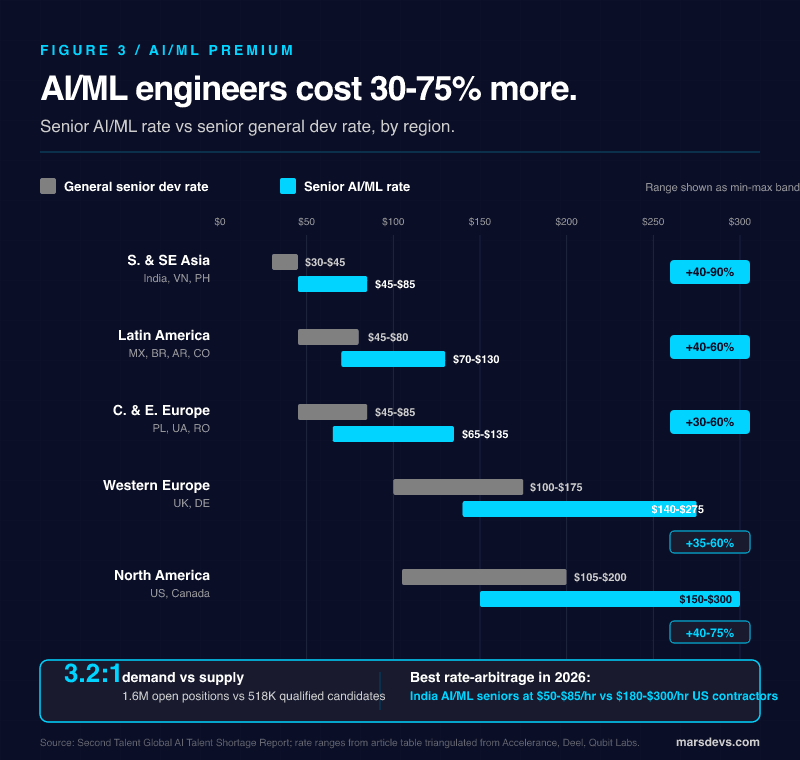
AI/ML engineers carry a 15-50% hourly rate premium over general software developers in every region. At top US firms, the premium exceeds 70% at senior levels. The driver is simple: 1.6 million open AI positions worldwide against 518,000 qualified candidates, a 3.2:1 demand-supply ratio that compounded through 2025 and 2026.
Here is the global AI/ML senior rate picture in 2026:
| Region | AI/ML Senior Rate | General Senior Dev Rate | Premium |
|---|---|---|---|
| South Asia (India, Vietnam, Philippines) | $45-$85/hr | $30-$45/hr | +40-90% |
| Latin America (Mexico, Brazil, Argentina, Colombia) | $70-$130/hr | $45-$80/hr | +40-60% |
| Central and Eastern Europe (Poland, Ukraine, Romania) | $65-$135/hr | $45-$85/hr | +30-60% |
| Western Europe (UK, Germany) | $140-$275/hr | $100-$175/hr | +35-60% |
| North America (US, Canada) | $150-$300/hr | $105-$200/hr | +40-75% |
The premium is not just rate. AI/ML hiring takes 2-3x longer than general engineering hiring in the US (4.6 months average per Second Talent's shortage analysis). Specialization tiers within AI/ML compound further. LLM fine-tuning specialists earn 25-40% above generalist ML engineers. AI safety and alignment expertise commands a 45% premium on top of that.
The winning offshore move in 2026 is AI/ML specifically. Senior AI/ML engineers in India at $50-$85/hr deliver production RAG systems, agent frameworks, and LLM integrations at 25-40% of US contractor cost. That ratio did not exist 18 months ago. It is the single best rate-arbitrage opportunity in global hiring right now. If you are evaluating where to hire AI developers, the country and seniority math inside this premium band is where the decision actually sits.
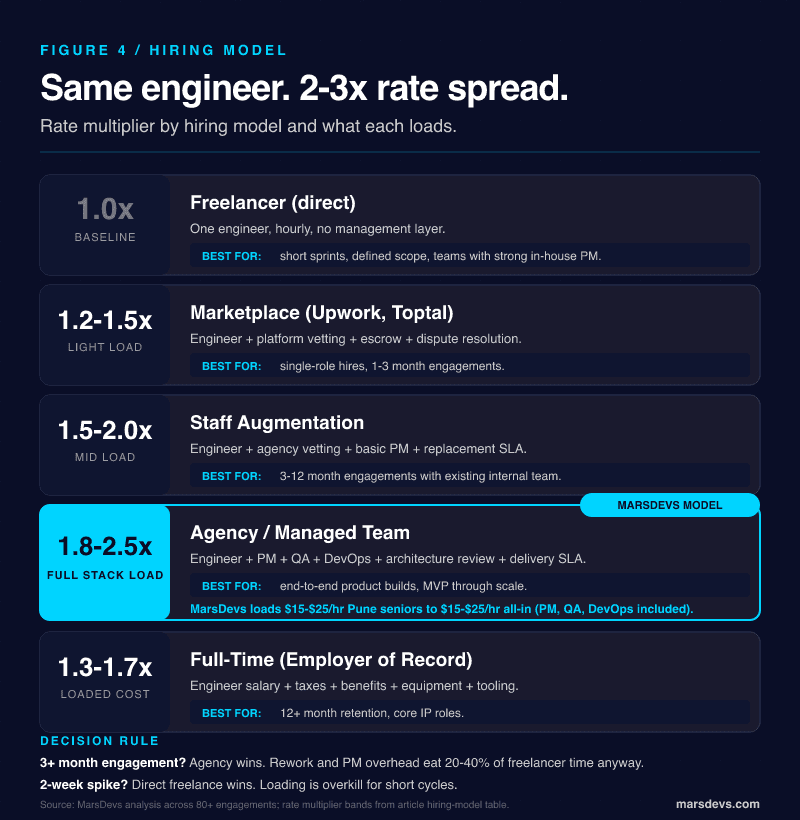
The same senior engineer in the same country charges 2-3x different rates depending on hiring model. The rate loads different things. Freelancer rate is labor only. Agency rate loads PM and QA and backup coverage. Staff augmentation loads engineer plus bench support. Full-time loads the employer's benefits and payroll cost plus retention risk.
| Hiring Model | Rate Multiplier (vs freelancer baseline) | What's Included | Best For |
|---|---|---|---|
| Freelancer (direct) | 1.0x | One engineer, hourly, no management layer | Short sprints, defined scope, teams with strong in-house PM |
| Marketplace (Upwork, Toptal) | 1.2-1.5x | Engineer + platform vetting + escrow + dispute resolution | Single-role hires, 1-3 month engagements |
| Staff Augmentation | 1.5-2.0x | Engineer + agency vetting + basic PM + replacement SLA | 3-12 month engagements, existing internal team |
| Agency / Managed Team | 1.8-2.5x | Engineer + PM + QA + DevOps + architecture review + delivery SLA | End-to-end product builds, MVP through scale |
| Full-Time (Employer of Record) | 1.3-1.7x (loaded) | Engineer salary + taxes + benefits + equipment + tooling | 12+ month retention, core IP roles |
The practical math. A senior Indian engineer at $22/hr direct freelance becomes $35-$55/hr through a managed agency because the agency carries PM, QA, DevOps, delivery risk, and replacement if the engineer exits. For a 3+ month engagement, the agency load is usually worth it. Rework and management overhead eat 20-40% of freelancer time anyway. For a 2-week spike, direct freelance wins.
For a deeper breakdown of the trade-offs, see our comparison on offshore vs nearshore vs onshore hiring models and staff augmentation vs outsourcing engagement structures.
Hourly rate is the label on the box. Total Cost of Ownership (TCO) is what you actually pay. TCO stacks rate with management overhead, communication latency, rework, onboarding time, tooling, churn risk, and IP friction. Two engineers at identical hourly rates can deliver 2x different TCO outcomes depending on how those stack factors behave.
Here is the worked example that matters. You are choosing between a US senior full-stack engineer at $150/hr and an Indian senior full-stack engineer at $22/hr via MarsDevs. The naive rate ratio is 6.8x. The actual TCO ratio rarely lands there.
| Cost Component | US Senior ($150/hr) | India Senior via MarsDevs ($22/hr) |
|---|---|---|
| Labor (160 hrs/month) | $24,000 | $3,520 |
| Recruiting / onboarding amortized | $1,500 | $0 (pre-vetted, on-bench) |
| Management overhead (10% PM time) | $2,400 | Included in agency rate |
| QA / DevOps coverage | $3,000 (separate hire) | Included in agency rate |
| Async communication overhead | ~0% | ~8% (Loom, written specs, PR reviews) |
| Rework from spec ambiguity | ~5% | ~8-12% |
| Tooling / equipment | $200 | Included |
| Churn replacement risk | ~$12K if engineer exits | Included in agency SLA |
| Monthly TCO | ~$32,000 | ~$4,000-$4,500 |
| TCO ratio | 1.0x | 0.13-0.14x |
The ratio is 7-8x in favor of the India-via-agency model, close to the rate ratio, because the agency model absorbs the management and coverage costs that blow out the US full-time line. The headline lesson is not "offshore is cheaper." It is "compare all-in, not rate-to-rate."
The failure mode is direct-to-freelancer offshore. A $12/hr freelancer with no PM, no QA, no DevOps, no code review, and 20-30% rework delivers a TCO closer to $8,000-$12,000/month for the same 160 hours of engineer time. Still better than US. Not the bargain the rate sheet suggests. That is why mid-market buyers gravitate to agency-managed offshore rather than marketplace freelance.
Timezone overlap determines whether your team runs sync-heavy or async-first. That choice determines whether your geographic arbitrage actually compounds or leaks back through communication overhead. Here is the overlap map for a US East Coast buyer.
| Buyer Location | Country | Daily Overlap (business hours) | Dominant Workflow |
|---|---|---|---|
| US East Coast | US West Coast | 6-7 hours | Sync-heavy, live-pair viable |
| US East Coast | Mexico / Colombia | 6-8 hours | Sync-heavy, LatAm wins on this lever |
| US East Coast | Brazil / Argentina | 7-9 hours | Sync-heavy |
| US East Coast | UK | 4-5 hours | Split sync/async |
| US East Coast | Poland / Ukraine / Romania | 2-3 hours | Async-first with 2-3 hr sync block |
| US East Coast | India | 2-4 hours | Async-first |
| US East Coast | Vietnam / Philippines | 1-3 hours | Async-first |
| US East Coast | Australia | 0-2 hours (inverse) | Fully async or shifted shifts |
The async-first workflow is not a compromise. It is a discipline. Teams that master it (written specs, Loom walkthroughs, async PR reviews, one daily sync block, documented decisions) compound well with 2-4 hour overlap markets like India and Eastern Europe. Teams that expect 6 hours of live pairing per day with a product manager need LatAm or a US-based tier.
The quantified cost of mismatched overlap is 5-15% of engineering time in coordination friction, per our internal observation across 80+ engagements. A $22/hr engineer on a sync-mismatched workflow delivers like a $25-$27/hr engineer. A $22/hr engineer on a sync-aligned workflow delivers like a $22/hr engineer. That 15% is the real cost of getting the timezone decision wrong.
MarsDevs is a product engineering company headquartered in Pune, India, providing senior engineers at $15-$25/hr. We have shipped 80+ products across 12 countries for startup founders and scale-ups since 2019. We hire exclusively from India (Pune, Bengaluru, Hyderabad, Gurgaon). We partner with LatAm and CEE agencies when a client needs timezone-first coverage. We have seen every pattern in this article play out on real engagements.
Three observations from 7 years of building and hiring across regions.
"The cheapest offshore hire is almost never the cheapest offshore outcome. The most expensive mistake a founder makes is the $12/hr freelancer quote from a marketplace that doesn't ship, doesn't communicate, and burns 8 weeks before everyone agrees to cut losses. The $22/hr senior engineer on an agency managed team ships. We see this every quarter." Vishvajit Pathak, Co-Founder, MarsDevs
The India reframe. India is not cheap labor. India is senior engineers at offshore rates. The engineers we hire have 8-12 years of production experience across fintech, SaaS, healthtech, and e-commerce, shipping to real users at real scale. The rate is low because cost of living in Pune is 5-8x lower than San Francisco, not because the engineer is less capable. This frame is load-bearing. Founders who get it route their hiring correctly. Founders who don't will keep chasing the next $10/hr market and keep getting burned.
When we route a client to a LatAm partner. A US East Coast founder building a live-collaborative product (real-time multiplayer editor, live trading platform, sales-team-in-the-loop workflow) that needs 6 hours of daily PM-engineer sync gets a better outcome from a Mexican or Colombian team than from us. We don't pretend otherwise. We introduce them to our LatAm partner network, and we keep the relationship honest. Async-tolerant product builds route cleanly to Pune.
Where the $10/hr Philippine quote goes wrong. Every 6-12 months a founder comes to us after a $10-$12/hr offshore engagement has stalled. Same pattern every time: junior engineer sold as senior, no PM layer, no QA, no code review, 30% rework compounding over 8 weeks, eventual scope blowout. The rate was real. The delivery wasn't. If you want to hire AI developers or ship a production MVP, pick the agency model with published seniority tiers, not the lowest marketplace rate.
Cheap rates fail for a small number of predictable reasons. Knowing them helps you spot the setup before you sign the contract.
Junior passed off as senior. The rate card lists "senior engineer $18/hr." The engineer who shows up has 2 years of experience and a LinkedIn title editor. Mitigation: ask for GitHub links, run a code-review exercise on their real code, verify the CV dates against LinkedIn endorsements.
Rate advertised, different engineer delivers. Classic bait-and-switch. The interview is with a senior architect. The work is done by a junior fill-in. Mitigation: name the engineer in the SOW, require daily commits under that engineer's GitHub handle, do a 2-week trial before scoping a 6-month engagement.
No QA or DevOps, so rework eats 20-40%. A freelancer at $15/hr shipping code with no test coverage, no CI/CD, and no production observability delivers a prototype, not a product. Mitigation: insist on QA and DevOps as line items, not "nice to haves." CI/CD from day one is not optional.
IP leakage from unvetted vendor. The engineer is contracted through a shell entity that can't enforce IP assignment. The code ends up in a private repo the vendor controls. Mitigation: sign the MSA with the incorporated agency entity, require IP-assignment at the engineer level (every engineer signs), use a code escrow for sensitive codebases.
A five-step checklist you can run on any offshore quote before you sign.
Check the rate against the regional band. Use the country table above. A "senior Indian engineer at $60/hr" is either a premium specialist or an inflated quote. A "senior Polish engineer at $30/hr" is either a junior mis-labeled or a red flag.
Ask for 3 engineer CVs and GitHub handles. Senior engineers have a public footprint (StackOverflow answers, GitHub contributions, LinkedIn endorsements). Juniors don't. If the vendor refuses or routes you to "anonymized profiles," walk.
Ask for 3 live client references with contact details. Not testimonials on a website. Real phone numbers. Call two of them. Ask: "Did they ship on time, what was the seniority in practice, what broke?"
Check the MSA IP clause. The contract should specify "work made for hire" or explicit IP assignment to you. Not joint ownership. Not "license to use." Not silence on the topic. Run the clause past your lawyer.
Benchmark the blended rate against the role mix. If the vendor quotes one blended rate for a team of 5, ask for the per-role breakdown. A team of 1 senior + 3 juniors + 1 PM at a $35/hr blended rate is probably 1 good engineer covering for 4 weaker ones.
The global median senior developer rate is around $55/hr in 2026, but the range is wide. US senior devs run $120-$200/hr, Indian seniors run $30-$45/hr, and LatAm seniors run $45-$80/hr. The "average" rate is almost never the rate you pay. Pick the country and seniority tier.
Vietnam, the Philippines, and India post the lowest hourly rates globally, typically $15-$45/hr from junior through senior. Vietnam is cheapest at the junior tier, India has the deepest senior bench, the Philippines has the strongest English. All three sit 60-80% below US rates for equivalent seniority.
Indian developer rates run $15-$75/hr depending on seniority and specialization. Junior $15-$22, mid-level $22-$35, senior $30-$45, staff/principal $45-$75, AI/ML senior $50-$85. MarsDevs charges $15-$25/hr for senior engineers from Pune, India, operating under a managed agency model with PM, QA, and DevOps included.
Only when the rate reflects cost-of-living arbitrage, not skill arbitrage. A $22/hr senior in Pune writing production code is a bargain because Pune's cost of living is 5-8x lower than San Francisco. A $12/hr junior marketed as senior is the most expensive mistake you will make. Vet the engineer, not the rate.
AI talent demand outpaces supply 3.2 to 1 globally, per Second Talent (1.6M open positions, 518K qualified candidates). Senior AI/ML engineers carry a 15-50% rate premium over general software engineers in every region surveyed in 2026. LLM fine-tuning specialists and AI safety experts carry another 25-45% premium on top.
Mixed by tier. Accelerance reports global outsourcing rates edged down single-digit percentages in 2026 due to AI-augmented productivity and vendor competition. Qubit Labs predicts mid and senior rates rise 3-6% in CEE. Net: junior rates flat to down, senior rates stable to up, AI/ML rates up in every region.
Nearshore wins on timezone overlap (6-8 hours vs 2-4 hours daily) and travel time for workshops. Offshore wins on rate and senior-talent depth, especially India. The choice is not about safety. It is about whether your team runs async-first or expects live pairing. Both models ship great products when matched correctly.
Agency rates run 1.5-2x freelancer rates for the same engineer. The agency loads PM, QA, DevOps, backup coverage, delivery SLA, and replacement risk into the rate. For 3+ month engagements the agency load is usually worth it because rework and management overhead eat 20-40% of direct-freelancer time anyway.
Sign an MSA with the incorporated agency entity that specifies "work made for hire" or explicit IP assignment, require per-engineer NDAs and IP-assignment riders, and use a DPA for data handling. Route work through the agency legal entity, not the individual contractor. Use a code escrow if the codebase is sensitive.
Yes. MarsDevs engineer rates are $15-$25/hr for senior engineers from Pune, India, with project minimums starting at $5,000. We cap at 4 new MVP or SaaS engagements per month to protect delivery quality. Book a free strategy call for a scope and quote tailored to your build.
Rates are researched, not guessed. Every cell in the table above traces to a cited source. Every tradeoff in the country profiles maps to something we have actually seen across 80+ engagements and 12 countries.
If you are scoping a 2026 hire and want a second opinion on the vendor quote sitting in your inbox, or you want to hire AI developers without burning 4.6 months on US recruiting, book a 30-minute strategy call with our founders. We will benchmark the rate, name the red flags, and route you to the right country and hiring model for your build. If that is MarsDevs, we start within 48 hours. If it's a LatAm or CEE partner, we make the introduction. The goal is your shipping velocity, not our slot.

Co-Founder, MarsDevs
Vishvajit started MarsDevs in 2019 to help founders turn ideas into production-grade software. With deep expertise in AI, cloud architecture, and product engineering, he has led the delivery of 80+ software products for clients in 12+ countries.
Get more insights like this
Join founders, CTOs, and engineering leaders who receive our engineering insights weekly. No spam, just actionable technical content.


