TL;DR
Build SOC 2 and HIPAA controls into your CI/CD pipeline (access, audit logging, encryption, evidence) so the audit becomes a report you run on demand.
TL;DR: SOC 2 and HIPAA-ready engineering means controls live inside the delivery pipeline, not in a binder assembled the week before an audit. The AICPA's SOC 2 framework rests on 5 Trust Services Criteria, and Type II measures whether controls operated correctly over a 6 to 12 month window. When access control, audit logging, encryption, and evidence collection are CI/CD gates, the audit becomes a query against systems you already run. MarsDevs has shipped products in regulated healthtech and fintech since 2019. This guide maps controls to pipeline implementation and to the evidence an auditor checks.
Most teams discover compliance the hard way. A large customer sends a security questionnaire, or a hospital's procurement team asks for a SOC 2 Type II report, and an engineering org that has shipped fast for two years suddenly has to reconstruct who had access to what, when, and why. The evidence is scattered across Slack threads, manual spreadsheets, and people's memories. The audit window is already half over.
That scramble is avoidable. SOC 2 and HIPAA are not features you bolt on at the end. They are properties of how you build, deploy, and operate software every day. Put the controls in the pipeline and the audit stops being a project. It becomes a report you generate on demand.
This article is for CTOs, CISOs, and compliance leads in regulated industries: healthtech handling protected health information, fintech moving money, and B2B SaaS selling upmarket where every deal now carries a security review. It maps specific controls to specific pipeline implementations, shows what auditors actually test, and explains how we approach this work at MarsDevs.
The short version: if compliance is a phase, you will fail it repeatedly. If compliance is a gate, you pass it continuously.
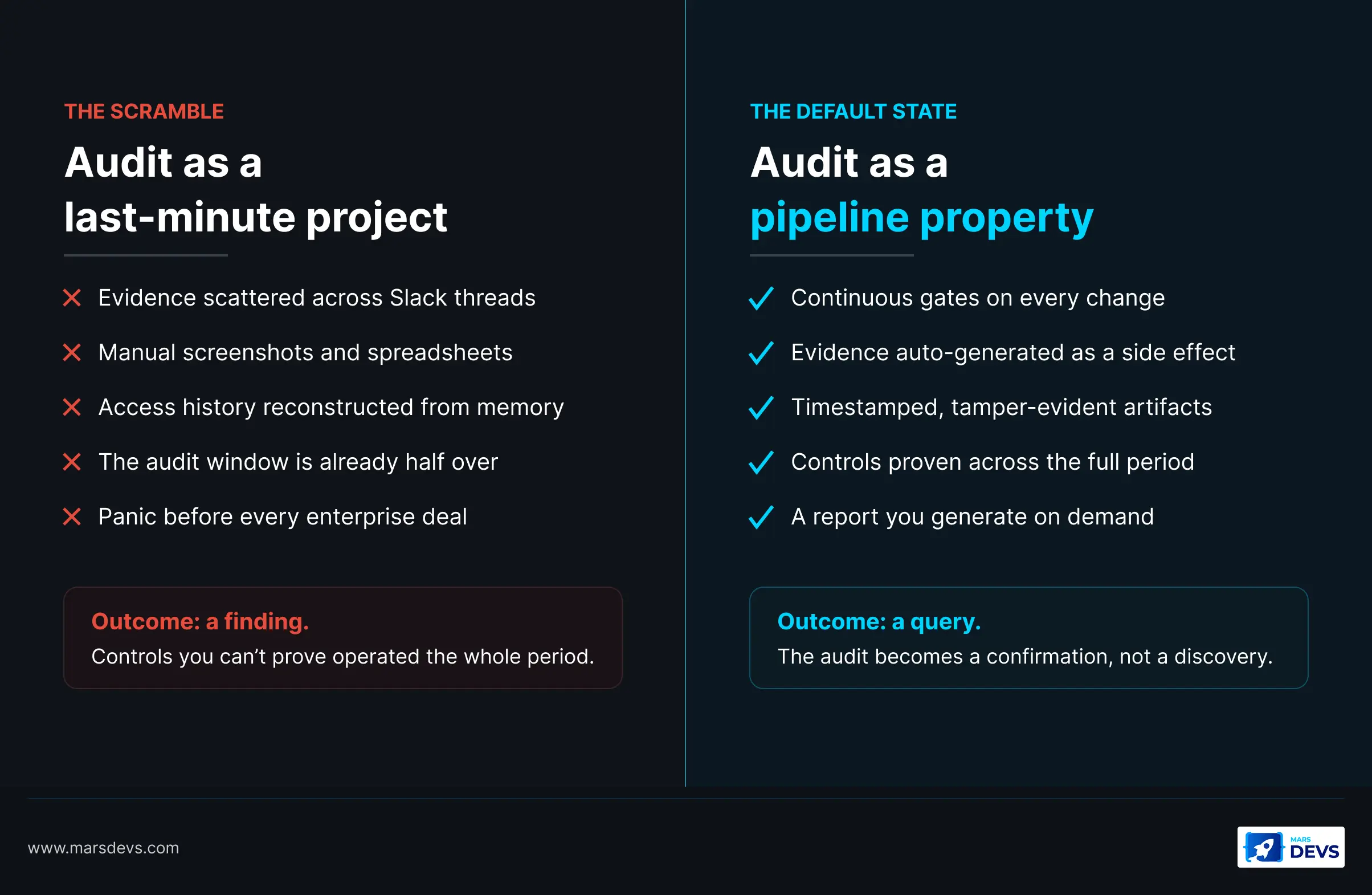
Compliance belongs in the pipeline because both SOC 2 Type II and the HIPAA Security Rule test continuous operation, not a point-in-time snapshot. A SOC 2 Type II audit assesses whether controls operated effectively over a period of 6 to 12 months, according to the AICPA's Trust Services Criteria. You cannot retrofit six months of consistent behavior in two weeks.
Here is the distinction that trips teams up. SOC 2 Type I asks whether your controls are designed correctly on a single day. Type II asks whether they actually ran, every day, for the whole period. Enterprise buyers want Type II. That means your access reviews, your deployment approvals, and your audit logs need to have been working the entire time, with evidence to prove it.
The same logic governs HIPAA. The HIPAA Security Rule requires covered entities and business associates to implement administrative, physical, and technical safeguards for electronic protected health information (ePHI). The HHS Notice of Proposed Rulemaking published in January 2025 proposes making most implementation specifications mandatory and requiring a compliance audit at least once every 12 months, per the HHS fact sheet. Continuous is becoming the legal default, not the gold standard.
So the question is not whether to operationalize compliance. It is where. And the answer is the same place every other quality property lives: the CI/CD pipeline. We treat audit logging, access control, and evidence collection the way we treat tests. They run on every change, they block merges when they fail, and they produce artifacts automatically.
When a control is a pipeline gate, the evidence collects itself. When a control is a policy document, someone has to remember to follow it, and auditors test the gap between the document and reality.
MarsDevs is a product engineering partner for early- and growth-stage businesses. We embed senior engineering pods that scale software from MVP to platform: multi-quarter engagements, outcome ownership, AI-native by default. Founded in 2019, MarsDevs has shipped 80+ production systems across 12 countries, including replatforming projects, multi-year SaaS builds, and AI integrations into existing products.
Related: See how we set up CI/CD for startups so the controls below have a pipeline to live in.
We build client systems to SOC 2 and HIPAA controls, and we support client audits with evidence and engineering. That is a precise claim, and it matters. MarsDevs does not hold its own SOC 2 attestation or operate as a HIPAA-covered entity on your behalf; those are client-specific arrangements.
What we do bring is lived experience building in regulated verticals. We have delivered healthtech and fintech products where the controls below were not optional, and we have sat on the engineering side of customer security reviews.
SOC 2 rests on five Trust Services Criteria: Security, Availability, Processing Integrity, Confidentiality, and Privacy. Security is the only criterion required in every audit; you add the other four based on what you promise customers and what your buyers demand, as outlined in the AICPA Trust Services Criteria. For most B2B SaaS selling upmarket, Security plus Availability plus Confidentiality covers the questionnaire.
These criteria sound like governance language, but each one decomposes into concrete engineering work. Here is the translation that matters to a CTO.
The criteria themselves have been stable since 2017, with revised points of focus issued in 2022. That stability is good news. The target does not move, so the engineering work compounds. Build the control once, gate it in the pipeline, and it keeps paying down audit risk on every release.
SOC 2 Security is not a separate workstream from good engineering. Access control, change management, and vulnerability scanning are things a competent team should already do. SOC 2 just asks you to prove you do them.
If you are early enough that you are still choosing your build approach, our breakdown of CI/CD for startups covers the pipeline foundations that every one of these criteria depends on.
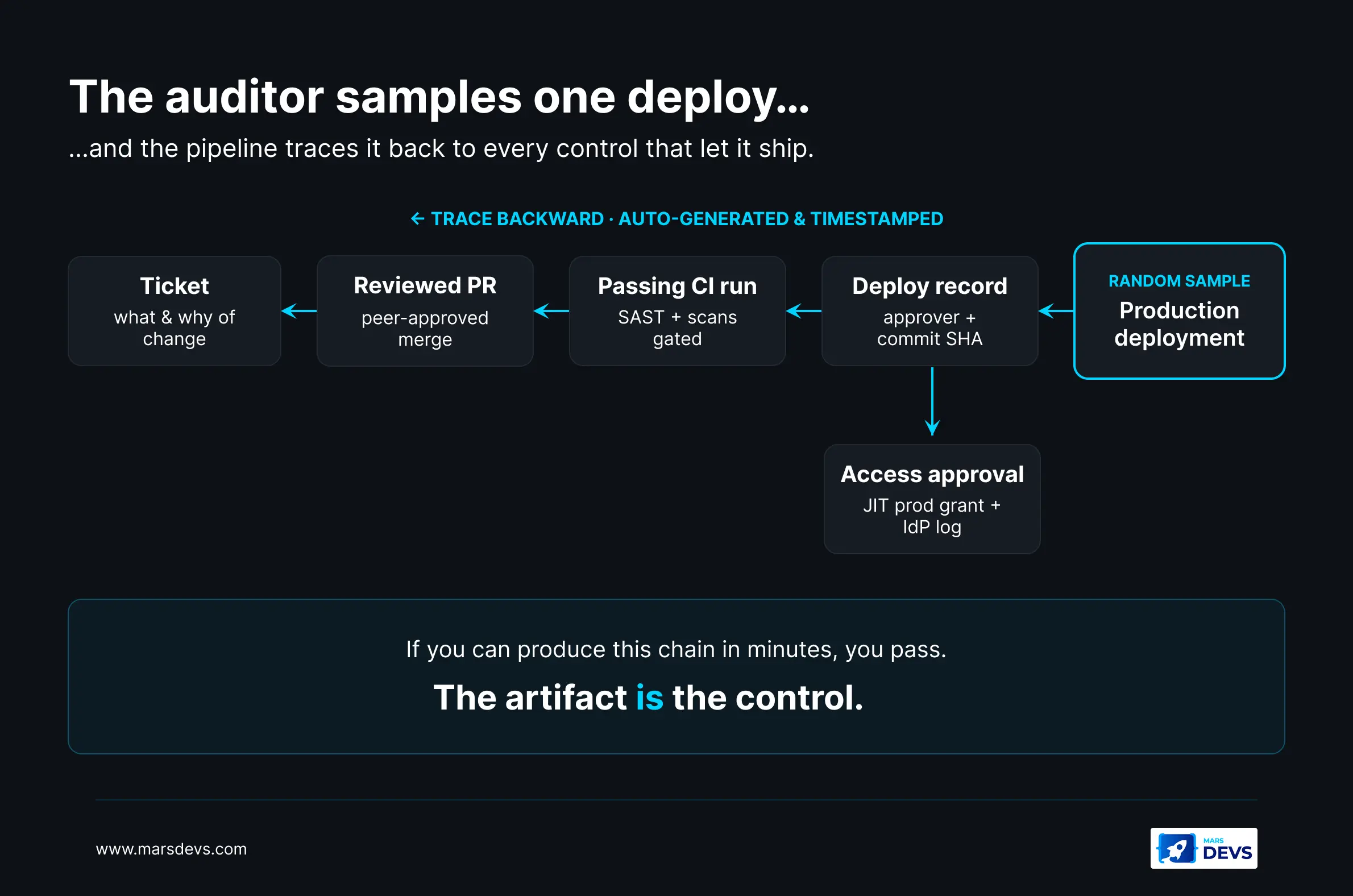
Auditors do not read your code. They test whether stated controls operated, and they ask for evidence that an independent person could verify, sampled across the audit period. A SOC 2 Type II auditor will pull a random set of deployments and ask you to show the approval, the test run, and the access that the change required. If you can produce that in minutes, you pass that control. If you reconstruct it from memory, you have a finding.
Here is the single most important thing to understand about regulated engineering: the artifact is the control. A policy that says "all production changes require peer review" is worthless to an auditor without commit history showing reviews actually happened on the sampled changes. The evidence has to be a byproduct of the work, generated automatically, time-stamped, and tamper-evident.
Three categories of evidence cover most of what an auditor samples:
The HIPAA Security Rule adds a fourth that auditors weigh heavily: an audit-controls safeguard requiring you to record and examine activity in systems that contain ePHI. That is immutable, queryable audit logging at the application layer, not just infrastructure logs. We treat application-level audit logging as a non-negotiable in any healthtech build for exactly this reason.
The teams that pass audits cleanly are not the teams with the thickest policy binders. They are the teams whose pipeline produces the evidence as a side effect of shipping.
The fastest way to make an audit boring is to map every control to a pipeline gate and a self-generating piece of evidence. Below is the core mapping we use when we set up a delivery pipeline for a regulated client. Each row turns a compliance requirement into engineering work with an automatic evidence trail.
| Control (SOC 2 / HIPAA) | Pipeline / Platform Implementation | Evidence the Auditor Pulls |
|---|---|---|
| Least-privilege access (SOC 2 CC6, HIPAA access control) | SSO + role-based IAM, just-in-time prod access, no standing admin keys | IdP access logs, quarterly access-review exports, IAM policy as code in Git |
| Change management & peer review (SOC 2 CC8) | Protected main branch, mandatory PR review, no direct prod pushes | Git history of reviewed and approved PRs tied to tickets |
| Secure SDLC / vulnerability mgmt (SOC 2 CC7) | SAST, dependency scanning, and secret scanning as blocking CI steps | CI logs showing scans ran and gated each release |
| Encryption at rest and in transit (SOC 2 confidentiality, HIPAA technical safeguards) | TLS enforced, KMS-managed keys, encrypted databases and buckets by default | Infra-as-code config, cloud provider encryption attestations |
| Audit logging of ePHI access (HIPAA audit controls) | Immutable, append-only application audit log of every read/write to PHI | Queryable audit-log records sampled by date and user |
| Deployment approval & traceability (SOC 2 CC8, processing integrity) | CD pipeline requires approval gate; every deploy linked to a release tag | CD run history with approver, timestamp, and commit SHA |
| Backup & recovery (SOC 2 availability) | Automated backups + tested restore runbook on a schedule | Backup job logs and dated restore-test results |
| Incident response (SOC 2 CC7, HIPAA contingency) | Alerting wired to on-call; documented runbook; post-incident review | Alert-to-ticket trail and completed incident reviews |
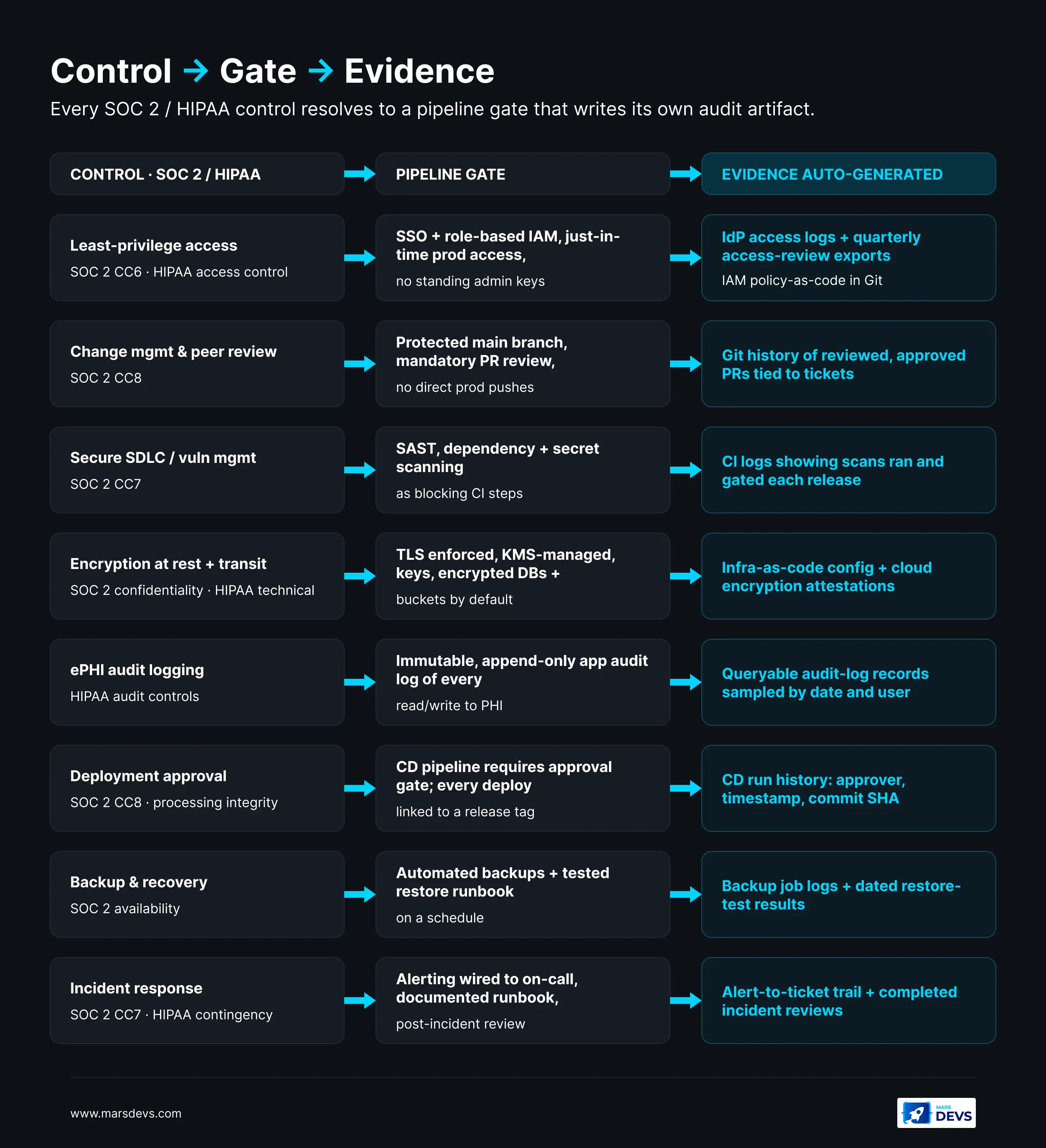
The pattern is consistent across every row. The control is not a rule someone follows. It is a gate the pipeline enforces, and the act of passing the gate writes the evidence. That is what we mean by compliance as a property of delivery.
This mapping also clarifies build priorities. Access control, change management, and secure SDLC sit upstream of everything else. Get those three right and you have covered the largest share of what a SOC 2 Security audit samples. The rest layers on as you commit to additional criteria.
Map each control to a gate, and the gate to an artifact. Once that mapping exists, "are we audit-ready?" stops being an opinion and becomes a dashboard.
Most SOC 2 Security controls and several HIPAA technical safeguards resolve to CI/CD configuration, which is also exactly where the OWASP CI/CD Top 10 risks live. The OWASP Top 10 CI/CD Security Risks names inadequate identity and access management, insufficient credential hygiene, and insufficient logging and visibility as top threats. Those three map one-to-one onto SOC 2 access control and audit-logging requirements.
That overlap is a gift. Hardening your pipeline against OWASP CI/CD risks and satisfying SOC 2 Security are largely the same task. When we build a pipeline for a regulated client, we treat the OWASP list as the threat model and the SOC 2 criteria as the acceptance test. Fix one, and you have largely fixed the other.
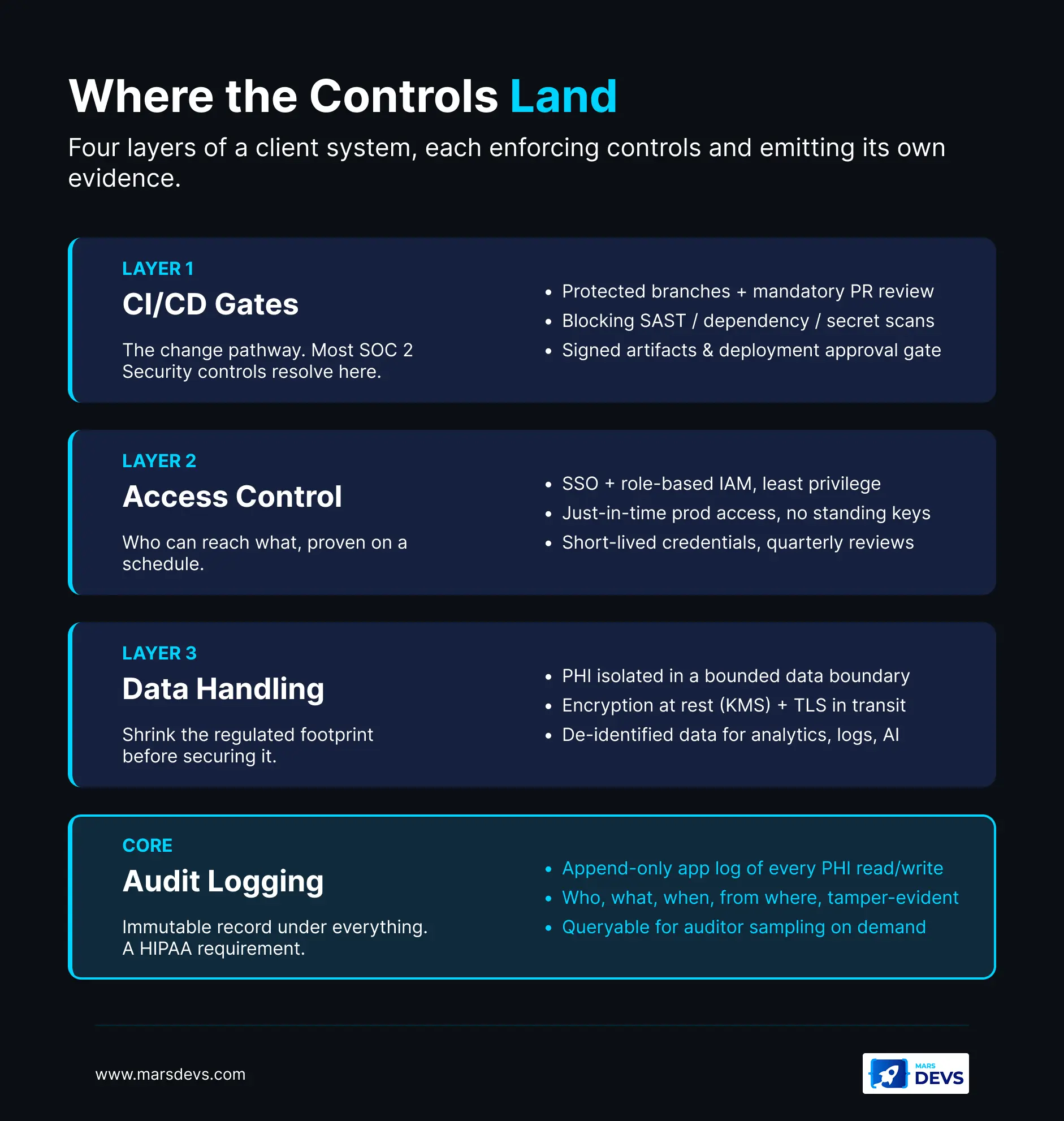
Concretely, that means short-lived credentials instead of long-lived secrets, pipeline-based access controls so a build job cannot reach production data it does not need, signed artifacts so you can prove what shipped, and complete logging of every pipeline action. Each of those is both a security improvement and an audit-evidence source.
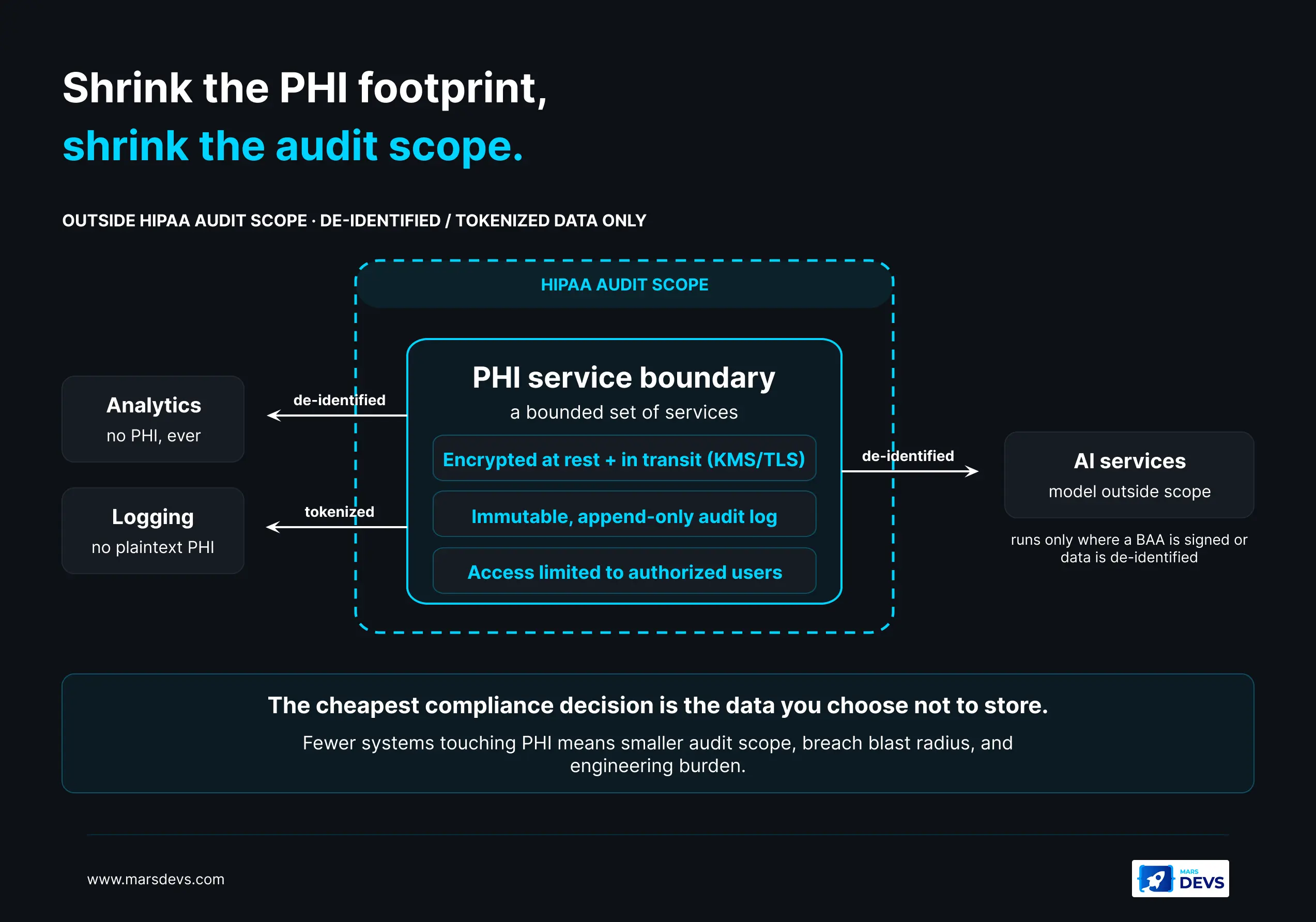
HIPAA engineering differs from standard SaaS in one decisive way: every system that touches ePHI inherits the full weight of the Security Rule, so your first job is to shrink that surface. The HIPAA Security Rule requires encryption of ePHI at rest and in transit, audit controls that record system activity, and access controls that limit ePHI to authorized users, with the January 2025 NPRM proposing to make these mandatory rather than addressable, per the HHS fact sheet.
The architectural move that matters most is data minimization and segmentation. The fewer systems that store or process PHI, the smaller your audit scope, your breach blast radius, and your engineering burden. We design healthtech systems so PHI flows through a tightly bounded set of services, with everything else operating on de-identified or tokenized data.
Here is how that plays out in practice across the build.
That last point connects to a question we get constantly now: can we use AI on this data? The answer depends entirely on whether the model provider signs a BAA and whether you can keep PHI out of training and logging paths. We design those data flows so AI features run on de-identified data wherever the use case allows, which keeps the model layer outside HIPAA scope.
In healthtech, the cheapest compliance decision is the data you choose not to store. Minimize the PHI footprint first, then secure what remains.
For a deeper look at how these constraints shape an early build, see our guide on building healthtech MVPs, which covers compliance-first scoping for healthcare products. The data-handling discipline that fintech demands is parallel, and we cover it in how to build a fintech app.
Compliance automation tools collect, store, and continuously check evidence against a control framework, so your team stops gathering screenshots by hand. Platforms in this category connect to your cloud, identity provider, and code repositories, pull configuration and access data automatically, and flag controls that drift out of compliance. Vendor documentation from providers like Secureframe describes mapping these integrations directly onto the SOC 2 Trust Services Criteria.
These tools are useful, and they are not magic. They automate evidence collection and monitoring. They do not implement the underlying controls. If your pipeline has no deployment approval gate, the tool will faithfully report that you have no deployment approval gate. The engineering work comes first; the automation reports on it.
So the right sequence is: build the controls into the pipeline, then connect an automation platform to harvest the evidence those controls already produce. We have seen teams do it backwards, buying the platform first and then discovering they have no controls for it to monitor. That is an expensive way to learn what an auditor wants.
Here is the division of labor we recommend.
| Layer | Owns | Examples |
|---|---|---|
| Engineering pipeline | Implementing and enforcing controls | CI gates, IAM policy, encryption, audit logging |
| Compliance automation platform | Collecting evidence and monitoring drift | Continuous control checks, evidence vault, alerts |
| Auditor / CPA firm | Independent testing and the report | Type II opinion, sampled testing, findings |
When all three layers are doing their job, the audit is a confirmation exercise, not a discovery exercise. The auditor samples controls the platform already tracks, which the pipeline already enforces. We aim every regulated engagement at that end state.
We treat SOC 2 Security controls as default pipeline configuration on regulated engagements, not as a later phase. From the first commit, the main branch is protected, every change goes through reviewed pull requests, and SAST, dependency scanning, and secret scanning run as blocking CI steps. None of that slows delivery. It is just how a senior pod ships.
We have built healthtech and fintech products since 2019, in verticals where these controls were a condition of going live, not a nice-to-have. Our delivery pods operate under documented access-control and audit-logging baselines on enterprise engagements. On the engineering side of customer security reviews, we have answered the questionnaires and produced the evidence trail that buyers demand.
The practical sequence we follow on a regulated build looks like this.
This is also a governance question, not only a tooling question. A distributed pod has to operate under the same access and review discipline as an in-house team, or the controls leak. We cover how to run that kind of pod under enterprise governance in governing a distributed engineering pod for enterprise.
We do not sell a compliance product. We build software that is audit-ready by construction, because the controls live in the same pipeline that ships the features.
The biggest cost driver is not the controls themselves. It is when you add them. Building SOC 2 Security controls into the pipeline from day one adds modest upfront effort and almost no ongoing drag. Retrofitting them onto a year-old codebase that ships directly to production with shared credentials is a multi-month remediation project. The order of operations sets the price.
We do not publish fixed figures for compliance engineering, because the scope swings on a handful of variables. What we can do is name the variables so you can reason about your own situation.
Here is the honest trade-off. Front-loading controls costs a little speed on day one and saves a remediation project later. Across the regulated builds we have run, the teams that paid the small upfront tax shipped to enterprise buyers without a six-month detour. That is the whole argument for building compliance into the pipeline.
It means your access control, change management, encryption, and audit logging are enforced as pipeline gates that generate evidence automatically. When controls run on every change and produce time-stamped artifacts, a SOC 2 Type II audit becomes a sampling exercise against systems you already operate.
Type I tests whether controls are designed correctly on a single date. Type II tests whether those controls actually operated effectively over a 6 to 12 month period. Enterprise buyers generally require Type II, which is why continuous, pipeline-enforced controls matter more than point-in-time fixes.
You can, but it is far more expensive than building it in. Retrofitting encryption, immutable audit logging, and access controls onto a live system touches nearly every component. Building HIPAA technical safeguards from the first commit avoids a multi-month remediation project.
Auditors sample controls across the audit period and ask for evidence an independent person can verify: reviewed pull requests, deployment approvals, access-review exports, and monitoring logs. They test whether stated controls operated, not your code quality. The artifact is the control.
No. Tools like Secureframe, Vanta, or Drata collect evidence and monitor for drift, but they do not implement the controls. If your pipeline lacks a deployment approval gate, the tool reports that gap. Engineering builds the controls first; the platform reports on them.
MarsDevs builds client systems to SOC 2 and HIPAA controls and supports client audits with engineering and evidence. MarsDevs does not hold its own SOC 2 attestation or operate as a HIPAA-covered entity; those remain client-specific arrangements. We have shipped healthtech and fintech products in regulated verticals since 2019.
Most SOC 2 Security controls resolve to CI/CD configuration: protected branches, mandatory review, blocking security scans, and short-lived credentials. The OWASP Top 10 CI/CD Security Risks overlap directly with SOC 2 access-control and logging requirements, so hardening your pipeline and passing the Security criterion are largely the same task.
Minimize the PHI footprint. Isolate protected health information in a bounded set of services and run analytics, logging, and AI features on de-identified data. The fewer systems that touch PHI, the smaller your audit scope, breach blast radius, and engineering burden.
Compliance stops being a fire drill the moment it becomes a property of how you ship. Map each SOC 2 and HIPAA control to a pipeline gate, make the gate generate its own evidence, and the audit turns into a report you can run on demand. Teams that do this sell upmarket without a six-month detour. Teams that defer it relive the same scramble before every enterprise deal.
If you are building in healthtech, fintech, or any vertical where the next big customer comes with a security review, the time to wire in controls is the first commit, not the first questionnaire. We have built in these verticals since 2019, and we set up the pipeline so audit-readiness is the default state, not a project.
Selling into regulated buyers and want your pipeline to carry the controls? Talk to our engineering team about building SOC 2 and HIPAA-ready delivery from day one. We can help you avoid 6 to 12 months of remediation mistakes.

Co-Founder, MarsDevs
Vishvajit started MarsDevs in 2019 to help founders turn ideas into production-grade software. With deep expertise in AI, cloud architecture, and product engineering, he has led the delivery of 80+ software products for clients in 12+ countries.
Get more insights like this
Join founders, CTOs, and engineering leaders who receive our engineering insights weekly. No spam, just actionable technical content.


