TL;DR
Hire AI developers in 2026: rates by region ($15-$300/hr), 3-stage vetting framework, skills checklist, and where to find senior AI engineers fast.
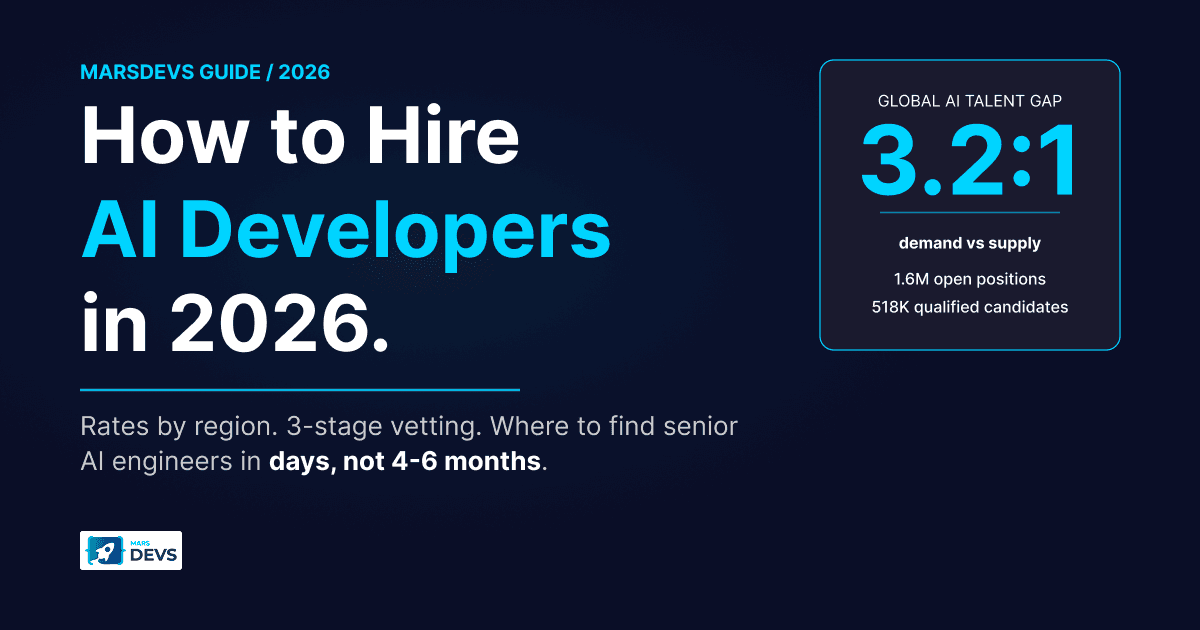
To hire AI developers in 2026, you need clarity on which AI role you actually need (AI engineer, ML engineer, or LLM specialist), a structured vetting process that tests production skills over theory, and a sourcing strategy that reaches beyond your local market. AI talent demand outpaces supply 3.2 to 1 globally, with 1.6 million open positions and only 518,000 qualified candidates. Rates run $15 to $300/hr depending on region. The average US hire takes 4.6 months. The smartest founders skip that entire cycle by working with offshore engineering partners who can place senior AI engineers in days.

1.6 million AI positions are open worldwide. Only 518,000 qualified candidates exist to fill them. That's a 3.2:1 demand-to-supply ratio, and it's getting worse, according to Second Talent's Global AI Talent Shortage report.
Universities produce roughly 65,000 computer science graduates per year. The market needs 180,000 AI-capable engineers. The software developer shortage in 2026 is 40% more severe than in 2025, driven by three forces: AI-driven demand requiring 3x more ML engineers than currently exist, senior engineer retirements removing 18% of experienced developers, and visa restrictions shrinking the available talent pool by 15%.
What does this mean if you want to hire AI developers? A full-time AI engineer in the US now takes 4.6 months on average to bring on board. The median salary hit $185,000, and the fully loaded cost (recruiting fees, onboarding, tooling, management overhead) routinely exceeds $300,000 per year. If you're a startup burning $80,000 a month, that single hire eats nearly four months of runway before they write a line of production code.
AI talent acquisition is the end-to-end process of defining the right AI role, structuring technical interviews, and securing engineers with specialized artificial intelligence and machine learning skills for your product team. It covers everything from sourcing and vetting to choosing between in-house hires, freelancers, and engineering partners.
Here's the thing: the shortage isn't evenly distributed. The US and Western Europe are hit hardest. India, Eastern Europe, and parts of Southeast Asia have deep AI talent pools at a fraction of the cost. Founders who look globally fill roles 3x faster than those who limit themselves to local markets.
MarsDevs is a product engineering company that builds AI-powered applications, SaaS platforms, and MVPs for startup founders. We've placed senior AI engineers on over 80 projects across 12 countries since 2019, and every pattern in this guide comes from that experience.
Not every AI developer is the same. The role has splintered into distinct specializations, and hiring the wrong type is one of the most expensive mistakes a founder can make. Before you post a single job listing, get clear on what you're building.
An AI engineer, an ML engineer, and an LLM specialist solve different problems despite overlapping skill sets. Here's how they break down:
| Role | What They Build | Core Skills | Best For |
|---|---|---|---|
| AI Engineer | AI-powered product features, LLM integrations, RAG pipelines, AI APIs | Python, LangChain/LlamaIndex, vector databases, API design, prompt engineering | Startups adding AI features to existing products |
| ML Engineer | Custom machine learning models, training pipelines, model optimization | TensorFlow/PyTorch, data pipelines, model serving, experiment tracking | Companies with proprietary data needing custom models |
| LLM Specialist | Fine-tuned language models, multi-agent systems, production LLM infrastructure | Transformers library, fine-tuning techniques, LLMOps, evaluation frameworks | Products built entirely around language AI |
An ML engineer (machine learning engineer) focuses on building and optimizing custom models from training data, while an AI engineer focuses on integrating pre-trained models into production software. For most startups in 2026, the highest-value hire is an AI engineer with strong software engineering fundamentals. They can ship AI-powered features into your product without needing a separate ML infrastructure team.

The AI skills landscape has matured past the "knows Python and TensorFlow" stage. Here's what production-ready AI developers actually need in 2026, according to Second Talent's skills analysis:
Technical chops get candidates through the door. These traits determine whether they actually deliver:
Your sourcing channel determines the quality, speed, and cost of your hire. Here are the real options in 2026, ranked by how well they work for startup founders.
This is the fastest path for most founders who need to hire AI developers quickly. Staff augmentation is a flexible outsourcing strategy where external engineers are embedded into your existing team, working under your management while the partner handles sourcing, vetting, and payroll. Engineering partners like MarsDevs maintain pre-vetted teams of senior AI developers who can start contributing within days, not months. You skip the 4.6-month hiring cycle entirely.
MarsDevs provides senior engineering teams for founders who need to ship fast without compromising quality. Our AI engineers start within 48 hours, you get 100% code ownership, and rates start at $15-25/hr compared to $150-300/hr for US-based equivalents.
Staff augmentation works best when you need AI expertise embedded in your existing team. The engineers join your Slack, attend your standups, and push to your repos. You keep full control over priorities and architecture while the partner handles sourcing, vetting, and payroll.
Learn more about how staff augmentation compares to traditional outsourcing.
Platforms like Toptal, Arc.dev, and Turing pre-screen candidates and match them to your requirements. Quality is higher than open marketplaces, but you pay a premium (typically 20-40% markup over direct hire rates). Turnaround is usually 1 to 4 weeks.
Upwork and similar platforms give you the widest selection and maximum flexibility. The trade-off is vetting. You'll sift through dozens of profiles, run your own technical interviews, and manage the relationship yourself. For one-off AI projects under $10,000, this can work. For anything mission-critical, the risk is high.
Posting on LinkedIn, Indeed, or specialized job boards (Hugging Face, AI-specific communities on GitHub and Stack Overflow) gives you the most control. It also takes the longest. Budget 4 to 6 months and $20,000 to $40,000 in recruiting costs for a single senior AI engineer in the US.
If you've been burned by an agency that missed deadlines or delivered sloppy work, direct hiring feels safer. But the timeline and cost can drain your runway before you ship anything.
GitHub contributions, Kaggle competition rankings, and open-source AI project participation are strong signal sources. A developer who has shipped production RAG systems or contributed to LangChain is worth more than one with a Stanford ML certificate and zero real-world deployments.
| Channel | Time to Hire | Cost | Quality Control | Best For |
|---|---|---|---|---|
| Engineering partner | Days to 2 weeks | $15-80/hr (varies by region) | Pre-vetted by partner | Ongoing AI product development |
| Vetted platform | 1-4 weeks | $80-200/hr (with markup) | Platform screening | Short-term specialized projects |
| Freelance marketplace | 1-3 weeks | $25-250/hr (wide range) | Self-managed | Budget-constrained small projects |
| Direct hire (US) | 4-6 months | $185K+ salary + $30K+ recruiting | Your own process | Long-term full-time roles |
| Developer communities | Variable | Time-intensive sourcing | High signal, low volume | Finding niche specialists |
This is the section every founder skips to first. AI developers command a 30-50% premium over general software developers, but rates vary dramatically by geography.
| Region | Junior AI Dev (Hourly) | Mid-Level AI Dev (Hourly) | Senior AI Dev (Hourly) | Senior AI Architect (Hourly) |
|---|---|---|---|---|
| United States | $80-120 | $120-200 | $150-300 | Up to $350 |
| Western Europe | $60-100 | $80-150 | $100-200 | Up to $250 |
| Eastern Europe | $30-45 | $40-55 | $50-80 | Up to $100 |
| Latin America | $35-50 | $45-65 | $55-80 | Up to $100 |
| India | $15-30 | $25-45 | $35-70 | Up to $90 |
| Southeast Asia | $15-25 | $25-40 | $30-55 | Up to $75 |
Sources: Second Talent Rate Card, Innov8World Global Developer Rates, Debut Infotech Cost Analysis

Geography is the biggest factor, but not the only one:
For a detailed breakdown of AI project costs and budgeting, see our AI development cost guide.
A bad AI hire costs you six months and $100,000+. A good interview process prevents that. We've seen it firsthand: companies with structured AI hiring processes fill roles 40% faster and report higher retention than those winging it with ad-hoc interviews.
We've refined this process across dozens of AI hires. Three stages, each testing something different:
Stage 1: Take-Home Project (4-6 hours) Give candidates a small AI feature to build using your actual tech stack. For example: "Build a RAG pipeline that answers questions about this PDF dataset with source citations." This tests practical ability, code quality, and architectural thinking in a realistic context.
Stage 2: Code Review Session (60-90 minutes) Walk through their take-home submission. Focus on:
Stage 3: System Design Interview (60 minutes) Present a real-world AI system challenge relevant to your product. Evaluate their ability to design data pipelines, model serving infrastructure, evaluation frameworks, and monitoring systems.
Skip the textbook questions. Ask these instead:
"Walk me through an AI system you deployed to production. What broke first?" Good candidates have war stories. Great ones explain what they learned and how they prevented it from happening again.
"How do you evaluate whether an LLM response is good enough for production?" Look for answers that mention automated evaluation pipelines, specific metrics (BLEU, ROUGE, faithfulness scores), human-in-the-loop review, and A/B testing. Not just "I read the outputs and they looked fine."
"Your RAG system returns irrelevant results for 15% of queries. How do you diagnose and fix this?" This tests debugging methodology. Strong answers walk through retrieval analysis, chunk size experiments, re-ranking models, hybrid search, and query reformulation.
"The CEO wants to add AI to the product. The budget is $10,000/month for infrastructure. What do you build?" This reveals cost awareness and practical thinking. You want engineers who architect within constraints, not ones who default to the most expensive solution.
"What's the difference between fine-tuning and RAG, and when would you choose each?" A foundational question that exposes depth. Weak answers give textbook definitions. Strong answers discuss cost, latency, data freshness, and maintenance burden.
Here's the reality for most founders: you need AI capabilities now, not in 4.6 months when your direct hire finally starts. The AI talent shortage is structural. It won't resolve in 2026 or 2027. Smart founders build AI teams through engineering partners instead of fighting over the same small pool of local candidates.
The math is straightforward. A senior AI engineer in the US costs $300,000+ per year fully loaded. The same caliber of engineer through an offshore partner costs $40,000 to $80,000. That's not a quality trade-off. India produces more AI-trained engineers than any country except the US. The difference is cost of living, not skill level.
Founded in 2019, MarsDevs has shipped 80+ products across 12 countries for startups and scale-ups. Our AI engineering team has built RAG systems, multi-agent platforms, LLM integrations, and AI-powered MVPs for founders across fintech, healthcare, logistics, and SaaS.
Here's what working with an engineering partner actually looks like:
The contract vs full-time decision depends on your stage:
| Factor | Contract / Partner | Full-Time Hire |
|---|---|---|
| Best for | MVPs, specific AI features, scaling fast | Core AI product, long-term R&D |
| Time to start | Days to 2 weeks | 4-6 months |
| Monthly cost | $3,000-$12,000 per engineer | $15,000-$25,000+ (US, fully loaded) |
| Flexibility | Scale up or down each sprint | Fixed headcount, slow to adjust |
| Risk | Low. Pause or end anytime. | High. Severance, morale impact. |
| Knowledge retention | Moderate. Documentation and handoffs. | High. Institutional knowledge stays. |
| When to transition | After product-market fit, when you need dedicated AI R&D | When AI is your core product differentiator |
Most founders we work with start with a contract partner to build their AI MVP (minimum viable product, the simplest version of a product that delivers core value to early users), validate the approach, and then selectively hire full-time for the roles that become core to their competitive advantage. We've seen this pattern play out across dozens of our remote team engagements.
For a typical AI-powered product, here's the team structure that works:
This team ships an AI MVP in 6 to 8 weeks at MarsDevs rates. Compare that to six months of recruiting before a single line of code gets written. If you need to show traction to investors before your next round, that timeline difference changes everything.
Want to build your AI product without burning through your runway on recruiting? Book a free strategy call with MarsDevs and have your AI engineering team assembled within 48 hours.
AI developer costs range from $15/hr (offshore, through a partner like MarsDevs) to $300+/hr (senior US-based freelancers). Full-time US salaries average $185,000 per year. Fully loaded costs exceed $300,000 when you include recruiting fees, benefits, and onboarding. Offshore engineering partners in India offer the best value at $15-25/hr for senior engineers with production experience. The total cost depends on your engagement model (contract vs full-time), the engineer's specialization (AI engineer vs ML engineer vs LLM specialist), and their geographic location.
The fastest channels to find AI ML developers are engineering partners (like MarsDevs, which can place senior AI engineers within 48 hours), vetted talent platforms (Toptal, Arc.dev, Turing), and developer communities (GitHub, Kaggle, Hugging Face). Direct hiring through LinkedIn and job boards works for full-time roles but takes 4 to 6 months on average. For most startups, a staff augmentation partner offers the best balance of speed, quality, and cost.
A strong AI developer in 2026 needs expertise in Python, LLM integration (OpenAI, Anthropic, open-source models), RAG pipeline construction, prompt engineering, and MLOps (Docker, Kubernetes, MLflow). They should have hands-on experience with vector databases (Pinecone, Weaviate, Chroma), agent frameworks (LangChain, LlamaIndex, LangGraph), and production deployment. Beyond technical skills, look for production thinking (they ask about latency and cost before writing code), business translation ability (they can explain trade-offs to non-technical stakeholders), and evaluation rigor (they measure AI output quality with metrics, not vibes).
For most startups, offshore AI developers deliver better ROI. A senior AI engineer in the US costs $300,000+ per year fully loaded. The same skill level through an offshore partner in India costs $40,000 to $80,000. The quality gap has closed significantly. India produces more AI-trained engineers than any country except the US, and distributed work is now standard. Hire in-house when AI is your core product differentiator and you need deep institutional knowledge retention. Use offshore teams for everything else: MVPs, feature development, and scaling.
Look for production deployments, not prototypes. Ask to see live AI systems they've built, not Kaggle notebooks or course projects. Evaluate their portfolio against these criteria: Did the system handle real users at scale? Did they solve a real business problem (not just a technical demo)? Can they show metrics like response accuracy, latency, or cost per query? Do they have experience with your specific AI use case (RAG, agents, computer vision, NLP)? A developer who shipped one production RAG system is worth more than one with ten Jupyter notebook demos.
The AI talent shortage in 2026 is severe. Global demand outpaces supply 3.2 to 1, with 1.6 million open AI positions and only 518,000 qualified candidates. AI roles command 67% higher salaries than traditional software positions, with 38% year-over-year salary growth. The shortage is 40% worse than in 2025, driven by explosive demand for AI engineers, a limited pipeline of qualified graduates (65,000/year vs 180,000 needed), and senior engineer retirements. 72% of employers report difficulty hiring AI talent. The IT skills shortage is projected to cause $5.5 trillion in losses globally by the end of 2026.
An AI engineer builds AI-powered product features, LLM integrations, and RAG pipelines using tools like Python, LangChain, and vector databases. An ML engineer (machine learning engineer) builds custom models, training pipelines, and model optimization using TensorFlow or PyTorch. An LLM specialist focuses on fine-tuned language models, multi-agent systems, and production LLM infrastructure. For most startups in 2026, the highest-value hire is an AI engineer with strong software engineering fundamentals who can ship AI features without needing a separate ML infrastructure team.
Direct hiring a full-time AI engineer in the US takes 4 to 6 months on average and costs $20,000 to $40,000 in recruiting expenses. Vetted talent platforms (Toptal, Arc.dev) deliver candidates in 1 to 4 weeks. Engineering partners like MarsDevs can place senior AI engineers within 48 hours. The fastest approach for most startups is staff augmentation through an engineering partner, which eliminates the recruiting cycle entirely and lets you start building immediately.
The AI talent market won't get easier. Demand grows every quarter. Salaries keep climbing. The 4.6-month average hiring timeline keeps stretching. Every month you spend recruiting is a month your competitors spend shipping.
You have two options. Fight the talent war on the most expensive battlefield (US direct hiring), or go where the talent is abundant and the rates are 5 to 10x lower.
We've assembled AI engineering teams for 80+ products. We know which skills matter for your specific use case, and we can have senior engineers writing code on your project within 48 hours.
Want to skip the 4-month hiring cycle? Talk to our AI engineering team and start building this week. We take on 4 new projects per month. Claim a slot.
Co-Founder, MarsDevs
Vishvajit started MarsDevs in 2019 to help founders turn ideas into production-grade software. With deep expertise in AI, cloud architecture, and product engineering, he has led the delivery of 80+ software products for clients in 12+ countries.
Get more insights like this
Join founders, CTOs, and engineering leaders who receive our engineering insights weekly. No spam, just actionable technical content.


