TL;DR
AI development cost in 2026 ranges from $15,000 for a simple AI feature to $500,000+ for a production enterprise system. A typical startup AI MVP costs $25,000 to $80,000 and takes 6 to 12 weeks. The biggest cost driver is data preparation (30 to 50% of budget), not the AI model itself. API costs dropped 40 to 70% since 2024, making 2026 the best year to build.

You closed your funding round. Your investors want AI in the product. Your first question: "How much is this going to cost?"
The honest answer: it depends on five variables that most founders underestimate. AI development cost is the total investment required to build, deploy, and maintain an artificial intelligence application. It includes data preparation, model selection, system integration, engineering team costs, and ongoing inference and maintenance expenses. It is not a single line item. It is a stack of decisions, each with its own price tag.
MarsDevs is a product engineering company that builds AI-powered applications, SaaS platforms, and MVPs for startup founders. We have priced and shipped AI projects across every category below, so these numbers come from production experience, not theory.
Data preparation is the process of cleaning, labeling, structuring, and validating raw data so it can be used by AI models. It eats 30 to 50% of most AI project budgets. This is the cost founders underestimate most often. Raw data is never ready to use. It needs cleaning, labeling, structuring, deduplication, and validation before any model can touch it.
If your data is messy (and it usually is), budget 35 to 40% of your total project cost here. Skipping this step is the fastest path to a model that looks great in demos and fails in production.
Your choice of AI model drives costs more than any other technical decision. A Large Language Model (LLM) is an AI model trained on massive text datasets that generates human-like text, powers chatbots, and handles natural language tasks. The cost difference between using an LLM via API versus training your own model is enormous.
| Approach | Cost Range | Best For |
|---|---|---|
| Pre-trained APIs (OpenAI, Anthropic, Google) | $0.50 to $25 per 1M tokens | Chatbots, text generation, classification |
| Fine-tuned models | $5,000 to $100,000+ | Domain-specific language, specialized tasks |
| Custom ML models | $50,000 to $300,000+ | Unique data patterns, proprietary algorithms |
| Open-source models (Llama, Mistral) | $2,000 to $50,000 (infra costs) | Full control, data privacy, no vendor lock-in |
Fine-tuning is additional training of a pre-trained AI model on domain-specific data to improve performance for specialized tasks. It costs 10x to 50x more than using pre-trained APIs.
The short answer for most startups: start with pre-trained APIs. Fine-tune only when you have clear evidence the base model cannot meet your accuracy requirements. We have shipped 80+ products and the pattern holds: well-crafted prompts with RAG (Retrieval-Augmented Generation) achieve 90%+ of results at 10% of the fine-tuning cost.
Connecting an AI model to your existing systems adds $10,000 to $100,000+ depending on how many APIs, databases, and workflows need to talk to each other. A simple chatbot on your website costs far less than an AI agent that reads and writes to your CRM, payment system, inventory database, and email platform.
AI developer rates vary dramatically by geography. This is where your budget decision has the biggest multiplier effect. We break this down fully in the location section below.
Inference cost is the expense incurred every time an AI model processes a request in production. A chatbot handling 5,000 queries per day at $0.01 per query costs $1,500 per month in API fees alone. At 50,000 queries per day, that jumps to $15,000 per month. Model your token economics at 10x your expected volume before committing to an architecture.
Every founder asks: "What will my specific project cost?" Here are real numbers from production AI projects in 2026, based on what we see across the market and in our own client work.
| Tier | Features | Cost Range | Timeline |
|---|---|---|---|
| Basic | FAQ bot, pre-built APIs, single channel | $5,000 to $20,000 | 2-4 weeks |
| Mid-Level | NLP-powered, multi-channel, CRM integration | $20,000 to $80,000 | 4-8 weeks |
| Enterprise | Custom NLU, omnichannel, analytics, human handoff | $80,000 to $300,000+ | 8-20 weeks |
A basic AI chatbot using pre-trained models (GPT-4o, Claude) with a simple knowledge base costs $5,000 to $20,000. The moment you add custom training data, multi-channel deployment, and deep integrations, costs jump 4x to 10x.
RAG (Retrieval-Augmented Generation) is an AI architecture that feeds relevant data from a knowledge base into a Large Language Model at generation time, so responses stay accurate and grounded. RAG systems connect LLMs to your proprietary data. This is the most requested AI feature we build for SaaS companies.
| Component | Cost Range |
|---|---|
| Vector database setup | $3,000 to $15,000 |
| Document processing pipeline | $8,000 to $30,000 |
| Retrieval optimization | $5,000 to $25,000 |
| LLM integration and prompt engineering | $5,000 to $20,000 |
| Total RAG MVP | $20,000 to $80,000 |
| Production RAG system | $80,000 to $180,000 |
The biggest variable: data volume and document complexity. A RAG system for 1,000 clean PDFs costs half as much as one that needs to process 50,000 mixed-format documents with tables, images, and handwritten notes. For a deeper comparison of RAG against fine-tuning, see our RAG vs fine-tuning guide.
An AI agent is an autonomous AI system that plans, executes, and iterates on multi-step tasks using tools and external data sources. AI agents that autonomously complete multi-step tasks are the fastest-growing category of AI development in 2026. The agentic AI market reached approximately $10 billion in 2026, growing at over 42% CAGR according to Mordor Intelligence.
| Tier | Scope | Cost Range | Timeline |
|---|---|---|---|
| Simple Agent | Single workflow, 3-5 tools, basic memory | $10,000 to $35,000 | 4-6 weeks |
| Multi-Step Agent | Complex workflow, 8-12 tools, long-term memory | $40,000 to $120,000 | 6-16 weeks |
| Multi-Agent System | Coordinated agents, shared state, monitoring | $80,000 to $300,000+ | 12-40 weeks |
For a deeper look at building AI agents, see our complete guide to AI agents.
Custom ML models for prediction, classification, or recommendation engines carry the highest price tags. Machine learning (ML) is a subset of AI where algorithms learn patterns from data to make predictions or decisions without explicit programming. Custom ML models require proprietary training data, specialized expertise, and significant compute resources.
Adding AI to an existing product (smart search, recommendation engine, content generation, image analysis) is often the most cost-effective path for startups that need to show AI traction to investors before the next round.
Here is the thing: you almost never need the most expensive option first. Start with the smallest AI feature that proves value. Then scale. We have helped founders go from a $15,000 proof of concept to a $200,000 production system, and the proof of concept informed every decision that followed. This pattern also applies to SaaS product development, where phased builds consistently outperform big-bang launches.

Where you hire matters as much as what you build. The same AI project can cost 3x more depending on your team's location. This is the highest-impact budget decision most founders make.
| Region | Hourly Rate Range | Annual Cost per Engineer | Quality Level |
|---|---|---|---|
| United States | $120 to $200/hr | $250,000 to $400,000+ | Top-tier research and innovation |
| Western Europe | $100 to $180/hr | $200,000 to $350,000 | Strong ML/AI expertise |
| Eastern Europe | $40 to $80/hr | $80,000 to $160,000 | Excellent engineering, growing AI talent |
| India | $15 to $25/hr | $30,000 to $50,000 | Deep enterprise AI expertise, scalable teams |
| Latin America | $35 to $70/hr | $70,000 to $140,000 | Timezone-aligned with US, growing talent pool |
MarsDevs provides senior engineering teams from India at $15 to $25/hr. That is not a compromise on quality. It is the same caliber of engineers who build for companies across 12 countries. The difference is operational cost, not skill. A $200,000 AI project built with a US team costs $40,000 to $70,000 with an equally skilled India-based team.
A startup building an AI-powered SaaS product needs roughly 2 to 3 senior AI engineers for 4 months.
Same deliverable. Same timeline. $249,600 difference. That is runway you keep for growth, marketing, or your next funding round.
If you are a founder weighing this decision, consider this: AI captured roughly 50% of all global VC funding in 2025 ($202.3 billion), according to industry reports. Investors expect AI in your product. They do not expect you to overpay for it.

The initial build is only 25 to 35% of what you will spend over three years. These are the costs that blindside founders after launch.
Every production AI request costs money. API pricing in 2026 (per million tokens):
| Provider | Model | Input Cost | Output Cost |
|---|---|---|---|
| OpenAI | GPT-4o | $2.50 | $10.00 |
| OpenAI | GPT-5.2 | $1.75 | $14.00 |
| Anthropic | Claude Sonnet 4.6 | $3.00 | $15.00 |
| Anthropic | Claude Haiku 4.5 | $1.00 | $5.00 |
| Gemini 2.0 Flash | $0.10 | $0.40 |
Source: Anthropic pricing page, IntuitionLabs API comparison.
A chatbot handling 10,000 conversations per day, averaging 2,000 tokens per conversation, burns through 20 million tokens daily. At GPT-4o rates, that is $250 per day ($7,500/month) just for output tokens.
If you self-host models, GPU costs add up fast.
For fewer than 10,000 API calls per month, cloud APIs are almost always cheaper than self-hosting. Cross that threshold and run the math on dedicated GPU instances.
Your AI is only as good as its data. Expect ongoing costs for:
Model drift is the degradation of machine learning model accuracy over time as real-world data patterns shift away from the original training distribution. Budget 15 to 25% of your initial build cost annually for retraining, prompt optimization, and model updates.
If you have been burned by an agency that launched your AI and walked away, this is why it stopped working. AI systems need ongoing care. No exceptions.
AI systems handling user data need security audits, GDPR/SOC 2 compliance, and AI governance frameworks. This adds $10,000 to $50,000 annually depending on your industry and data sensitivity.
Prompt engineering is the practice of designing and iterating on the instructions given to an LLM to produce accurate, consistent, and useful outputs. Prompts are not "set and forget." Production prompts need ongoing tuning as models update, user behavior changes, and edge cases surface. Budget $2,000 to $10,000/month for a dedicated prompt engineer or allocate 10 to 15% of your engineering team's time.
The total cost of ownership (TCO) formula: Initial build cost + (annual maintenance at 20% of build) + (monthly inference x 12) + security/compliance = 3-year TCO. For a $100,000 AI build, that is roughly $100,000 + $60,000 + $72,000 + $30,000 = $262,000 over 3 years.
You do not need to spend $300,000 to get AI into your product. Here are seven strategies we use with every startup client to keep AI project budgets lean.
Use OpenAI, Anthropic, or Google APIs for your v1. Fine-tune only after you have 3+ months of production data showing where the base model falls short. This alone saves 60 to 80% on initial model costs.
RAG grounds LLM responses in your proprietary data without the expense of training a custom model. A $25,000 RAG implementation often delivers better results than a $100,000 fine-tuning project because it stays current with your data automatically.
Not every task needs GPT-4o or Claude Opus. Route simple classification to Haiku ($1/M tokens) and save the powerful models for complex reasoning. Smart model routing cuts API costs by 40 to 60%.
Anthropic and OpenAI both offer prompt caching (up to 90% savings on repeated system prompts) and batch APIs (50% discount for non-real-time processing). Combine both for up to 95% cost reduction on eligible requests.
Build the smallest AI feature that proves value. An MVP (Minimum Viable Product) is the simplest version of a product that delivers core value to early users. A $15,000 proof of concept that validates your hypothesis is worth more than a $150,000 system that solves the wrong problem. We have shipped 80+ products. The pattern holds: founders who scope tight ship faster and spend less.
Maybe you are a non-technical founder who cannot tell if your AI vendor is overbuilding. This is exactly why we do free scoping sprints. You see the scope before you spend a dollar.
The math is clear (see the location section above). India-based senior AI engineers deliver the same quality at 40 to 70% lower cost. MarsDevs starts building in 48 hours with senior engineers only. No juniors learning on your project.
Phase your AI development:
This approach lets you validate before investing heavily. Every dollar in Phase 2 is informed by real production data from Phase 1.
Founded in 2019, MarsDevs has shipped 80+ products across 12 countries for startups and scale-ups. Here is how we approach AI development pricing differently from typical agencies.
| Project Type | MarsDevs Cost | US Agency Equivalent | You Save |
|---|---|---|---|
| AI Chatbot MVP | $5,000 to $40,000 | $25,000 to $80,000 | 50-80% |
| RAG System | $8,000 to $50,000 | $60,000 to $180,000 | 60-85% |
| AI Agent (Single) | $3,000 to $15,000 | $30,000 to $100,000 | 70-85% |
| Multi-Agent System | $5,000 to $30,000 | $80,000 to $300,000 | 90-95% |
| AI MVP | $5,000 to $30,000 | $25,000 to $80,000 | 60-80% |
| Full Enterprise AI | $50,000 to $300,000 | $150,000 to $2,000,000 | 65-85% |
These are not discounted rates. They reflect the real cost of senior India-based engineering teams with a 4.9 rating on Clutch.
We do not charge for bloated discovery phases. Here is our process:
Want to know exactly what your AI project will cost? Book a free strategy call. We scope AI projects in 48 hours and give you a binding estimate before you commit a dollar.
A basic AI chatbot costs $5,000 to $20,000 and takes 2 to 4 weeks to build. This includes a pre-trained LLM (GPT-4o or Claude), a simple knowledge base, and single-channel deployment (website widget or Slack). Adding multi-channel support, CRM integration, and custom training data pushes costs to $20,000 to $80,000. The biggest variable is integration complexity: a standalone chatbot is cheap, but one that reads and writes to your existing systems costs 3x to 5x more.
A custom AI agent costs $10,000 to $35,000 for a simple single-workflow agent and $40,000 to $300,000+ for multi-agent systems. The price depends on the number of tools the agent connects to, memory requirements, and whether it operates autonomously or with human-in-the-loop approval. Ongoing LLM API costs add $500 to $5,000/month depending on execution volume. MarsDevs builds production AI agents that prove ROI before you commit to a full system.
RAG (Retrieval-Augmented Generation) implementation costs $20,000 to $80,000 for an MVP and $80,000 to $180,000 for a production system. The major cost components are vector database setup ($3,000 to $15,000), document processing pipeline ($8,000 to $30,000), retrieval optimization ($5,000 to $25,000), and LLM integration ($5,000 to $20,000). RAG is almost always cheaper than fine-tuning and delivers better results for knowledge-grounding use cases because it stays current with your data automatically.
Pre-trained models are 60 to 90% cheaper for initial development. Using OpenAI or Anthropic APIs for a chatbot or content generation tool costs $5,000 to $30,000 versus $50,000 to $300,000+ for a custom-trained model. The trade-off is control and specialization. Pre-trained models work for 80%+ of startup use cases. Custom models make sense when you need domain-specific accuracy (medical diagnosis, legal analysis) or when API costs at scale exceed self-hosting costs. Start with APIs. Graduate to custom models when production data proves you need them.
Plan for 15 to 25% of your initial build cost annually, plus monthly operational expenses. A $100,000 AI application typically costs $3,000 to $10,000/month to maintain: $500 to $5,000 for LLM API calls, $200 to $2,000 for cloud infrastructure, $500 to $1,500 for data pipeline maintenance, and $500 to $2,000 for monitoring and prompt optimization. Model drift requires periodic retraining ($5,000 to $20,000 per cycle). The initial build is only 25 to 35% of your three-year total cost of ownership.
Senior AI engineers in the US charge $120 to $200/hr (total annual cost $250,000 to $400,000+ per engineer including benefits). India-based senior AI engineers at MarsDevs charge $15 to $25/hr (annual cost $30,000 to $50,000). The same AI project built by a US team costing $250,000 typically costs $75,000 to $85,000 with an India-based team of equal seniority. MarsDevs provides senior engineering teams from India at $15 to $25/hr, delivering 40 to 70% cost savings with zero quality compromise. Our 4.9 Clutch rating across 80+ shipped products backs that claim.
Most AI investments show positive ROI within 4 to 12 months depending on the use case. A $50,000 AI customer service chatbot that cuts support costs by $100,000 annually pays for itself in 6 months with 200%+ first-year ROI. Automation agents that replace manual workflows show faster payback (3 to 6 months) because the labor savings are immediate and measurable. The key to fast ROI: start with your highest-cost manual process and automate that first, not the process that sounds most impressive.
Budget $5,000 to $80,000 for an AI MVP, depending on complexity. A simple AI feature (smart search, content generation) costs $5,000 to $25,000. A chatbot with integrations runs $5,000 to $40,000. A RAG-powered knowledge system costs $8,000 to $50,000. An AI agent MVP costs $3,000 to $15,000. The biggest budget mistake founders make: building too much in v1. Scope to one core AI feature, prove it works with real users, then expand. Your runway is more valuable than your feature list. MarsDevs helps founders ship AI MVPs in 6 to 8 weeks, starting from $5,000. Start building in 48 hours.
The AI development market is more accessible and more affordable than it has ever been. API costs dropped 40 to 70% since 2024. Open-source models closed the gap with proprietary ones. And the LLMOps ecosystem (worth $4.38 billion in 2026, growing at 39.8% CAGR) means the tooling to build, deploy, and maintain AI is mature enough for startups, not just Big Tech.
Your competitors are building AI right now. The question is not whether you can afford to build AI. It is whether you can afford to wait.
MarsDevs ships AI products for startups in 6 to 8 weeks. Senior engineers. 100% code ownership. Start building in 48 hours. Book a free strategy call and get a binding cost estimate for your AI project within the week. We take on 4 new projects per month, so claim an engagement slot before they fill up.
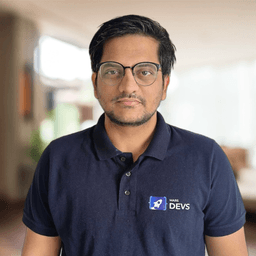
Co-Founder, MarsDevs
Vishvajit started MarsDevs in 2019 to help founders turn ideas into production-grade software. With deep expertise in AI, cloud architecture, and product engineering, he has led the delivery of 80+ software products for clients in 12+ countries.
Get more guides like this
Join founders, CTOs, and engineering leaders who receive our engineering insights weekly. No spam, just actionable technical content.
Partner with our team to design, build, and scale your next product.
Let’s Talk