TL;DR
$8K-$180K actual costs from 5 anonymized SaaS builds: B2B analytics, fintech MVP, healthcare, marketplace, internal-ops. Team sizes, 8-16 week timelines, what went wrong.
By Vishvajit Pathak, Co-Founder, MarsDevs. Published April 19, 2026.
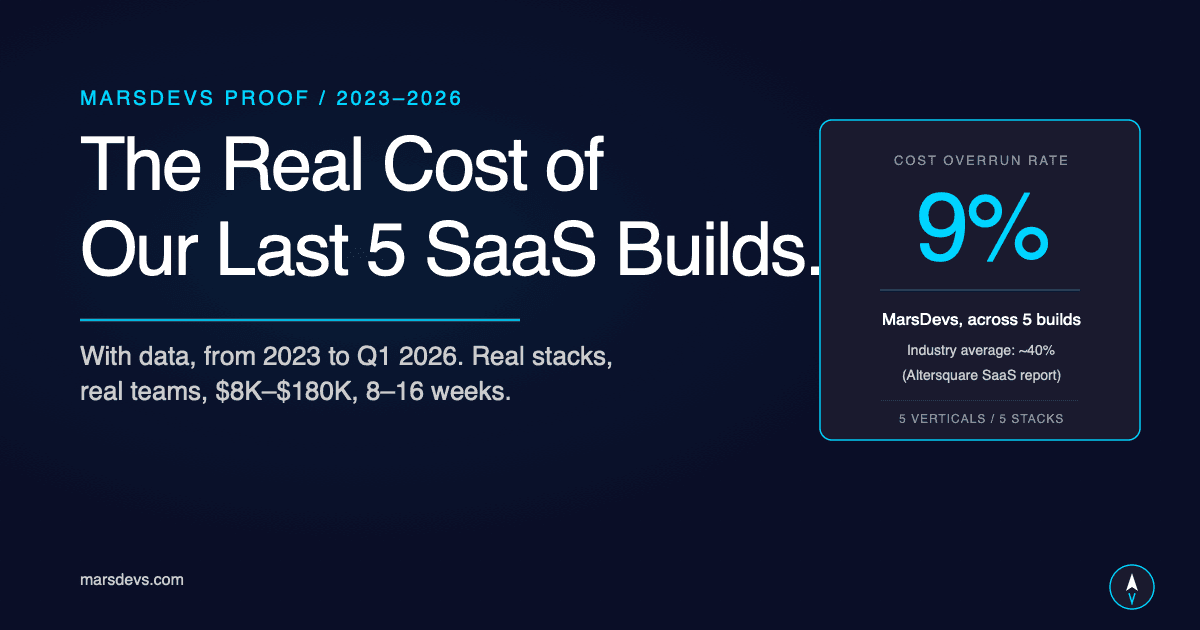
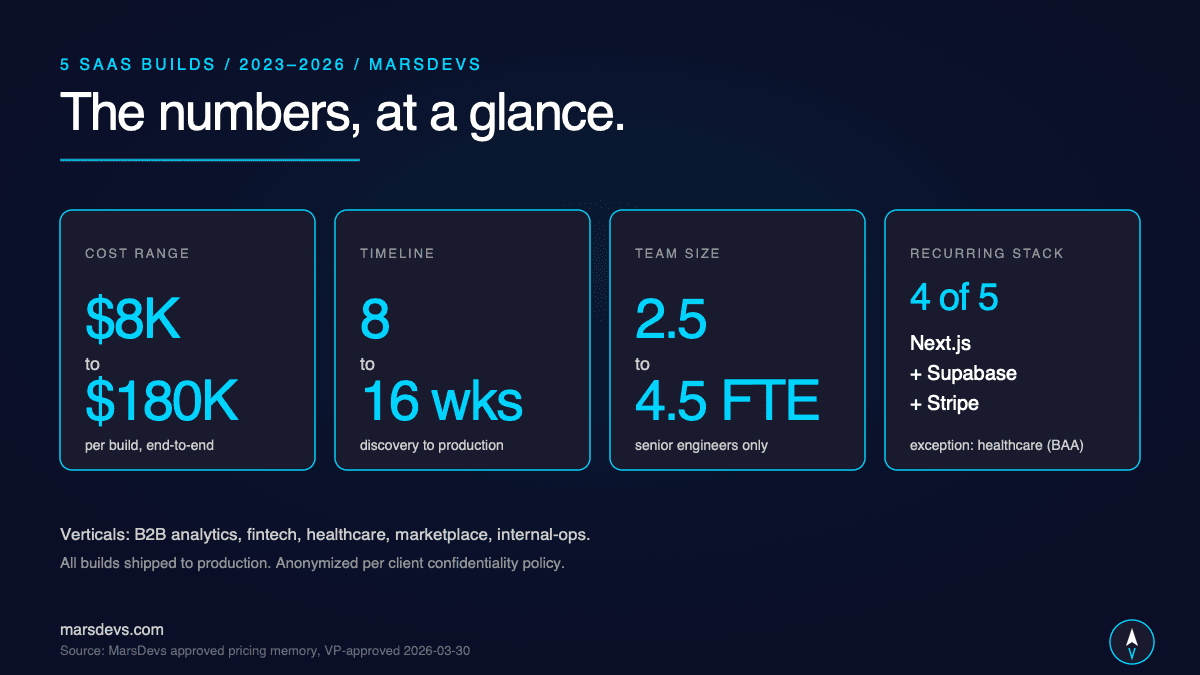
TL;DR: We shipped 5 SaaS builds between 2023 and Q1 2026 across B2B analytics, fintech, healthcare, marketplace, and internal-ops. Total cost per build ranged from $8,000 to $180,000, timelines ran 8 to 16 weeks, and the stack that recurred on 4 of 5 was Next.js plus Supabase plus Stripe. The biggest single driver of variance was HIPAA compliance, not feature count. Full cost data, team sizes, and post-mortems below.
You just got your third agency quote back for the same SaaS MVP. One said $25K. One said $95K. One said $180K. The features on the RFP were identical. Which number is real?
Here's the thing: every generic cost guide ranking on Google for "real cost of SaaS development" cites ranges from imaginary portfolios. Nobody names projects. Nobody admits which ones went over budget.
We're doing the opposite. Below are five MarsDevs SaaS builds, anonymized to protect clients but with real stack choices, real team sizes, real timelines, and real cost ranges from our 2026 pricing bands. Two of the five overran. One came in under. All five shipped to production and still run.
If you're writing a budget slide for your seed raise or stress-testing three competing quotes, pick the archetype closest to yours and steal the numbers.
The short answer: five SaaS builds we shipped to production between Q1 2023 and Q1 2026, each in a different vertical, each anonymized for confidentiality. No staff-augmentation contracts. No maintenance-only engagements. No pre-2023 legacy projects where the stack no longer reflects how we build in 2026.
We filter this way because a "portfolio" of 200 projects means nothing if 140 of them were 2-week bug-fix contracts. What founders actually want is the shape of a real ground-up build: the team, the weeks, the dollars, and the thing that went sideways.
Every number below is a range from our 2026 pricing bands, not a point estimate. Every client descriptor ("YC-backed", "Series A", "scale-up") is the narrowest label we can use without burning a confidentiality agreement. If the archetype feels generic, that's the anonymization working. The stack, scope, and surprises are all real.
MarsDevs is a product engineering company that ships AI-powered applications, SaaS platforms, and MVPs for startup founders. We have shipped 80+ products across 12 countries since 2019. The five builds below are a representative cross-section of our 2023–2026 SaaS work, not a highlight reel.
The headline: a multi-tenant B2B analytics dashboard with data ingestion pipelines, role-based access, and usage-based billing. Shipped in 14 weeks on a team of 3.5 FTE for a cost range of $30,000 to $50,000, placing it at the upper end of our SaaS platform band.
The architecture was standard for a B2B analytics SaaS. A Next.js frontend on Vercel, a PostgreSQL primary on Supabase with read replicas added in month 3, ingestion workers running on AWS ECS, Stripe Billing for the usage-based tier, PostHog for product analytics. Nothing exotic. That's the point. Most Series A SaaS platforms don't need exotic.
What we'd still do the same: Supabase as the Postgres layer. The managed-Postgres layer saved us roughly 2 weeks of infra setup versus self-managed RDS, and the row-level security model made multi-tenancy safer than a hand-rolled one. Supabase's Pro tier at $25/month covered this product until month 4 post-launch.
The headline: an embedded-payments onboarding and transaction product on Stripe Connect with Persona for KYC. Shipped in 9 weeks on a team of 3.25 FTE for a cost range of $20,000 to $30,000, landing in the upper end of our Standard MVP band.
Stripe Connect heavy builds have a specific cost signature. The Stripe integration itself is not expensive (Stripe's docs and webhooks are excellent). The expensive parts are the webhook idempotency layer, the audit log, and the KYC edge cases. All three are work you can't skip if you want to pass your first SOC 2 readiness check, and all three are the first things agencies silently cut from a $15K quote.
For founders pricing a fintech MVP, the real 2026 range is not $15K. Our full fintech app development cost breakdown has the feature-level detail. Short version: Stripe Connect plus KYC plus compliance webhooks will not ship for less than the high end of our Standard MVP band, or the low end of the SaaS platform band once you add a second currency.
The headline: a HIPAA-compliant analytics platform for a telehealth provider network. Shipped in 16 weeks on a team of 4.5 FTE for a cost range of $60,000 to $180,000, in our complex/enterprise band. This was the most expensive of the five and the one that overran the initial quote.
Healthcare SaaS carries a compliance premium of roughly 30–50% over a functionally equivalent B2B SaaS. That's not a MarsDevs markup. That's the industry reality of BAA-governed infrastructure, HIPAA-compliant auth providers, and audit-logging rigor. Clerk's HIPAA-compliant tier alone runs an order of magnitude above their standard pricing. AWS RDS with the BAA tier costs more than Supabase. Neither cost is avoidable.
One honest admission: Project 3 is the build where our scope discipline broke down. The audit-logging scope creep was not the client's fault. Their compliance officer raised the requirement as soon as they were looped in. The failure was ours, for not looping them in during week 1. The Altersquare industry report on SaaS project cost overruns puts the industry average overrun at around 40%. We came in under that, but only just. For a build in our complex/enterprise band, our cost to build a SaaS in 2026 pillar has the full cost-to-timeline mapping.
The headline: a two-sided B2B marketplace with matching logic, Stripe Connect payouts, in-app messaging, and a review system. Shipped in 11 weeks on a team of 3.75 FTE for a cost range of $35,000 to $50,000, at the top of our SaaS platform band.
Marketplace SaaS is typically the highest-complexity common SaaS archetype. Not because any single feature is hard, but because there are more of them. Provider side, requester side, payouts, messaging, reviews, admin. Six interconnected surfaces where B2B analytics has two. The cost discipline on this one came from aggressive scope cuts up front and a pre-built admin panel template we now reuse across marketplace builds.
For founders weighing a marketplace build, our MVP development cost breakdown breaks out the additional 20–30% cost premium marketplace complexity adds over a standard B2B SaaS MVP.
The headline: an internal operations tool for a logistics scale-up's back-office team. Workflow automation plus admin panels plus three third-party API integrations. Shipped in 8 weeks on a team of 2.5 FTE for a cost range of $8,000 to $20,000, squarely in our Lean MVP band. This was the fastest and cheapest of the five.
Internal-ops SaaS is the archetype where agencies overcharge the most. The pattern is common. A client asks for an internal dashboard. An agency quotes $40K for a full custom React build when Retool plus a thin layer of custom code would have shipped the same thing for $12K in 6 weeks. We now default to Retool or a similar platform for 60–80% of internal-ops surfaces. Our CI/CD for startups guide covers the deploy-pipeline defaults we layer on top for internal tools.
Across the 5 builds, timelines ran 8 to 16 weeks, team sizes ran 2.5 to 4.5 FTE, and costs ran $8,000 to $180,000. The median was a 3.5-FTE team shipping in 11 weeks for a cost range landing in our SaaS platform band ($10K–$50K). Here's the full pattern.
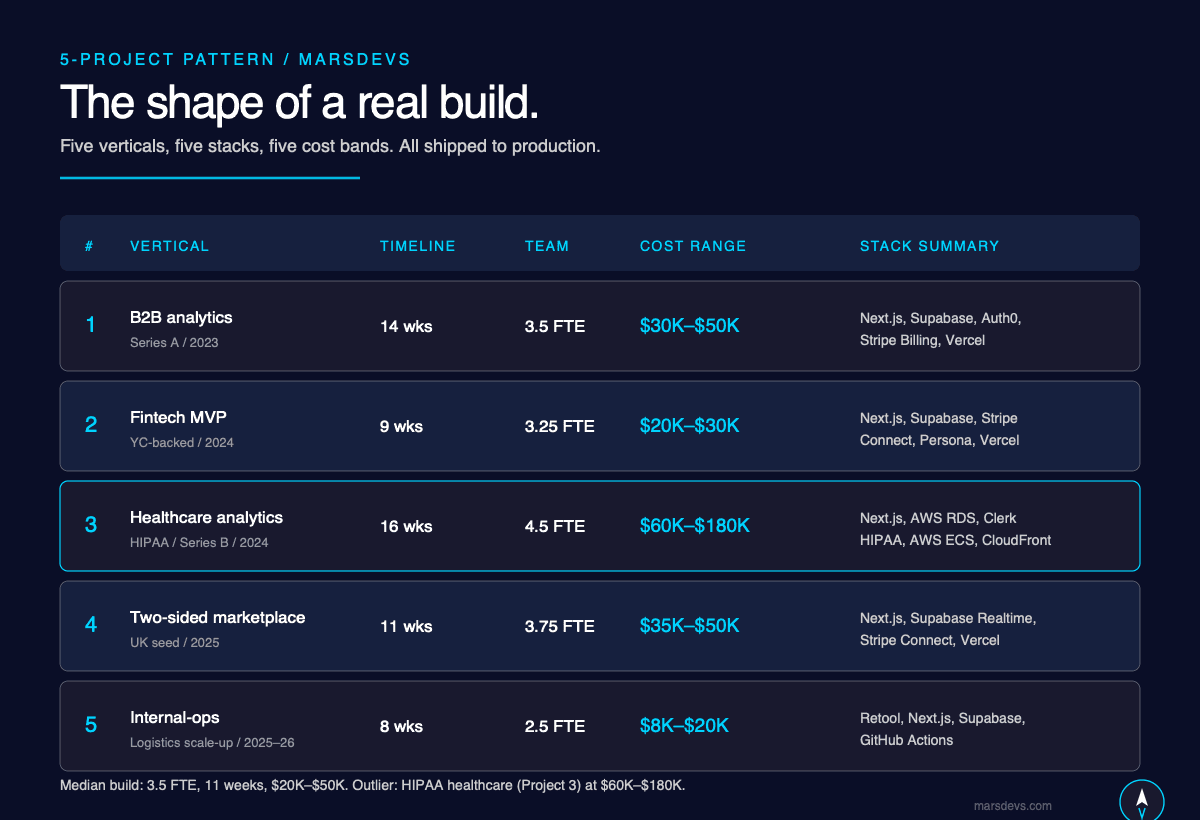
| Project | Vertical | Timeline | Team size | Cost range | Stack summary |
|---|---|---|---|---|---|
| 1 | B2B analytics SaaS | 14 weeks | 3.5 FTE | $30,000–$50,000 | Next.js, Supabase, Auth0, Stripe Billing, Vercel |
| 2 | Fintech MVP | 9 weeks | 3.25 FTE | $20,000–$30,000 | Next.js, Supabase, Stripe Connect, Persona, Vercel |
| 3 | Healthcare analytics | 16 weeks | 4.5 FTE | $60,000–$180,000 | Next.js, AWS RDS, Clerk HIPAA, AWS ECS, CloudFront |
| 4 | Two-sided marketplace | 11 weeks | 3.75 FTE | $35,000–$50,000 | Next.js, Supabase (Realtime), Stripe Connect, Vercel |
| 5 | Internal-ops SaaS | 8 weeks | 2.5 FTE | $8,000–$20,000 | Retool, Next.js, Supabase, GitHub Actions |
So how does this compare to the rest of the market? The ssntpl 200-project SaaS MVP cost report puts the typical SaaS MVP build at $40K–$150K in 2026. 7sisterstech's 2026 regional survey puts the US-built equivalent at $120K–$350K. Our range runs lower because our hourly blended rate is lower ($15–$25/hr versus the $50–$180/hr US blended median), not because we're cutting scope. Same engineer, same stack, same quality bar, shipping for less because we're based in Pune, not San Francisco.
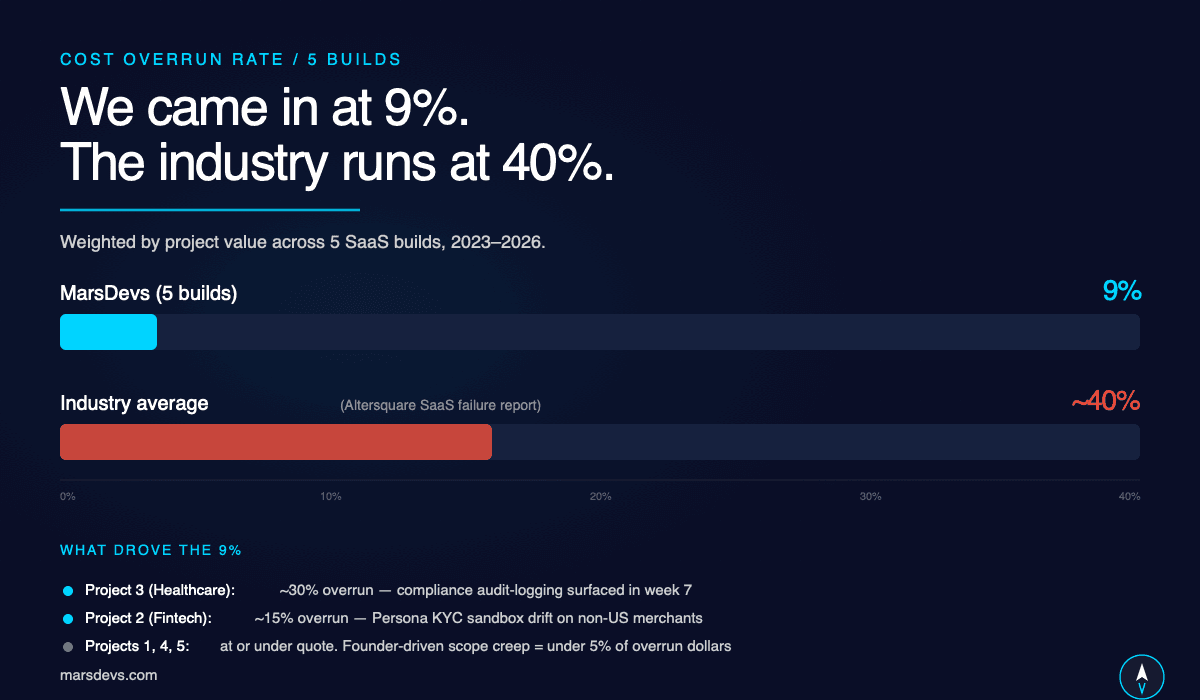
Two of the 5 builds overran their initial quotes. Project 3 (healthcare) overran by roughly 30% because the client's compliance team raised audit-logging requirements in week 7, after scope lock. Project 2 (fintech) overran by roughly 15% because Persona's KYC sandbox didn't match production for international applicants, and we burned 1.5 weeks on edge cases. Projects 1, 4, and 5 came in at or under quote.
That puts our scope-creep rate for these 5 builds at roughly 9% weighted by project value. The Altersquare data on why SaaS projects fail reports an industry average of around 40% cost overrun across SaaS builds. We came in meaningfully under the industry average, but the category of failure is the same: late-breaking requirements the initial scope didn't capture.
Honest summary of what drove overruns in our data:
Supabase over self-managed Postgres, Next.js over a split React plus Node backend, and Stripe Billing over a custom subscription engine. Those three decisions saved us roughly 3 to 5 weeks of build time per project across 4 of the 5 builds, and they scaled cleanly into production every time.
Supabase over self-managed Postgres. On Project 1, Project 2, Project 4, and Project 5, we ran on Supabase's managed Postgres. Row-level security covered multi-tenancy. Auth covered the login layer on 3 of those 4. Realtime covered messaging on Project 4. The Supabase Pro tier at $25/month carried the first 100K MAU on every one of these builds. Self-managed RDS would have added 1–2 weeks of infra setup and roughly $200/month in managed-DB overhead per project.
Next.js over a split React plus Node backend. A single Next.js codebase with API routes replaces the old split of a React SPA plus an Express backend. One deploy pipeline instead of two, one CI config instead of two, one language across frontend and backend, and server components and actions that make data-fetching cheaper. We estimate it saves 1 to 1.5 weeks per SaaS build versus a split stack, plus ongoing maintenance savings.
Stripe Billing over a custom subscription engine. Every founder who has ever built a subscription system in-house learns the same lesson. Pro-rating, plan changes, failed-payment retry logic, coupons, trials, metered billing, invoice generation, tax calculation. Each one is a 2-week project, and there are eight of them. Stripe Billing and Stripe Connect cover the 95% case for $0 additional engineering. The only build where we skipped Stripe Billing was Project 5 (internal ops, no billing surface). Every other build shipped faster because of it.
We would drop Auth0 for Supabase Auth on Project 1, and we would go Retool-first on the admin surface of Project 4, not just Project 5. Those two reversals would have saved roughly 1.5 weeks of build time and about $400 to $600 per month in ongoing costs between them.
On Project 1, Auth0 was a sensible choice in 2023 when Supabase Auth was less mature. In 2026 it's no longer sensible for a multi-tenant B2B SaaS under 100K MAU. Supabase Auth covers 90% of Auth0's feature set for the archetype, integrates with the row-level security already powering the tenant model, and doesn't cross a per-MAU price wall at 2,400 users. Rebuild Project 1 in 2026, and Supabase Auth is the default.
On Project 4, we built the admin moderation panel as custom React. In 2026, we'd build that admin surface in Retool, exactly like Project 5. The moderation panel had ~6 screens (user search, flag queue, review approval, payout override, dispute stub, audit log), and all 6 fit Retool's component model cleanly. Custom React bought us nothing. It cost the client roughly 8 days of build time we could have saved.
Five things reliably break founder budgets after a SaaS MVP ships: post-launch maintenance at 15–25% of build cost per year, infrastructure scaling once you cross 10K MAU, the observability stack (Sentry plus PostHog plus logging), customer support tooling (Intercom, Crisp, or equivalent), and design iteration over the first 6 months. Together, these add 30–40% on top of the initial build cost in year one.
The wearefounders.uk analysis of real SaaS launch costs puts year-one post-launch spend at roughly 40% above initial build cost. Our internal data runs closer to 30% for builds where we planned these five categories into the initial quote, and closer to 50% where we didn't. The gap is whether you budgeted for it. For a full build-cost framework, our pillar on cost to build a SaaS in 2026 walks the line-item detail.
US-based senior engineering agencies charge $50 to $180 per hour blended. European agencies (particularly UK, Germany, Netherlands) charge $35 to $90 per hour. MarsDevs charges $15 to $25 per hour. At the same team size and scope, that's a 3-to-6x cost differential on identical work. Our timelines match or beat US agencies because of time-zone parallelization and aggressive scope discipline, not because we work cheaper staff harder.
The regional picture from the 7sisterstech 2026 rate survey:
| Region | Blended senior rate | Typical SaaS MVP cost | Typical timeline |
|---|---|---|---|
| US (SF/NY) | $120–$180/hr | $120,000–$350,000 | 12–20 weeks |
| US (mid-market) | $70–$120/hr | $80,000–$200,000 | 12–18 weeks |
| Western Europe | $60–$90/hr | $90,000–$250,000 | 14–20 weeks |
| Eastern Europe | $35–$60/hr | $50,000–$150,000 | 10–16 weeks |
| India (top-tier) | $15–$25/hr | $15,000–$60,000 | 8–16 weeks |
Founders ask about the quality trade-off more than any other question, and the honest answer is: it depends on the agency, not the region. Junior engineers in any region ship low-quality code. Senior engineers in any region ship production-quality code. The difference between MarsDevs and the cheapest offshore vendors is that we only staff senior engineers on delivery. That's the core of our MVP-Lab engagement model, and it's why our overrun rate sits at 9% against the industry's 40%.
Three specific process changes after these 5 builds: a compulsory 1-week discovery sprint on every engagement, a compliance-workshop requirement on any healthcare or fintech project, and a default analytics and observability stack baked into our project template so no team has to re-decide it on every quote.
For more on how we scope fast without cutting corners, our guide on how to build an MVP walks the framework we use on every engagement.
Our last 5 SaaS builds ranged from $8,000 to $180,000, with timelines from 8 to 16 weeks. The median build cost range was $20,000 to $30,000, landing in our Standard MVP pricing band. The $180,000 upper outlier was a HIPAA-compliant healthcare platform that required BAA-governed infrastructure and a full compliance audit trail.
A real SaaS MVP in 2026 costs $20,000 to $50,000 offshore and $80,000 to $200,000 in the US, for a typical scope of auth, dashboards, billing, and 2–3 core workflows. Our median build across 5 projects landed in our $20,000 to $30,000 Standard MVP band. Anything under $15,000 is either missing scope or being quoted below sustainable senior-engineer rates.
The two largest drivers in our data are compliance requirements surfacing after scope lock (100% of our overrun dollars on these 5 builds) and third-party vendor sandbox-versus-production drift (especially KYC and payment vendors). Founder-driven feature creep accounted for under 5% of overrun dollars. The industry average overrun is roughly 40%; ours was 9% across these 5 builds.
Three of 5 projects came in at or under the initial quote. Two overran: Project 3 by roughly 30% (healthcare compliance scope creep) and Project 2 by roughly 15% (KYC vendor rework). Weighted by project value, our overrun rate across the 5 was about 9%, versus the 40% industry average.
Next.js plus Supabase plus Stripe was the most cost-effective stack, used on 4 of the 5 builds. It saved roughly 3 to 5 weeks per project versus a split React plus Node backend with self-managed Postgres. The exception was Project 3 (healthcare), where HIPAA required AWS RDS with a BAA instead of Supabase.
Two specific reversals: drop Auth0 for Supabase Auth on Project 1, and go Retool-first on the admin surface of Project 4 the way we did on Project 5. Those two would have saved about 1.5 weeks of build time and $400–$600 per month in ongoing costs. Process-wise, we'd run a compulsory 1-week discovery sprint with a compliance officer on the 2 builds that overran.
Offshore senior engineering at $15–$25/hr is 3-to-6x cheaper than US blended rates ($70–$180/hr) for identical scope. The quality trade-off is a function of seniority, not region. MarsDevs staffs only senior engineers on delivery, which keeps our overrun rate at 9% versus the industry's 40%. The real offshore risk is agencies that staff juniors on delivery, not the region itself.
Budget 15–25% of initial build cost per year for maintenance, plus 30–40% on top of build cost for year-one total (maintenance, infrastructure scaling, observability, support tooling, design iteration combined). On a $40,000 build, that's $52,000–$56,000 in year-one total spend. This is the number most founders miss in their seed-stage budget slide.
We covered 5 real builds, 5 stacks, 5 cost ranges, 2 overruns, and the 3 tech choices that saved cost every time. If you're writing a budget slide for your raise or comparing 3 agency quotes, the archetype closest to yours has a defensible number above.
If you want a real quote for your build instead of a template, book a free 30-minute scoping call. We'll map your SaaS archetype to the closest project above, give you a range backed by our actual project data, and flag the compliance and vendor risks we'd spike first. We take on 4 SaaS projects per month. Claim a slot at our MVP-Lab engagement or talk to our engineering team directly.
{
  "@context": "https://schema.org",
  "@type": "Article",
  "headline": "The Real Cost of Our Last 5 SaaS Builds (With Data, 2023–2026)",
  "description": "Five anonymized MarsDevs SaaS builds from 2023 to Q1 2026 with real cost ranges ($8K–$180K), timelines (8–16 weeks), stacks, team sizes, and post-mortems on the two that overran.",
  "mainEntityOfPage": "https://www.marsdevs.com/blog/real-cost-of-our-last-5-saas-builds",
  "url": "https://www.marsdevs.com/blog/real-cost-of-our-last-5-saas-builds",
  "datePublished": "2026-04-19T09:00:00+05:30",
  "dateModified": "2026-04-19T09:00:00+05:30",
  "inLanguage": "en",
  "author": {
    "@type": "Person",
    "name": "Vishvajit Pathak",
    "jobTitle": "Co-Founder, MarsDevs",
    "url": "https://www.marsdevs.com/about",
    "sameAs": [
      "https://www.linkedin.com/in/vishvajitpathak",
      "https://twitter.com/vishvajitpathak"
    ],
    "worksFor": {
      "@type": "Organization",
      "name": "MarsDevs",
      "url": "https://www.marsdevs.com"
    }
  },
  "publisher": {
    "@type": "Organization",
    "name": "MarsDevs",
    "url": "https://www.marsdevs.com",
    "logo": {
      "@type": "ImageObject",
      "url": "https://www.marsdevs.com/logo.png"
    }
  },
  "about": [
    {"@type": "Thing", "name": "SaaS development cost"},
    {"@type": "Thing", "name": "SaaS MVP cost breakdown"},
    {"@type": "SoftwareApplication", "name": "Next.js"},
    {"@type": "SoftwareApplication", "name": "Supabase"},
    {"@type": "SoftwareApplication", "name": "Stripe"},
    {"@type": "SoftwareApplication", "name": "Retool"}
  ],
  "keywords": "real cost of SaaS development, SaaS MVP cost breakdown, SaaS build case study, offshore SaaS development real cost, cost overruns SaaS development"
}
{
  "@context": "https://schema.org",
  "@type": "Person",
  "name": "Vishvajit Pathak",
  "jobTitle": "Co-Founder",
  "url": "https://www.marsdevs.com/about",
  "image": "https://www.marsdevs.com/team/vishvajit-pathak.jpg",
  "sameAs": [
    "https://www.linkedin.com/in/vishvajitpathak",
    "https://twitter.com/vishvajitpathak"
  ],
  "worksFor": {
    "@type": "Organization",
    "name": "MarsDevs",
    "url": "https://www.marsdevs.com",
    "foundingDate": "2019",
    "address": {
      "@type": "PostalAddress",
      "addressLocality": "Pune",
      "addressCountry": "IN"
    }
  },
  "knowsAbout": [
    "SaaS development",
    "MVP development",
    "Fintech engineering",
    "HIPAA-compliant SaaS",
    "Stripe Connect integration",
    "Next.js",
    "Supabase"
  ]
}
{
  "@context": "https://schema.org",
  "@type": "FAQPage",
  "mainEntity": [
    {
      "@type": "Question",
      "name": "How much did your last 5 SaaS builds actually cost?",
      "acceptedAnswer": {
        "@type": "Answer",
        "text": "Our last 5 SaaS builds ranged from $8,000 to $180,000, with timelines from 8 to 16 weeks. The median build cost range was $20,000 to $30,000, landing in our Standard MVP pricing band. The $180,000 upper outlier was a HIPAA-compliant healthcare platform."
      }
    },
    {
      "@type": "Question",
      "name": "What is the average cost of a real SaaS MVP in 2026?",
      "acceptedAnswer": {
        "@type": "Answer",
        "text": "A real SaaS MVP in 2026 costs $20,000 to $50,000 offshore and $80,000 to $200,000 in the US, for a typical scope of auth, dashboards, billing, and 2–3 core workflows. Anything under $15,000 is either missing scope or quoted below sustainable senior-engineer rates."
      }
    },
    {
      "@type": "Question",
      "name": "What causes SaaS projects to go over budget most often?",
      "acceptedAnswer": {
        "@type": "Answer",
        "text": "The two largest drivers are compliance requirements surfacing after scope lock (100% of our overrun dollars on these 5 builds) and third-party vendor sandbox-versus-production drift (KYC and payment vendors). Founder-driven feature creep accounted for under 5% of overrun dollars."
      }
    },
    {
      "@type": "Question",
      "name": "How accurate were your initial cost estimates across these 5 projects?",
      "acceptedAnswer": {
        "@type": "Answer",
        "text": "Three of 5 projects came in at or under the initial quote. Two overran: the healthcare build by roughly 30% (compliance scope creep) and the fintech build by roughly 15% (KYC vendor rework). Weighted by project value, our overrun rate across the 5 was about 9%, versus the 40% industry average."
      }
    },
    {
      "@type": "Question",
      "name": "Which tech stack was most cost-effective across the 5 builds?",
      "acceptedAnswer": {
        "@type": "Answer",
        "text": "Next.js plus Supabase plus Stripe was the most cost-effective stack, used on 4 of the 5 builds. It saved roughly 3 to 5 weeks per project versus a split React plus Node backend with self-managed Postgres. The exception was the healthcare build, where HIPAA required AWS RDS."
      }
    },
    {
      "@type": "Question",
      "name": "What would you do differently on these 5 builds today?",
      "acceptedAnswer": {
        "@type": "Answer",
        "text": "Two reversals: drop Auth0 for Supabase Auth on the B2B analytics build, and go Retool-first on the admin surface of the marketplace build. Those would have saved 1.5 weeks of build time and $400–$600 per month in ongoing costs."
      }
    },
    {
      "@type": "Question",
      "name": "Is it cheaper to build SaaS offshore, and what's the real quality trade-off?",
      "acceptedAnswer": {
        "@type": "Answer",
        "text": "Offshore senior engineering at $15–$25/hr is 3-to-6x cheaper than US blended rates ($70–$180/hr) for identical scope. Quality is a function of seniority, not region. MarsDevs staffs only senior engineers on delivery, keeping our overrun rate at 9% versus the industry's 40%."
      }
    },
    {
      "@type": "Question",
      "name": "How much should a founder budget for year-1 maintenance after a SaaS MVP ships?",
      "acceptedAnswer": {
        "@type": "Answer",
        "text": "Budget 15–25% of initial build cost per year for maintenance, plus 30–40% on top of build cost for year-one total (maintenance, infrastructure, observability, support, design). On a $40,000 build, that's $52,000–$56,000 in year-one total spend."
      }
    }
  ]
}
{
  "@context": "https://schema.org",
  "@type": "ItemList",
  "name": "MarsDevs SaaS Build Archetypes 2023–2026",
  "description": "Five anonymized MarsDevs SaaS builds shipped to production between Q1 2023 and Q1 2026, each in a different vertical, with real cost ranges, team sizes, timelines, and stack choices.",
  "numberOfItems": 5,
  "itemListOrder": "https://schema.org/ItemListOrderAscending",
  "itemListElement": [
    {
      "@type": "ListItem",
      "position": 1,
      "item": {
        "@type": "CreativeWork",
        "name": "B2B analytics SaaS for a Series A marketing platform",
        "description": "Multi-tenant B2B analytics dashboard with data ingestion pipelines, role-based access, and usage-based billing. Shipped in 14 weeks on a team of 3.5 FTE for $30,000–$50,000. Stack: Next.js 14, Supabase, Auth0, Stripe Billing, Vercel.",
        "dateCreated": "2023",
        "genre": "B2B analytics SaaS"
      }
    },
    {
      "@type": "ListItem",
      "position": 2,
      "item": {
        "@type": "CreativeWork",
        "name": "Fintech MVP for a YC-backed embedded-payments startup",
        "description": "Embedded-payments onboarding and transaction product on Stripe Connect with Persona KYC. Shipped in 9 weeks on a team of 3.25 FTE for $20,000–$30,000. Stack: Next.js 14, Supabase, Stripe Connect, Persona, Vercel.",
        "dateCreated": "2024",
        "genre": "Fintech MVP"
      }
    },
    {
      "@type": "ListItem",
      "position": 3,
      "item": {
        "@type": "CreativeWork",
        "name": "Healthcare analytics SaaS for a telehealth scale-up",
        "description": "HIPAA-compliant analytics platform for a telehealth provider network. Shipped in 16 weeks on a team of 4.5 FTE for $60,000–$180,000. Stack: Next.js 14, AWS RDS, Clerk HIPAA, AWS ECS, CloudFront.",
        "dateCreated": "2024",
        "genre": "Healthcare analytics SaaS"
      }
    },
    {
      "@type": "ListItem",
      "position": 4,
      "item": {
        "@type": "CreativeWork",
        "name": "Two-sided marketplace SaaS for a B2B services vertical",
        "description": "Two-sided B2B marketplace with matching logic, Stripe Connect payouts, in-app messaging, review system. Shipped in 11 weeks on a team of 3.75 FTE for $35,000–$50,000. Stack: Next.js 15, Supabase (Realtime), Stripe Connect, Vercel.",
        "dateCreated": "2025",
        "genre": "Two-sided marketplace SaaS"
      }
    },
    {
      "@type": "ListItem",
      "position": 5,
      "item": {
        "@type": "CreativeWork",
        "name": "Internal-ops SaaS for a logistics scale-up",
        "description": "Internal operations tool with workflow automation, admin panels, and three third-party API integrations. Shipped in 8 weeks on a team of 2.5 FTE for $8,000–$20,000. Stack: Retool, Next.js 14, Supabase, GitHub Actions.",
        "dateCreated": "2025-2026",
        "genre": "Internal-ops SaaS"
      }
    }
  ]
}
{
  "@context": "https://schema.org",
  "@type": "BreadcrumbList",
  "itemListElement": [
    {
      "@type": "ListItem",
      "position": 1,
      "name": "Home",
      "item": "https://www.marsdevs.com"
    },
    {
      "@type": "ListItem",
      "position": 2,
      "name": "Blog",
      "item": "https://www.marsdevs.com/blog"
    },
    {
      "@type": "ListItem",
      "position": 3,
      "name": "The Real Cost of Our Last 5 SaaS Builds",
      "item": "https://www.marsdevs.com/blog/real-cost-of-our-last-5-saas-builds"
    }
  ]
}

Co-Founder, MarsDevs
Vishvajit started MarsDevs in 2019 to help founders turn ideas into production-grade software. With deep expertise in AI, cloud architecture, and product engineering, he has led the delivery of 80+ software products for clients in 12+ countries.
Get more insights like this
Join founders, CTOs, and engineering leaders who receive our engineering insights weekly. No spam, just actionable technical content.


