TL;DR
A minimum viable product (MVP) is the smallest version of your product that delivers enough value to attract early users and validate your core assumption. To build one in 2026: validate your problem first, scope to one workflow, pick a speed-optimized tech stack (Next.js + Supabase is the default), and ship in 6 to 8 weeks. AI tools compress timelines by 40% to 60%, but the last 20% still needs real engineering.

You have a startup idea, $200K in seed funding, and 12 months of runway. Your investors expect a working product and early traction before the next round. Hiring a full engineering team will burn half that runway before you write a single line of code.
That is exactly the scenario an MVP solves.
A minimum viable product (MVP) is the smallest version of your product that delivers enough value to attract early users, validate your core assumption, and generate real feedback. Not a prototype. Not a proof of concept. A live product that real people use, pay for, or at least repeatedly return to. The term was popularized by Eric Ries as part of the lean startup method, a methodology that emphasizes building the smallest thing, measuring how users respond, learning from the data, and iterating. The framework is over a decade old. What's changed is the speed at which you can execute it.
In 2026, AI-assisted development tools have compressed MVP timelines by 40% to 60% for teams that know how to use them. Founders ship functional products in 30 days that would have taken 6 months in 2022. But speed creates its own risks. The startups seeing the best results pair AI tooling with experienced engineering teams, not replace one with the other.
Here's the thing: 42% of startups still fail because they build something nobody wants (CB Insights). Not because the code was bad. Not because the design was ugly. Because they skipped validation. That single discipline separates founders who ship from founders who burn through runway chasing a fantasy feature list.
MarsDevs is a product engineering company that builds AI-powered applications, SaaS platforms, and MVPs for startup founders. We've shipped 80+ products across 12 countries, and the pattern is consistent: founders who scope aggressively and ship fast win. Founders who try to build "the full vision" in v1 lose.
Every successful MVP follows the same core process. The tools change. The frameworks evolve. The fundamentals don't.
Most founders skip this step. They fall in love with their solution and start building immediately. That's how you burn $50K building something nobody asked for.
Before you write a line of code, answer three questions:
User validation at this stage costs nothing but time. Skipping it costs everything.
This is where discipline matters most. Your MVP should include exactly one core workflow that solves the validated problem. Not three. Not five. One.
Use the MoSCoW method for feature prioritization. The MoSCoW method is a prioritization technique that categorizes features into four buckets: Must Have, Should Have, Could Have, and Won't Have. It forces founders to separate essential features from nice-to-haves before writing any code.
| Priority | Definition | Example (Invoicing MVP) |
|---|---|---|
| Must Have | MVP fails without it | Create and send invoices |
| Should Have | Important, but workaround exists | Recurring invoice templates |
| Could Have | Nice to have, adds polish | Multi-currency support |
| Won't Have | Save for v2 or later | Full accounting integration |
The "Must Have" column is your MVP. Everything else is a distraction.
We've shipped 80+ products. The pattern is consistent: founders who scope to one workflow and ship in 3 to 8 weeks get to product-market fit faster than founders who build feature-rich products over 6 months. The reason is simple. A shipped MVP generates real user data. An unshipped product generates opinions.
Your tech stack should optimize for speed to market, not technical perfection. You can always refactor later. You can't un-burn 4 months of runway.
Here's the default MVP stack we recommend in 2026:
| Layer | Technology | Why |
|---|---|---|
| Frontend | Next.js (React) | Largest ecosystem, fastest hiring pool, AI tools generate React code best |
| Backend/Database | Supabase (PostgreSQL) | Auth, database, storage, and real-time in one platform. Row-level security built in |
| Deployment | Vercel | Zero-config deployment, preview URLs for every PR, edge functions |
| Payments | Stripe | Standard for SaaS billing, excellent docs, works everywhere |
| Auth | Supabase Auth or Clerk | Social login, magic links, MFA without building from scratch |
Next.js is a React-based web framework that supports server-side rendering and static generation, making it the default choice for web MVPs in 2026. Supabase is an open-source Firebase alternative built on PostgreSQL that provides authentication, database, storage, and real-time subscriptions in a single platform.
For mobile MVPs, React Native or Flutter give you iOS and Android from a single codebase. React Native uses JavaScript and React patterns, while Flutter uses Dart and offers pixel-perfect UI control. For internal tools, consider Retool or similar low-code platforms.
The point isn't that this exact stack is right for every project. The point is that deciding on a stack should take hours, not weeks. Pick proven tools, start building, and optimize later.
Break your MVP into 1 to 2 week agile sprints. An agile sprint is a fixed time period during which a development team works to complete a set amount of work, delivering a working increment of the product. Each sprint delivers working software, not just code that "almost works."
A typical 6 to 8 week MVP timeline:
Every sprint ends with a demo. Every demo gets feedback from at least one real potential user. If your development partner can't show you working software every two weeks, find a different partner.

Your MVP launch isn't a press event. It's a learning event.
Launch to a small group (50 to 200 users) and track these metrics from day one:
If activation is below 30%, your onboarding is broken. If day-7 retention is below 20%, your core value proposition isn't landing. Fix these before adding features. Features don't fix a broken value proposition.
The lean startup method exists for this exact reason: build, measure, learn, repeat. Your first version will be wrong. The goal is to be wrong quickly and cheaply so you can get to "right" before your runway runs out.
Want to ship your MVP before your runway runs out? Here's how we do it in 6 weeks.
The tech stack decision paralyzes founders. Hundreds of frameworks, dozens of hosting platforms, and a new "best tool" announcement every week. Here's how to cut through the noise.
1. Full-code stack (maximum control) Next.js + Supabase + Vercel. Best for: SaaS products, marketplaces, anything that needs custom logic and scale. Timeline: 3 to 8 weeks with an experienced team. This is the stack MarsDevs uses for most client MVPs because it scales from prototype to production without a rewrite.
2. Low-code/no-code stack (maximum speed) Bubble, FlutterFlow, or Webflow + Xano. Best for: validating an idea before investing in custom development. Timeline: 2 to 4 weeks. Limitation: you'll likely rebuild when you scale. Gartner forecasts that 75% of new applications will use low-code development by 2026, but most production SaaS products still run on custom code.
3. AI-generated stack (emerging) Lovable, Bolt.new, or V0 for initial generation, then Cursor or Claude Code for iteration. Best for: solo founders testing an idea over a weekend. Timeline: days to 2 weeks. Limitation: gets you 80% there; the last 20% (auth, payments, security, error handling) still needs engineering.
| Factor | Full-Code | Low-Code/No-Code | AI-Generated |
|---|---|---|---|
| Time to launch | 3-8 weeks | 2-4 weeks | 1-2 weeks |
| Cost | $5K-$30K | $2K-$10K | $0-$500 |
| Scalability | High | Low to medium | Low (needs rewrite) |
| Customization | Unlimited | Platform-limited | Unpredictable |
| Production-ready | Yes | Depends on platform | No (needs engineering) |
| Best for | Funded startups | Idea validation | Weekend prototypes |
So, which approach should you pick? If you have funding and a validated idea, go full-code from day one. If you're still figuring out product-market fit, start with no-code or AI-generated, prove demand, then invest in a proper build.
AI captured over 50% of all global venture capital funding in 2025, totaling more than $200 billion (Crunchbase). That money isn't going to research labs. It's going to startups building AI-powered products. If you're building an MVP in 2026, you need to understand the AI-first approach, whether you're building an AI product or using AI to build faster.
An AI-first MVP puts an AI capability at the core of its value proposition. Not "we added a chatbot." More like "our product automates invoice processing using Large Language Models (LLMs) and OCR, replacing 4 hours of manual work per day."
Examples of AI-first MVP categories gaining traction in 2026:
Building an AI-first MVP requires additional components beyond a standard web stack:
| Component | Tool Options | Purpose |
|---|---|---|
| LLM Provider | OpenAI, Anthropic, Google | Core reasoning and generation |
| Vector Database | Pinecone, Weaviate, pgvector (via Supabase) | Semantic search and RAG |
| Orchestration | LangChain, LlamaIndex, Vercel AI SDK | Chaining LLM calls with tools |
| Evaluation | LangSmith, Braintrust, custom evals | Measuring AI output quality |
| Guardrails | Guardrails AI, custom validation | Preventing hallucination and bad outputs |
Retrieval-Augmented Generation (RAG) is an AI architecture that feeds relevant data from a knowledge base into an LLM at query time, producing accurate, grounded responses instead of hallucinated outputs. Most AI-first MVPs that work with proprietary data use some form of RAG. For a full breakdown, read our guide to RAG in AI.
The cost difference is real. A standard SaaS MVP runs $8K to $30K. An AI-powered MVP runs $5K to $30K because of model integration, evaluation infrastructure, and the iterative prompt engineering required to get reliable outputs. For a detailed breakdown, read our guide to AI development costs.
MarsDevs builds production AI agents and AI-powered MVPs for startup founders. We've deployed AI systems across fintech, e-commerce, and SaaS. The pattern is clear: teams that invest in evaluation and guardrails from day one ship better products than teams that "move fast and break things" with LLM calls.
We've shipped 80+ products. These mistakes show up repeatedly, across industries, geographies, and founding team compositions. Every one of them is avoidable.
The number one MVP killer. Founders confuse "minimum viable product" with "version 1 of the full product." An MVP isn't v1. It's a hypothesis test. If your MVP takes longer than 8 weeks, your scope is too big.
The fix: Write down your riskiest assumption. Build only enough to test that assumption. Ship.
Your friends saying "that's a great idea" isn't validation. Your mom downloading the app isn't validation. Validation is strangers using your product repeatedly, or paying for it, without you standing over their shoulder.
Talk to 20 to 30 potential users before you build. Then ship to 50 to 200 users and watch what they actually do (not what they say they'll do).
Founders who spend 3 weeks choosing between Kubernetes and serverless for an MVP that will have 50 users are solving the wrong problem. You don't need microservices. You don't need a data lake. You need a monolith that works.
The fix: Pick the simplest architecture that supports your core workflow. Optimize for developer speed, not theoretical scale.
If you can't measure it, you can't learn from it. Too many MVPs launch without basic analytics, leaving founders to guess whether the product is working.
Set up event tracking before launch. Track activation, retention, and task completion. Mixpanel, PostHog, or even simple custom events will do. The tool matters less than the habit of checking data weekly.
An MVP is disposable by design. Some of the code will be ugly. Some features will be manual behind the scenes. That's fine. The point is learning, not perfection.
The danger is the opposite extreme: founders who are embarrassed to show their MVP because it's "not ready." If you're not embarrassed by your first version, you launched too late. Reid Hoffman said it, and it remains true in 2026.
This is the newest and most dangerous mistake. AI tools like Lovable, Bolt.new, and Cursor can generate a functional prototype in hours. Founders see a working UI and assume they're 90% done. They're not.
The prototype-to-production gap is the engineering work required to take a rapid prototype from demo state to production-ready software. It includes: authentication and authorization, payment processing and billing, error handling and edge cases, security (SQL injection, XSS, CSRF), performance under real user load, monitoring and alerting, and data backup and recovery.
AI tools get you 80% there. The last 20% is the difference between a demo and a business. Bridging that gap requires engineering experience, and it's exactly where MarsDevs operates.
Your MVP worked. Users are engaged. Maybe you have paying customers. Now what?
The transition from MVP to production-grade product is where most startups stumble. The code that was "good enough" for 50 users breaks at 5,000. The shortcuts that saved time now create tech debt that slows every new feature.
Don't scale prematurely. Scale when you see these signals:
If you don't have at least two of these signals, keep iterating on the MVP. Adding features to a product that lacks product-market fit is like putting racing tires on a car driving in the wrong direction.
When you're ready to scale, here's what changes:
| Area | MVP State | Production State |
|---|---|---|
| Architecture | Monolith, single server | Load-balanced, horizontally scalable |
| Database | Single instance | Read replicas, connection pooling, backups |
| Auth | Basic email/password | SSO, MFA, role-based access, audit logs |
| Testing | Manual QA | Automated CI/CD, unit tests, integration tests |
| Monitoring | Console logs | APM, error tracking, uptime monitoring, alerting |
| Security | Basic HTTPS | Penetration testing, OWASP compliance, SOC 2 prep |
| Performance | "It works" | Sub-200ms response times, CDN, caching layers |
This transition typically takes 8 to 16 weeks with an experienced team. The biggest mistake founders make here is trying to do it incrementally alongside feature development. Dedicate a focused sprint (or several) to production hardening. Your users will thank you when the product stops crashing during peak usage.
Founded in 2019, MarsDevs has shipped 80+ products across 12 countries for startups and scale-ups. We specialize in taking MVPs from validation to production-grade, so founders don't have to rebuild from scratch or hire a full engineering department.
Founders always ask this first. Here are real numbers based on 2026 market rates.
| Tier | Scope | Cost Range | Timeline |
|---|---|---|---|
| No-code MVP | Landing page + core workflow on Bubble/FlutterFlow | $2,000 to $10,000 | 2-4 weeks |
| Standard MVP | Full-code web app, auth, payments, basic integrations | $8,000 to $30,000 | 3-8 weeks |
| AI-Powered MVP | LLM integration, vector search, evaluation pipeline | $5,000 to $30,000 | 3-12 weeks |
| Enterprise MVP | Compliance (HIPAA, SOC 2), multi-tenant, audit trails | $30,000 to $200,000 | 12-20 weeks |

MarsDevs provides senior engineering teams for founders who need to ship fast without compromising quality. We take on 4 new projects per month. Claim an engagement slot before they fill up.
A standard MVP takes 3 to 8 weeks with an experienced team. No-code MVPs can ship in 2 to 4 weeks. AI-powered MVPs take 3 to 12 weeks due to model integration and evaluation requirements. The biggest timeline risk isn't the code; it's scope creep. At MarsDevs, most MVPs ship in 3 to 8 weeks when we scope aggressively from day one.
MVP development costs range from $2,000 for a no-code validation to $200,000 for a compliance-heavy enterprise MVP. A standard full-code web app MVP costs $8,000 to $30,000. AI-powered MVPs cost $5,000 to $30,000. The primary cost drivers are feature scope, AI integration, compliance requirements, and team location. India-based teams like MarsDevs (headquartered in Pune) offer senior engineers at $15 to $25/hour.
Use no-code tools if you need to validate an idea quickly and cheaply before investing in custom development. Platforms like Bubble and FlutterFlow can deliver a functional MVP in 2 to 4 weeks for under $10,000. The trade-off is limited customization and scalability. If your concept is validated and you need to scale, plan to rebuild on a custom tech stack.
A prototype demonstrates how a product could work. An MVP demonstrates that a product does work, with real users. Prototypes are for internal feedback and investor demos. MVPs are for market validation with actual customers. Build prototypes to get buy-in. Build MVPs to get users.
Scale when you have evidence of product-market fit: 40%+ of surveyed users say they'd be "very disappointed" without your product, day-30 retention stabilizes, and users are paying or committing. Don't scale based on feature requests alone. If users aren't engaging with what you already built, more features won't fix that.
No. Many successful startups (Airbnb, Groupon, Zappos) launched their MVPs without deep technical expertise on the founding team. Your options in 2026: hire a product engineering partner (like MarsDevs), use no-code or AI-assisted tools for early validation, or bring on a technical co-founder. For AI-powered or complex SaaS products, working with an experienced engineering team is usually faster and more cost-effective than spending months recruiting a co-founder.
Only the features required to deliver the core value proposition to your target user. Start with one workflow, one user type, and one problem. A typical MVP includes: user authentication, the primary workflow (end-to-end), basic UI/UX (functional, not polished), payment processing (if revenue is part of validation), and analytics tracking. Everything else belongs in v2.
Launch to a small group of 50 to 200 target users. Track activation rate (do signups complete the core action?), retention (do they come back on day 7 and day 30?), and task completion (can they finish the primary workflow without help?). Supplement quantitative data with qualitative interviews. Ask five users per week: "What almost stopped you from using this?" Their answers reveal your biggest improvement opportunities faster than any A/B test.
The founders who win in 2026 aren't the ones with the best ideas. They're the ones who ship the fastest, learn from real users, and iterate before their runway runs out.
Your MVP isn't your product. It's your fastest path to product-market fit. Build the smallest thing that tests your riskiest assumption. Put it in front of real users. Watch what they do. Fix what's broken. Repeat.
AI tools have made the "build" part faster than ever. But speed without direction is just expensive waste. The discipline of scoping, validating, and measuring is what separates an MVP from a side project.
If you're planning an MVP build, start with scope. The tighter your scope, the faster you ship, and the sooner you learn whether your idea has legs.
Want to go from idea to launched MVP in 3 to 8 weeks? MarsDevs ships MVPs with senior engineers, not juniors learning on your project. You get 100% code ownership from day one. Book a free strategy call and we'll scope your MVP in a single session. We take on 4 new projects per month, so claim a slot before they fill up.
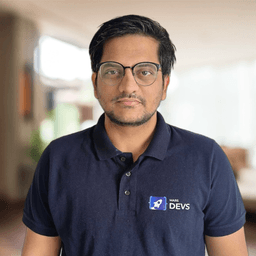
Co-Founder, MarsDevs
Vishvajit started MarsDevs in 2019 to help founders turn ideas into production-grade software. With deep expertise in AI, cloud architecture, and product engineering, he has led the delivery of 80+ software products for clients in 12+ countries.
Get more guides like this
Join founders, CTOs, and engineering leaders who receive our engineering insights weekly. No spam, just actionable technical content.
Partner with our team to design, build, and scale your next product.
Let’s Talk