TL;DR
Next.js 15 + Postgres 16 + Clerk + Stripe + Vercel: our default. One committed pick per layer, no 'it depends'. Infra $40-$60/mo at MVP scale. 80+ products shipped.
By Vishvajit Pathak, Co-Founder, MarsDevs. Published April 17, 2026. Updated April 19, 2026.
TL;DR: Our 2026 MVP stack is Next.js 15 (App Router) + Node.js 22 with Fastify 5 + Postgres 16 via Supabase + Drizzle ORM + Clerk + Stripe + Vercel + Railway + OpenAI and Anthropic APIs + PostHog + Sentry + Resend. For AI-heavy backends we swap Fastify for FastAPI on Python 3.12. MarsDevs has shipped 80+ products across 12 countries since 2019, and this is the exact stack we build new startup MVPs on every week. One pick per layer. No "it depends." Full rationale, archetypes, and costs below.
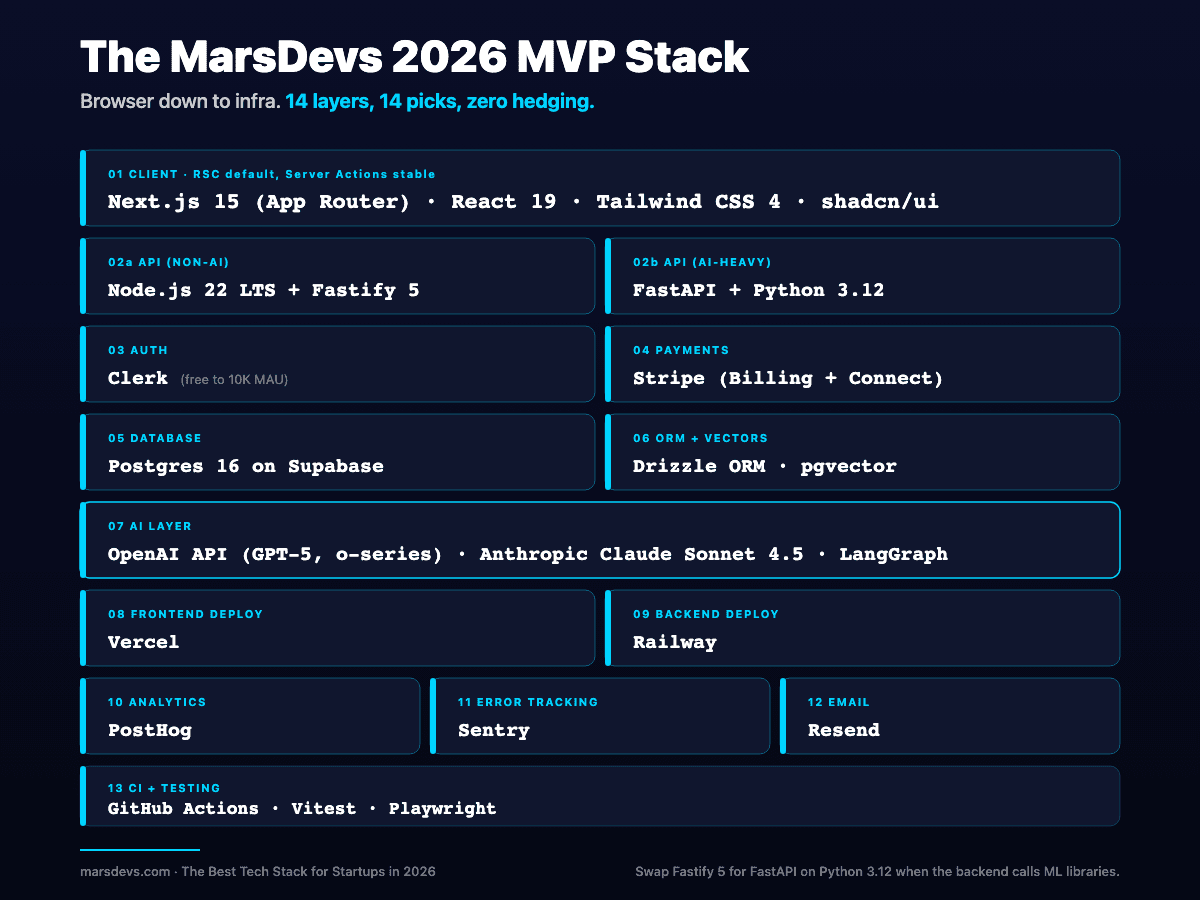
We build every new MVP on this stack unless there is a reason we cannot. Next.js 15 + Fastify 5 (or FastAPI) + Postgres 16 + Drizzle + Clerk + Stripe + Vercel + Railway + OpenAI + Anthropic + PostHog + Sentry + Resend + GitHub Actions. Fourteen layers, fourteen picks, zero hedging.
Most startup blog posts give you four options per layer and call that helpful. It is the opposite of helpful. A founder with 10 weeks of runway and no CTO cannot benchmark Remix against Next.js against Nuxt. They need the pick. Here is ours.
| Layer | Our Pick (2026) | Runner-up | Why we pick it |
|---|---|---|---|
| Frontend framework | Next.js 15 (App Router) | Remix | React Server Components plus Vercel deploy path cuts 2 days of DevOps per project |
| UI library | shadcn/ui + Tailwind CSS 4 | Radix + plain Tailwind | You own the components, no version lock |
| Backend (non-AI) | Node.js 22 LTS + Fastify 5 | NestJS 11 | TS monorepo, 2x perf over Express, no DI ceremony |
| Backend (AI-heavy) | FastAPI + Python 3.12 | Node + Langchain.js | The ML library ecosystem lives in Python |
| Database | Postgres 16 | MySQL 8 | Proven, pgvector built in, zero vendor lock |
| Managed DB host | Supabase | Neon | Postgres + Auth + Realtime + Storage in one bill |
| ORM | Drizzle | Prisma 6 | SQL-first, zero runtime, typed migrations |
| Auth | Clerk | Supabase Auth | Best Next.js DX, priced right under 100K MAU |
| Payments | Stripe (Billing + Connect) | Lemon Squeezy | No real alternative in 2026 |
| AI vendor (general) | OpenAI API (GPT-5, o-series) | Gemini 2.5 | Widest tooling plus fastest structured output |
| AI vendor (agents/safe) | Anthropic API (Claude Sonnet 4.5) | OpenAI | Best long context, best tool use, safer for customer-facing |
| AI orchestration | LangGraph | Vercel AI SDK alone | Stateful graphs, resumable runs |
| Vector store | pgvector | Pinecone | One DB. Good to ~10M vectors. |
| Frontend deploy | Vercel | Netlify | Zero-config Next.js, preview URLs |
| Backend deploy | Railway | Fly.io | Postgres co-located with the API, best DX |
| Analytics | PostHog | Mixpanel | 1M free events plus replays plus feature flags |
| Error tracking | Sentry | Rollbar | Free Developer tier plus $50K startup credits |
| Resend | Postmark | React Email templates, modern API | |
| Monorepo | pnpm + Turborepo | Nx | Only when you have >1 app, then it is mandatory |
| Testing | Vitest + Playwright | Jest + Cypress | Faster, modern, zero-config |
That is the stack. The rest of this article is why each pick, when to deviate, what it costs, and what we think we will change for 2027.
Quotable: MarsDevs is a product engineering company that has shipped 80+ products across 12 countries since 2019. Our 2026 default stack for a new startup MVP is Next.js 15, Postgres 16, Clerk, Stripe, Vercel, OpenAI, and Anthropic.
We tried Remix on 3 projects in 2024. SvelteKit on 2. Nuxt 4 on 1. All 6 shipped. None convinced us to move our default. Here is the thing: the stack itself is rarely what makes a startup win or lose. Shipping speed is.
Rotating your stack every six months costs you in three places. First, your senior engineers relearn the edges instead of writing product. Second, your hiring pool shrinks. We can find a Next.js engineer in Pune, Bangalore, Lisbon, or Austin in a week. A Svelte engineer takes four times as long. Third, your bug tail is worse. Battle-tested paths have fewer sharp edges.
So we picked one stack and we defend it. We change a layer when the evidence forces us, not when a new tool trends on Hacker News. Drizzle replaced Prisma for us in late 2025 after three client projects hit Prisma migration issues in production. That was evidence. We did not replace Postgres with anything, because Postgres has 25 years of evidence behind it.
Quotable: Boring stacks ship faster. We ship boring stacks on purpose.
If you are a founder trying to evaluate whether your agency's stack pitch is sensible, here is the first question to ask. When did they last change a default, and why? "We moved off X in Q4 2024 after hitting Y in production on Z projects" is a real answer. "We use whatever is modern" is not.
We ship every new MVP frontend on Next.js 15 with the App Router, React 19, Tailwind CSS 4, and shadcn/ui. This is the tightest path from pnpm create to a production deploy in 2026.
Next.js 15 landed RSC as the default, Server Actions as stable, and a much better caching model than the 14.x line that burned people. We deploy it on Vercel, where Next.js is a first-party runtime target. The official Next.js 15 release notes{target="_blank"} document the changes if you want the primary source. What that means for your MVP: your first deploy is 6 minutes after git push, not 2 days of Kubernetes.
React 19's use() hook and form actions cut the amount of state management code we write by roughly 30%. The 2025 Stack Overflow Developer Survey{target="_blank"} still shows React as the most-used web framework at 39.5%, and Next.js as the most-loved meta-framework. Hiring follows usage. Your senior engineer pool is deepest here.
We stopped using component libraries that you install from npm (Material UI, Chakra, Mantine) for new builds. We use shadcn/ui, which copies the component source into your repo. You own the code. You change the code. There is no breaking v3-to-v4 migration that eats a sprint.
Tailwind CSS 4 is the utility layer. The v4 engine is ~3x faster and drops the config file for most use cases. Between shadcn and Tailwind, we assemble a full design system in 2 days instead of 2 weeks.
Our backend decision rule is one sentence. Fastify 5 on Node 22 for TypeScript monorepos, FastAPI on Python 3.12 for anything where we are calling ML libraries or serving models. That covers 95% of startup backends.
Fastify beats Express on raw throughput by roughly 2x, has a first-class schema-validation story (JSON Schema plus TypeBox), and is mature enough to run in production without surprises. We use it with Node 22 LTS because LTS means security patches through 2027, which matches the lifetime of most MVP-to-Series-A timelines. Express still works. We just do not start there.
FastAPI is the default the moment a backend is going to call LangChain, PyTorch, HuggingFace, LlamaIndex, or any model-serving library. Python's ML ecosystem is not catching up to JS. It is the other way around, slower than the takes suggest. FastAPI's type hints plus Pydantic v2 give us the same DX as a TS API.
We respect all three. We do not pick them as our default.
We also skip tRPC for anything that will have a non-TS client eventually. It is lovely inside a Next.js monorepo. It is a rewrite when your mobile team arrives.
Postgres 16 with Drizzle ORM, hosted on Supabase for new builds, migrated to self-hosted or Neon when scale demands. This is the database layer for every MarsDevs MVP in 2026.
Postgres 16 handles everything most startups need through Series A: relational data, JSONB for schemaless fields, full-text search, pgvector for embeddings, LISTEN/NOTIFY for realtime. We have shipped one product with MongoDB in the last 18 months, and that was because the data was genuinely unknown at design time (a customer-configurable analytics tool). Every other build was Postgres.
Quotable: We use Postgres 16 by default. MongoDB only appears when the schema is genuinely unknown at design time, which happens on maybe 1 in 20 projects.
We shipped on Prisma for three years. In late 2025 we moved our default to Drizzle ORM after Prisma's migration engine hurt us on three separate production databases inside two months. Drizzle is SQL-first, has no binary runtime, and its types line up with actual database rows instead of a generated client.
Prisma is still fine for simpler schemas. For anything with complex joins, window functions, or custom SQL, Drizzle wins. If your team has not used Drizzle, Prisma is still a defensible pick. We just do not start new builds on it.
Supabase is our default managed host. You get Postgres 16, auth, storage, realtime subscriptions, and row-level security in one billed service. The Supabase pricing page{target="_blank"} puts the Pro tier at $25/month plus usage, which is enough for most pre-Series-A SaaS.
We have shipped on Supabase and migrated two projects off it post-Series A to self-hosted Postgres when load patterns demanded custom tuning. That is a healthy migration path. You are not locked in. Supabase is Postgres.
For AI-enabled products that need embeddings, we use pgvector inside the same Postgres 16 instance. One database, one backup, one connection pool. At under 10 million vectors, pgvector handles recall and latency well enough that a separate vector database is operational overhead you do not need. We reach for Pinecone, Weaviate, or Qdrant only above that threshold, and only after running recall benchmarks on our specific workload.
Clerk is our default auth layer for Next.js startups in 2026. Supabase Auth is our default when the rest of the stack is already Supabase. Anything else needs a real reason.
Clerk costs $0 up to 10,000 MAU, then roughly $0.02 per MAU after. Auth0 starts around $0.07 per MAU at equivalent tiers. For a startup crossing 10K MAU, Clerk is 3x cheaper and you keep better Next.js DX, magic links, Google/GitHub SSO, organizations, and webhook hooks into your user table. We have integrated Clerk into 11 Next.js products. The slowest integration took 3 hours.
Supabase Auth makes sense when you are already using Supabase for the database. Single bill, same team, RLS works natively off the auth JWT. No need to sync user IDs across two systems.
Stripe is the answer for a 2026 startup. There is no real alternative. This is the shortest section in the article because there is nothing to debate.
Stripe Billing handles subscriptions, metered billing, upgrades, proration, dunning, tax via Stripe Tax, and the webhook model every engineer already knows. Stripe Connect handles marketplace payouts. Stripe Radar handles fraud. You can ship a full B2B SaaS billing flow on Stripe in 4 days.
The one legitimate exception is merchant-of-record (MoR). If you are a one-person global SaaS selling to 40 countries and you do not want to handle VAT, GST, and sales tax filings yourself, use Lemon Squeezy or Paddle. They take ~5% plus $0.50 per transaction instead of Stripe's ~2.9% plus $0.30, but they file the taxes for you. For most VC-backed startups with a finance function, Stripe plus Stripe Tax is cheaper and more flexible. For solo founders, MoR is worth the premium.
We have integrated Stripe into every SaaS we have shipped since 2019. If you need the longer guide on pricing models and per-seat vs usage-based billing, see our cost to build a SaaS application in 2026 piece.
For any AI-enabled product in 2026, our default stack is the OpenAI API for generalist calls, the Anthropic API (Claude Sonnet 4.5) for agentic and long-context workflows, LangGraph for orchestration, Vercel AI SDK for streaming UI, and pgvector for retrieval. We use both OpenAI and Anthropic in the same product routinely, routed by task.
This is the 2026 differentiator. Stacks that do not name AI layers are incomplete.
We run a simple routing rule inside most products.
| Task | Primary model | Why |
|---|---|---|
| Short structured outputs (JSON, classification) | OpenAI GPT-5 or o-series | Best structured-output reliability, fastest tool calling |
| Long-context reasoning (100K+ tokens, agents, document analysis) | Anthropic Claude Sonnet 4.5 or Opus 4.5 | Best long-context performance, best tool use, safer defaults for customer-facing |
| High-volume cheap classification | OpenAI GPT-5-mini or Anthropic Claude Haiku 4.5 | Cost |
| Vision (OCR, doc parsing, UI understanding) | Either, depends on task | Test both |
| On-prem / compliance | Self-host Llama 3.3 70B via vLLM | When legal forces it |
The Anthropic API reference{target="_blank"} and OpenAI API reference{target="_blank"} are the primary sources you should read before shipping production calls. Both have prompt caching, streaming, and tool use. Both are stable APIs. Pick the model by task, not by vendor loyalty.
Call the API directly for fewer than three chained prompts. Reach for LangGraph the moment you need tool use, memory across turns, multi-agent flows, or resumable runs. That is our rule.
LangGraph (the stateful layer on top of LangChain) is our orchestration default for agents. It has graph semantics, checkpointing, and a usable interrupt model. LlamaIndex is our pick when the entire product is retrieval-heavy (document Q&A, knowledge assistants), because its retrieval primitives are denser.
Same reasoning as the database section. One DB. A startup does not need a second cluster to back up, monitor, and pay for at 50,000 vectors. At 10M+ vectors or sub-50ms p99 retrieval on huge catalogs, evaluate Pinecone or Qdrant. Not before.
MCP (Model Context Protocol) is the emerging standard for exposing tools to LLMs. Both Anthropic and OpenAI now support MCP servers. We have started wrapping internal tools as MCP servers for agentic products. It is not mandatory in 2026. It will likely be the default in 2027.
For the full playbook on building an AI MVP in 2026, we have a dedicated guide. This section is the stack slice.
Vercel for Next.js frontends, Railway for backend services that need a Postgres next to them. That is our 2026 infra default for any pre-Series-A startup. AWS enters in year two, not year zero.
Vercel is the zero-config deploy for Next.js. Preview URLs on every PR, automatic edge caching, build-in-seconds, generous free tier. At MVP scale a Vercel Pro seat is $20/month and that covers most products until real traffic arrives. The Vercel pricing page{target="_blank"} documents the current bands.
Railway is our default for anywhere we need a Python API, a worker, a Postgres, a Redis, and a GitHub-linked deploy on one dashboard. It is the DX that Heroku used to have before it stopped being maintained. At under $20/month you can run a Fastify API plus Postgres plus Redis, enough for a pre-Series-A B2B SaaS.
Rough monthly cost for an MVP running a Next.js frontend plus a Node or Python API plus Postgres plus Redis, serving ~10,000 MAU and ~500K requests/day. Numbers rounded to nearest $5.
| Host | Frontend | Backend + Postgres + Redis | Total / month | Notes |
|---|---|---|---|---|
| Vercel + Railway | $20 (Pro) | $20 to $40 | $40 to $60 | Our default. Best DX. |
| Vercel + Fly.io | $20 (Pro) | $15 to $35 | $35 to $55 | Cheapest global egress. Harder DX. |
| Vercel + Render | $20 (Pro) | $25 to $50 | $45 to $70 | Fine, slightly pricier than Railway. |
| AWS (ECS + RDS + ALB) | $15 | $120 to $200 | $135 to $215 | Only makes sense at scale. |
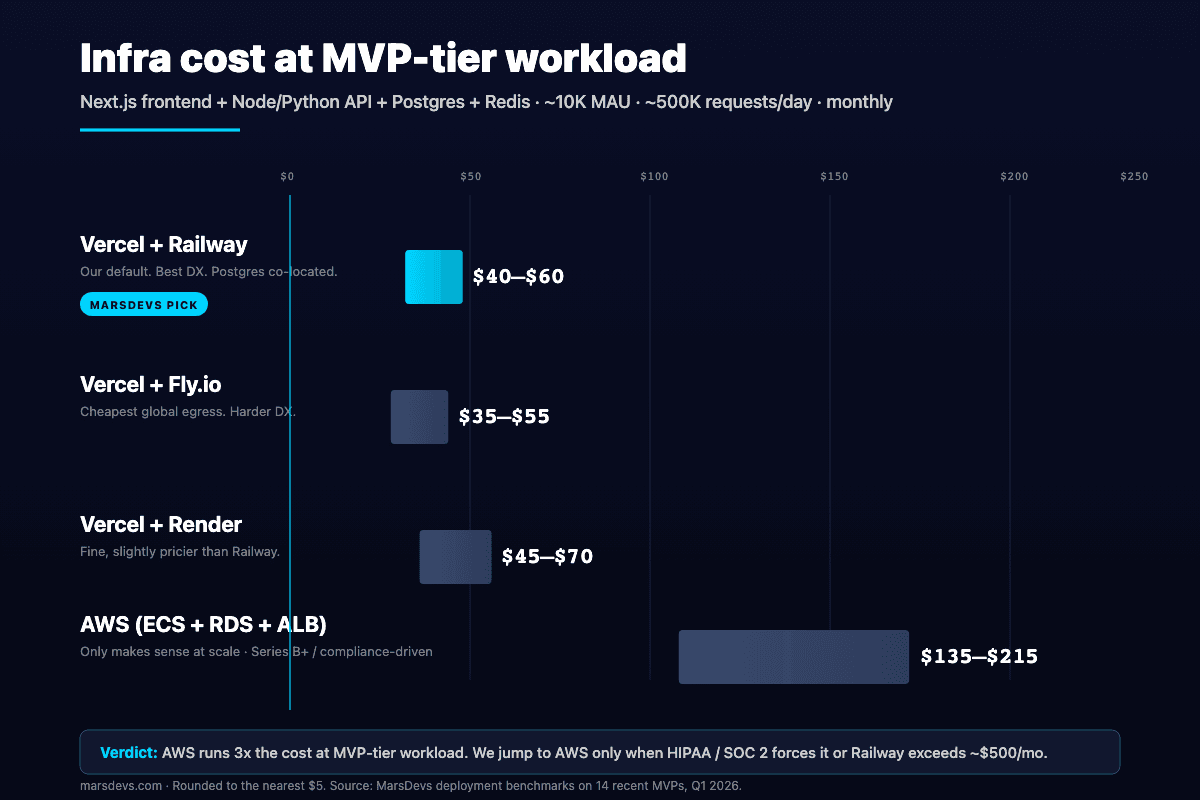
We migrate to AWS (ECS Fargate + RDS + ALB, or EKS at scale) in three scenarios only. HIPAA or SOC 2 Type II forces it. Workload exceeds ~$500/month on Railway. A late-Series-A customer demands VPC peering. Pre-Series A, AWS is usually a founder-gun-pointed-at-foot.
Cloudflare Workers and Cloudflare Pages are worth mentioning for edge-first products. We have shipped two projects on Workers. Good runtime. Cold start is gone. The ecosystem gap is the limiter. Some Node libraries simply do not work, so you write more from scratch.
Sentry for error tracking, PostHog for product analytics, OpenTelemetry for instrumentation standard. That covers observability for most startups through Series B. Datadog and the enterprise tier can wait.
Sentry's free Developer plan is enough for most MVPs. The Sentry pricing page{target="_blank"} documents current tiers, and the Sentry for Startups program offers up to $50,000 in credits for eligible funded startups. Sign up for it the day you raise. We track errors, releases, performance, and session replay all in one tool. When something breaks in production, Sentry tells you which deploy, which user, which browser, and which line within 30 seconds.
PostHog gives you product analytics, session replay, feature flags, experiments, and surveys on one free tier (1M events/month, 5K replays/month on the Cloud free plan as of early 2026). That combination used to cost you Mixpanel plus FullStory plus LaunchDarkly plus Typeform and $800/month minimum. Today it is $0 for your first year.
OpenTelemetry is the instrumentation standard we use regardless of where logs and metrics end up. Vendor-neutral, future-proof, and both Sentry and Datadog consume OTEL natively.
One more view. This is the reference table you screenshot and send to your cofounder when the agency pitch meeting starts. Every pick, one line, all 20 layers.
| # | Layer | Our Pick 2026 | Runner-up | Why |
|---|---|---|---|---|
| 1 | Frontend framework | Next.js 15 App Router | Remix | RSC plus hiring plus Vercel path |
| 2 | UI library | shadcn/ui + Tailwind 4 | Radix + Tailwind | You own the components |
| 3 | Data fetching | TanStack Query | SWR | Best cache model in React |
| 4 | Backend (non-AI) | Node 22 + Fastify 5 | NestJS 11 | Perf plus less ceremony |
| 5 | Backend (AI) | FastAPI + Python 3.12 | Node + LangChain.js | Python ML ecosystem |
| 6 | Database | Postgres 16 | MySQL 8 | Proven plus pgvector |
| 7 | Managed DB | Supabase | Neon | All-in-one |
| 8 | ORM | Drizzle | Prisma 6 | SQL-first, zero runtime |
| 9 | Auth | Clerk | Supabase Auth | Next.js DX, pricing |
| 10 | Payments | Stripe | Lemon Squeezy (MoR) | No alternative |
| 11 | AI vendor (general) | OpenAI API | Gemini 2.5 | Tooling breadth |
| 12 | AI vendor (agents) | Anthropic Claude 4.5 | OpenAI | Long context, safety |
| 13 | AI orchestration | LangGraph | Vercel AI SDK alone | Stateful graphs |
| 14 | Vector store | pgvector | Pinecone | One DB |
| 15 | Frontend deploy | Vercel | Netlify | Zero-config Next.js |
| 16 | Backend deploy | Railway | Fly.io | DX plus Postgres co-located |
| 17 | Analytics | PostHog | Mixpanel | Free tier covers MVP |
| 18 | Error tracking | Sentry | Rollbar | $50K startup credits |
| 19 | Resend | Postmark | React Email, modern | |
| 20 | CI + testing | GitHub Actions + Vitest + Playwright | CircleCI + Jest | Speed plus coverage |
If you are about to build a SaaS product, start here. You can be shipping a logged-in, paying user in two weeks on this stack.
The default stack holds across most archetypes. Four layers change depending on what you are building. The backend language choice, the database detail, the auth provider, and the AI layer scope.
organization_id column. RLS enforced at Supabase level or app layer.tenants table.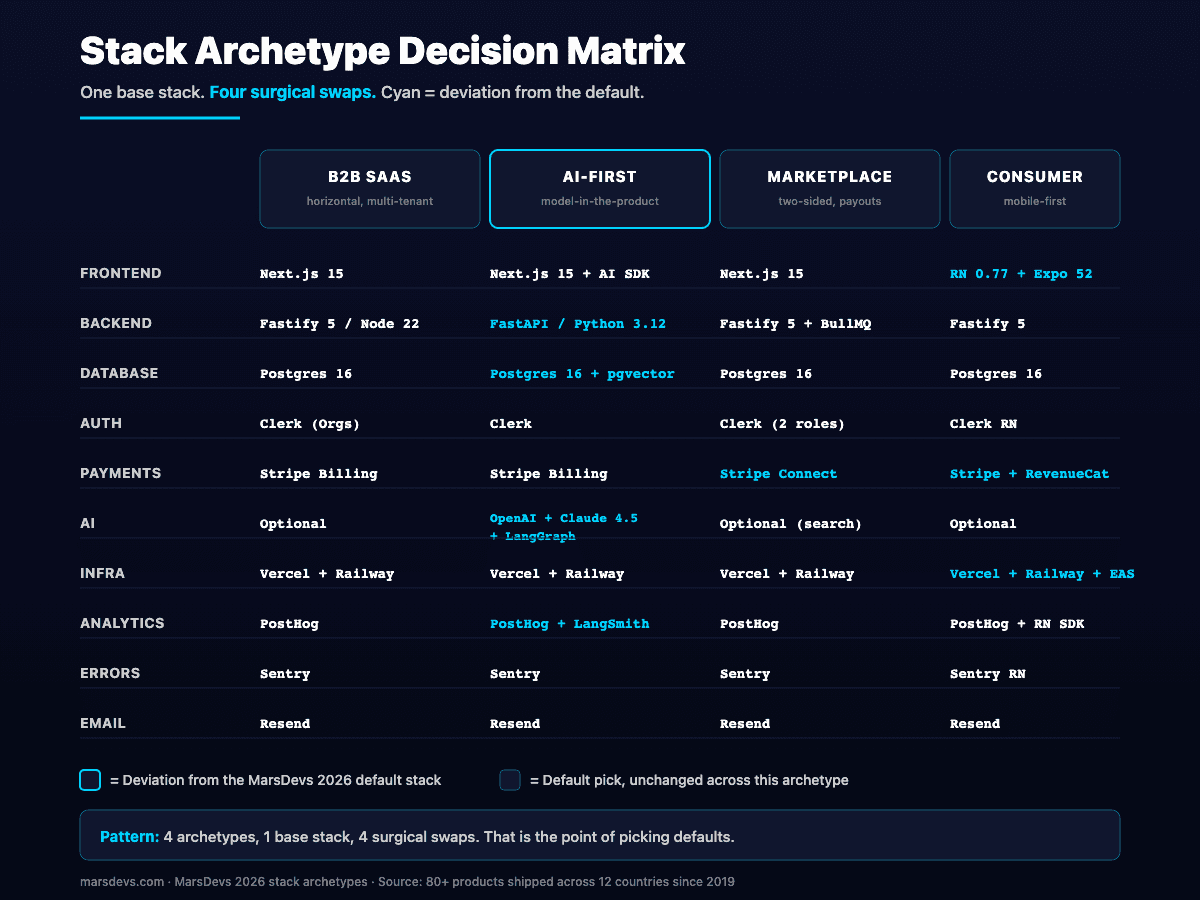
| Layer | B2B SaaS | AI-first | Marketplace | Consumer Mobile |
|---|---|---|---|---|
| Frontend | Next.js 15 | Next.js 15 + AI SDK | Next.js 15 | React Native + Expo |
| Backend | Fastify 5 | FastAPI | Fastify 5 + BullMQ | Fastify 5 |
| DB | Postgres 16 | Postgres + pgvector | Postgres 16 | Postgres 16 |
| Auth | Clerk (Organizations) | Clerk | Clerk (2 roles) | Clerk RN |
| Payments | Stripe Billing | Stripe Billing | Stripe Connect | Stripe + RevenueCat |
| AI | Optional | Core | Optional | Optional |
| Infra | Vercel + Railway | Vercel + Railway | Vercel + Railway | Vercel + Railway + EAS |
| Analytics | PostHog | PostHog + LangSmith | PostHog | PostHog + RN SDK |
| Errors | Sentry | Sentry | Sentry | Sentry RN |
| Resend | Resend | Resend | Resend |
Four archetypes, one base stack, four surgical swaps. That is the point of picking defaults. Book a free strategy call if you want us to walk through your archetype in 30 minutes.
Lean MVP on this stack runs $5,000 to $25,000. Standard MVP runs $8,000 to $30,000. AI MVP runs $5,000 to $30,000. Those are MarsDevs published ranges. Timeline is 3 to 12 weeks depending on scope and whether AI is in the critical path.
Our hourly rate is $15 to $25/hr for a senior team. Team composition on an MVP: one product manager, two full-stack engineers, one designer part-time, one QA part-time. Four projects per month cap. We do not take on a fifth even when the queue says yes, because quality erodes past four.
Infra cost in year one on this stack is $40 to $200/month depending on traffic. LLM API cost is the variable nobody can predict. We instrument every endpoint and set per-user quotas from day one. For the full breakdown see our cost to build a SaaS application in 2026 piece.
Here is one anonymized example so this stack is not hypothetical.
A B2B HR-tech startup came to us in Q1 2025. They had 6 weeks of runway, a contract with a design partner, and needed a working product or the contract disappeared. We scoped it aggressively. Single-tenant, Clerk for auth, Stripe for billing, Supabase for everything (Postgres, auth metadata, storage for uploaded CSVs), Next.js 15 on Vercel, one AI feature (resume parsing with OpenAI GPT-4o and Claude Sonnet 3.7 as a fallback, which were the current models then).
We shipped the MVP in 5 weeks and 3 days. Infra cost for the first 90 days was $142 total across Vercel, Supabase, and OpenAI API calls. The design partner signed the annual contract in week 8. The founder closed a $600K angel round the month after on the strength of that one logo. That is what the stack is for. Ship the product before the runway ends.
Quotable: We shipped a B2B HR-tech MVP in 5 weeks and 3 days on Next.js 15 + Supabase + Clerk + Stripe + OpenAI. First-90-day infra cost was $142. The design partner signed the annual contract in week 8.
We have run this play dozens of times since 2019 on variants of this stack. The stack is not the magic. Picking it once and defending it is.
This stack is wrong for you in four situations. Know them before you copy-paste our picks.
Next.js plus Postgres is not the stack. You want Unity, Unreal, or a WebGPU-first framework (Three.js, Babylon). Our defaults assume CRUD plus some AI plus some transactions.
If HIPAA, FedRAMP, or a bank customer demands VPC peering and no third-party auth vendor, Vercel and Clerk are harder conversations. You end up on AWS ECS + RDS + Cognito or Okta. That stack ships slower and costs more. Worth it when the customer is paying for it.
Do not force a rewrite because an article said so. Rails 8 ships real products every week. .NET 9 is a solid, fast web stack. A Java team using Spring Boot will outship a Node team that does not know Node. The stack matters less than the team's fluency.
Vercel and Railway are fine to 50ms p99 in most regions. Below that, Cloudflare Workers + Durable Objects or Fly.io + regional Postgres replicas become the conversation. We have shipped one project at that constraint and it doubled our DevOps time.
Three picks are on our watchlist. We will not pre-commit, but if you are reading this in late 2026 and things have moved:
Next.js, Postgres, Stripe, Vercel, Resend, and Sentry are not going anywhere.
The MarsDevs 2026 default: Next.js 15 (App Router) + Fastify 5 or FastAPI + Postgres 16 (on Supabase) + Drizzle ORM + Clerk + Stripe + Vercel + Railway + OpenAI and Anthropic APIs + PostHog + Sentry + Resend. One pick per layer. We ship new MVPs on this every week.
Next.js. The App Router with React Server Components is stable, the Vercel deploy path is zero-config, and the hiring pool is roughly 5x deeper than Remix. Remix (now part of React Router v7) is a fine framework. Next.js is the shorter path to production.
Yes, for MVP through early Series A. We have shipped on Supabase and migrated two projects off it post-Series A to self-hosted Postgres when workload patterns demanded custom tuning. Supabase is Postgres, so migration is a data move, not a rewrite.
Per-compute, Fly.io is usually cheapest. Railway has the best DX and Postgres co-located. Vercel is the fastest path for Next.js. Our default is Vercel + Railway at $40 to $60/month for most MVP workloads.
Call the API directly for under three chained prompts. Reach for LangGraph (the stateful layer on top of LangChain) once you have tool use, memory across turns, or multi-agent flows. Most AI MVPs start with direct API calls and graduate later.
Lean MVP runs $5,000 to $25,000. Standard MVP runs $8,000 to $30,000. AI MVP runs $5,000 to $30,000. Timelines: 3 to 8 weeks for a mobile app, 3 to 12 weeks for an AI MVP, 2 to 10 weeks for an AI agent. MarsDevs hourly rate is $15 to $25/hr for a senior team.
Postgres by default. MongoDB only when the schema is genuinely unknown at design time, which is rare. Postgres 16 handles relational data, JSONB for schemaless fields, full-text search, pgvector for embeddings, and realtime. One database covers most needs through Series A.
pgvector is good enough until roughly 10 million vectors or sub-50ms p99 retrieval on huge catalogs. Below that, pgvector inside your existing Postgres saves you an entire database to operate. Above it, benchmark Pinecone, Weaviate, or Qdrant against your specific recall targets.
Clerk. Best Next.js DX, free to 10,000 MAU, roughly $0.02 per MAU after, about 3x cheaper than Auth0 at equivalent tiers. Supabase Auth is the alternative when you are using Supabase end-to-end for the rest of the stack.
No. Sentry (free Developer plan, $50K startup credits available) plus PostHog (1M free events/month) cover error tracking, performance, session replay, product analytics, and feature flags through Series B. Datadog becomes worth $1K+/month once you have scale that justifies it.
If you are evaluating an agency pitch, ask them which layer they last replaced and why. If they cannot answer, they are guessing. We replaced Prisma with Drizzle in late 2025 after three production issues in two months. We moved our default AI orchestration from plain LangChain to LangGraph when state management became the bottleneck. Those are real answers.
If you want to ship an MVP on this stack, we take on 4 new projects per month. Book a free strategy call and we will walk through your archetype, scope, and a committed 3 to 12 week timeline before you write a check. Start building in 48 hours.
MarsDevs is a product engineering company that builds AI-powered applications, SaaS platforms, and MVPs for startup founders. Founded in 2019, we have shipped 80+ products across 12 countries. 4.9 rating on Clutch.
Related reading:
{
  "@context": "https://schema.org",
  "@type": "Article",
  "headline": "The Best Tech Stack for Startups in 2026: The Stack We Ship 80+ Products On",
  "description": "MarsDevs' committed 2026 MVP tech stack: Next.js 15, Fastify 5 or FastAPI on Python 3.12, Postgres 16, Drizzle, Clerk, Stripe, Vercel, Railway, OpenAI, Anthropic (Claude Sonnet 4.5), PostHog, Sentry, Resend. One pick per layer, with rationale, archetypes, and MVP cost ranges.",
  "image": "https://www.marsdevs.com/blog/best-tech-stack-for-startups-2026/hero.png",
  "author": {
    "@type": "Person",
    "name": "Vishvajit Pathak",
    "jobTitle": "Co-Founder, MarsDevs",
    "url": "https://www.marsdevs.com/about",
    "sameAs": [
      "https://www.linkedin.com/in/vishvajitpathak",
      "https://twitter.com/vishvajitpathak"
    ],
    "worksFor": {
      "@type": "Organization",
      "name": "MarsDevs",
      "url": "https://www.marsdevs.com"
    }
  },
  "publisher": {
    "@type": "Organization",
    "name": "MarsDevs",
    "url": "https://www.marsdevs.com",
    "logo": {
      "@type": "ImageObject",
      "url": "https://www.marsdevs.com/logo.png"
    }
  },
  "datePublished": "2026-04-17T09:00:00+05:30",
  "dateModified": "2026-04-19T09:00:00+05:30",
  "mainEntityOfPage": {
    "@type": "WebPage",
    "@id": "https://www.marsdevs.com/blog/best-tech-stack-for-startups-2026"
  },
  "keywords": "best tech stack for startups, startup tech stack 2026, MVP tech stack 2026, SaaS tech stack 2026, Next.js 15, Fastify 5, FastAPI, Postgres 16, Drizzle ORM, Clerk, Stripe, Vercel, Railway, OpenAI, Anthropic, Claude Sonnet 4.5, pgvector, LangGraph, PostHog, Sentry, Resend",
  "articleSection": "MVP / Startup",
  "wordCount": 5100,
  "inLanguage": "en-US"
}
{
  "@context": "https://schema.org",
  "@type": "Person",
  "name": "Vishvajit Pathak",
  "jobTitle": "Co-Founder",
  "url": "https://www.marsdevs.com/about",
  "sameAs": [
    "https://www.linkedin.com/in/vishvajitpathak",
    "https://twitter.com/vishvajitpathak"
  ],
  "worksFor": {
    "@type": "Organization",
    "name": "MarsDevs",
    "url": "https://www.marsdevs.com",
    "foundingDate": "2019",
    "address": {
      "@type": "PostalAddress",
      "addressLocality": "Pune",
      "addressCountry": "IN"
    }
  },
  "knowsAbout": [
    "Next.js",
    "React",
    "FastAPI",
    "Python",
    "Node.js",
    "PostgreSQL",
    "LangGraph",
    "Retrieval-Augmented Generation",
    "SaaS architecture",
    "MVP development"
  ]
}
{
  "@context": "https://schema.org",
  "@type": "BreadcrumbList",
  "itemListElement": [
    {
      "@type": "ListItem",
      "position": 1,
      "name": "Home",
      "item": "https://www.marsdevs.com"
    },
    {
      "@type": "ListItem",
      "position": 2,
      "name": "Blog",
      "item": "https://www.marsdevs.com/blog"
    },
    {
      "@type": "ListItem",
      "position": 3,
      "name": "The Best Tech Stack for Startups in 2026",
      "item": "https://www.marsdevs.com/blog/best-tech-stack-for-startups-2026"
    }
  ]
}
{
  "@context": "https://schema.org",
  "@type": "FAQPage",
  "mainEntity": [
    {
      "@type": "Question",
      "name": "What is the best tech stack for a startup in 2026?",
      "acceptedAnswer": {
        "@type": "Answer",
        "text": "The MarsDevs 2026 default: Next.js 15 (App Router) + Fastify 5 or FastAPI + Postgres 16 (on Supabase) + Drizzle ORM + Clerk + Stripe + Vercel + Railway + OpenAI and Anthropic APIs + PostHog + Sentry + Resend. One pick per layer. We ship new MVPs on this every week."
      }
    },
    {
      "@type": "Question",
      "name": "Should my startup use Next.js or Remix in 2026?",
      "acceptedAnswer": {
        "@type": "Answer",
        "text": "Next.js. The App Router with React Server Components is stable, the Vercel deploy path is zero-config, and the hiring pool is roughly 5x deeper than Remix. Remix (now part of React Router v7) is a fine framework. Next.js is the shorter path to production."
      }
    },
    {
      "@type": "Question",
      "name": "Is Supabase production-ready for a SaaS in 2026?",
      "acceptedAnswer": {
        "@type": "Answer",
        "text": "Yes, for MVP through early Series A. We have shipped on Supabase and migrated two projects off it post-Series A to self-hosted Postgres when workload patterns demanded custom tuning. Supabase is Postgres, so migration is a data move, not a rewrite."
      }
    },
    {
      "@type": "Question",
      "name": "Which is cheaper to deploy on: Vercel, Railway, Fly.io, or Render?",
      "acceptedAnswer": {
        "@type": "Answer",
        "text": "Per-compute, Fly.io is usually cheapest. Railway has the best DX and Postgres co-located. Vercel is the fastest path for Next.js. Our default is Vercel + Railway at $40 to $60/month for most MVP workloads."
      }
    },
    {
      "@type": "Question",
      "name": "Do I need LangChain for my AI startup in 2026, or can I just call OpenAI directly?",
      "acceptedAnswer": {
        "@type": "Answer",
        "text": "Call the API directly for under three chained prompts. Reach for LangGraph (the stateful layer on top of LangChain) once you have tool use, memory across turns, or multi-agent flows. Most AI MVPs start with direct API calls and graduate later."
      }
    },
    {
      "@type": "Question",
      "name": "What does it cost to build an MVP on this stack?",
      "acceptedAnswer": {
        "@type": "Answer",
        "text": "Lean MVP runs $5,000 to $25,000. Standard MVP runs $8,000 to $30,000. AI MVP runs $5,000 to $30,000. Timelines: 3 to 8 weeks for a mobile app, 3 to 12 weeks for an AI MVP. MarsDevs hourly rate is $15 to $25/hr for a senior team."
      }
    },
    {
      "@type": "Question",
      "name": "Should I pick MongoDB or Postgres for my startup?",
      "acceptedAnswer": {
        "@type": "Answer",
        "text": "Postgres by default. MongoDB only when the schema is genuinely unknown at design time, which is rare. Postgres 16 handles relational data, JSONB for schemaless fields, full-text search, pgvector for embeddings, and realtime. One database covers most needs through Series A."
      }
    },
    {
      "@type": "Question",
      "name": "Is pgvector good enough, or do I need Pinecone?",
      "acceptedAnswer": {
        "@type": "Answer",
        "text": "pgvector is good enough until roughly 10 million vectors or sub-50ms p99 retrieval on huge catalogs. Below that, pgvector inside your existing Postgres saves you an entire database to operate. Above it, benchmark Pinecone, Weaviate, or Qdrant against your specific recall targets."
      }
    },
    {
      "@type": "Question",
      "name": "What auth provider is best for a Next.js startup?",
      "acceptedAnswer": {
        "@type": "Answer",
        "text": "Clerk. Best Next.js DX, free to 10,000 MAU, roughly $0.02 per MAU after, about 3x cheaper than Auth0 at equivalent tiers. Supabase Auth is the alternative when you are using Supabase end-to-end for the rest of the stack."
      }
    },
    {
      "@type": "Question",
      "name": "Do I need Datadog as a startup?",
      "acceptedAnswer": {
        "@type": "Answer",
        "text": "No. Sentry (free Developer plan, $50K startup credits available) plus PostHog (1M free events/month) cover error tracking, performance, session replay, product analytics, and feature flags through Series B. Datadog becomes worth $1K+/month once scale justifies it."
      }
    }
  ]
}
{
  "@context": "https://schema.org",
  "@type": "ItemList",
  "name": "MarsDevs 2026 MVP Stack: 20 Committed Picks",
  "description": "One pick per layer of the MarsDevs default startup tech stack for 2026, with runner-up and rationale.",
  "numberOfItems": 20,
  "itemListElement": [
    {
      "@type": "ListItem",
      "position": 1,
      "name": "Frontend framework: Next.js 15 (App Router)",
      "description": "Runner-up: Remix. React Server Components plus Vercel deploy path cuts 2 days of DevOps per project."
    },
    {
      "@type": "ListItem",
      "position": 2,
      "name": "UI library: shadcn/ui + Tailwind CSS 4",
      "description": "Runner-up: Radix + plain Tailwind. You own the components, no version lock."
    },
    {
      "@type": "ListItem",
      "position": 3,
      "name": "Data fetching: TanStack Query",
      "description": "Runner-up: SWR. Best cache model in React."
    },
    {
      "@type": "ListItem",
      "position": 4,
      "name": "Backend (non-AI): Node.js 22 LTS + Fastify 5",
      "description": "Runner-up: NestJS 11. TypeScript monorepo, 2x perf over Express, no DI ceremony."
    },
    {
      "@type": "ListItem",
      "position": 5,
      "name": "Backend (AI-heavy): FastAPI + Python 3.12",
      "description": "Runner-up: Node + LangChain.js. The ML library ecosystem lives in Python."
    },
    {
      "@type": "ListItem",
      "position": 6,
      "name": "Database: Postgres 16",
      "description": "Runner-up: MySQL 8. Proven, pgvector built in, zero vendor lock."
    },
    {
      "@type": "ListItem",
      "position": 7,
      "name": "Managed DB host: Supabase",
      "description": "Runner-up: Neon. Postgres + Auth + Realtime + Storage in one bill."
    },
    {
      "@type": "ListItem",
      "position": 8,
      "name": "ORM: Drizzle",
      "description": "Runner-up: Prisma 6. SQL-first, zero runtime, typed migrations."
    },
    {
      "@type": "ListItem",
      "position": 9,
      "name": "Auth: Clerk",
      "description": "Runner-up: Supabase Auth. Best Next.js DX, priced right under 100K MAU."
    },
    {
      "@type": "ListItem",
      "position": 10,
      "name": "Payments: Stripe (Billing + Connect)",
      "description": "Runner-up: Lemon Squeezy (MoR). No real alternative in 2026."
    },
    {
      "@type": "ListItem",
      "position": 11,
      "name": "AI vendor (general): OpenAI API (GPT-5, o-series)",
      "description": "Runner-up: Gemini 2.5. Widest tooling plus fastest structured output."
    },
    {
      "@type": "ListItem",
      "position": 12,
      "name": "AI vendor (agents/safe): Anthropic API (Claude Sonnet 4.5)",
      "description": "Runner-up: OpenAI. Best long context, best tool use, safer for customer-facing."
    },
    {
      "@type": "ListItem",
      "position": 13,
      "name": "AI orchestration: LangGraph",
      "description": "Runner-up: Vercel AI SDK alone. Stateful graphs, resumable runs."
    },
    {
      "@type": "ListItem",
      "position": 14,
      "name": "Vector store: pgvector",
      "description": "Runner-up: Pinecone. One DB. Good to ~10M vectors."
    },
    {
      "@type": "ListItem",
      "position": 15,
      "name": "Frontend deploy: Vercel",
      "description": "Runner-up: Netlify. Zero-config Next.js, preview URLs."
    },
    {
      "@type": "ListItem",
      "position": 16,
      "name": "Backend deploy: Railway",
      "description": "Runner-up: Fly.io. Postgres co-located with the API, best DX."
    },
    {
      "@type": "ListItem",
      "position": 17,
      "name": "Analytics: PostHog",
      "description": "Runner-up: Mixpanel. 1M free events plus replays plus feature flags."
    },
    {
      "@type": "ListItem",
      "position": 18,
      "name": "Error tracking: Sentry",
      "description": "Runner-up: Rollbar. Free Developer tier plus $50K startup credits."
    },
    {
      "@type": "ListItem",
      "position": 19,
      "name": "Email: Resend",
      "description": "Runner-up: Postmark. React Email templates, modern API."
    },
    {
      "@type": "ListItem",
      "position": 20,
      "name": "Testing + CI: Vitest + Playwright + GitHub Actions",
      "description": "Runner-up: Jest + Cypress + CircleCI. Faster, modern, zero-config."
    }
  ]
}

Co-Founder, MarsDevs
Vishvajit started MarsDevs in 2019 to help founders turn ideas into production-grade software. With deep expertise in AI, cloud architecture, and product engineering, he has led the delivery of 80+ software products for clients in 12+ countries.
Get more insights like this
Join founders, CTOs, and engineering leaders who receive our engineering insights weekly. No spam, just actionable technical content.


