TL;DR
Step-by-step AI MVP process: validation, architecture, build sprint, and launch. Cost breakdown ($15K-$75K), tech stack picks, and the mistakes that kill most AI MVPs.

You have a startup idea that uses AI. Maybe it is a document analysis tool, an AI sales assistant, or an intelligent workflow automator. You have seen the demos. GPT-4o, Claude, Gemini. They all look incredible in a prompt window.
So you assume building your AI product will be straightforward. It will not be. That assumption is where most AI MVPs die.
An AI MVP is a minimum viable product where artificial intelligence is the core value driver, not a bolt-on feature. Traditional MVPs require one validation loop: do users want this? AI MVPs require two: do users want the outcome, and can AI reliably deliver it?
MarsDevs is a product engineering company that builds AI-powered applications, SaaS platforms, and MVPs for startup founders. We have deployed AI systems across fintech compliance pipelines, SaaS content automation, and e-commerce operations for clients in 12 countries. Here is the pattern we see every time: traditional MVP development principles still apply, but AI adds three layers of complexity that founders underestimate.
1. Non-deterministic outputs. A standard MVP feature either works or it does not. An AI feature works 87% of the time, hallucinates 8% of the time, and gives subtly wrong answers the other 5%. You need evaluation infrastructure from day one, not after launch.
2. Data dependency. Traditional MVPs need a database. AI MVPs need a data strategy. Where does your training or retrieval data come from? How do you handle the cold start problem (when you have zero user data at launch)? What happens when your RAG pipeline (Retrieval-Augmented Generation, a method that feeds external data to an LLM at query time) returns irrelevant context? A solid RAG architecture is often the difference between a demo and a product.
3. Cost scales with usage, not just users. Every API call to a Large Language Model (LLM) costs money. A chatbot handling 5,000 queries per day at $0.01 per query costs $1,500 per month in inference fees alone. Your unit economics depend on token consumption, not server costs.
Y Combinator's 2026 batches reflect this shift. Roughly 60% of funded startups are now AI-native, meaning the product could not exist without AI (TLDL YC Analysis). But YC also emphasizes that building the AI is only part of the equation. Talking to users, figuring out what to build, and proving measurable value are what separate funded startups from failed experiments.
Every AI MVP we have shipped follows this process. The tools change every quarter. The frameworks evolve. These fundamentals do not.
Before you build anything, answer one question: Does this problem actually need AI to solve it?
Most founders skip this. They see AI as the product instead of the tool. But the strongest AI MVPs solve a real problem where AI creates a 10x improvement over the non-AI alternative. Not a 2x improvement you could get with better UX or simple automation.
Run this filter on your idea:
Talk to 20 potential users. Not about AI. About the pain point. If they are not desperate for a solution, no amount of AI will make them care.
This is where discipline separates successful AI MVPs from expensive experiments. Your MVP should include exactly one workflow where AI creates the core value. Not two. Not five. One.
| What to Include | What to Cut |
|---|---|
| One AI-powered workflow that solves the validated pain point | Multiple AI features "because they are cool" |
| Basic input/output interface for that workflow | Polished UI/UX (ship functional, iterate later) |
| Evaluation metrics to measure AI accuracy | Custom model training (use pre-trained APIs first) |
| Human fallback for when AI fails | Full automation with zero human oversight |
| Usage tracking and cost monitoring | Complex analytics dashboards |
We worked with a fintech startup that wanted to build an AI-powered document analysis platform: OCR, entity extraction, compliance checking, summarization, and automated filing. That is a 6-month project. We scoped their MVP to one thing: extract key financial data from uploaded PDF statements and flag compliance risks. Eight weeks to ship. Users validated the core value within two weeks of launch. Everything else came in v2 and v3.
If you have been burned by a previous agency that promised the moon and shipped nothing after four months, this scoping discipline is your insurance policy. One workflow. Prove it works. Then expand.
This is the most consequential technical decision in your AI MVP. Get it wrong and you burn months and budget on unnecessary complexity.
The short answer for 90% of startups: start with pre-trained LLM APIs and add RAG (Retrieval-Augmented Generation) for domain-specific knowledge. Well-crafted prompts paired with RAG achieve 90%+ of results at 10% of the cost of fine-tuning.
| Approach | Cost | Timeline | Best For |
|---|---|---|---|
| Pre-trained APIs (OpenAI, Anthropic, Google) | $0.50 to $25 per 1M tokens | Days to integrate | Chatbots, content generation, classification, summarization |
| RAG (Retrieval-Augmented Generation) | $5K to $25K setup | 2 to 4 weeks | Domain-specific Q&A, document analysis, knowledge bases |
| Fine-tuned models | $10K to $100K+ | 4 to 12 weeks | When base models keep failing on your specific task |
| Custom ML models | $50K to $300K+ | 3 to 6+ months | Proprietary data patterns, unique prediction tasks |
| Open-source models (Llama, Mistral) | $2K to $50K (infra costs) | 2 to 6 weeks | Full data control, no vendor lock-in, cost optimization at scale |
We have shipped 80+ products. The pattern holds: well-crafted prompts paired with RAG achieve 90%+ of results at 10% of the cost of fine-tuning. Fine-tuning is the process of further training a pre-trained model on domain-specific data to improve accuracy on a particular task. Fine-tune only when you have clear evidence that prompt engineering and retrieval cannot hit your accuracy targets.
Here is how we think about model selection:
Do not over-invest in model selection at MVP stage. Pick one. Build. Test with real users. Switch later if needed. The abstraction layer between your app and the LLM should make model swaps painless.
This step separates AI MVPs that survive from AI MVPs that look great in demos and collapse with real users.
Before you ship, you need three things:
1. Accuracy benchmarks. Create a test dataset of 100 to 500 representative inputs with expected outputs. Run every model change against this benchmark before deploying. Skip this and you will ship regressions that destroy user trust.
2. Human-in-the-loop fallback. Human-in-the-loop is a design pattern where AI systems route low-confidence outputs to human reviewers for verification. This is not a failure. It is a feature. Users tolerate occasional human review far better than confidently wrong AI outputs.
3. Cost monitoring per request. Track token consumption, latency, and cost per API call from day one. A single prompt that accidentally sends 50K tokens per request can blow your monthly API budget in a day.
Here is the thing: over 80% of AI projects fail before reaching production (RAND Corporation, 2025). The most common cause is not bad models. It is the absence of evaluation frameworks, monitoring tools, and clear ownership of AI quality. Build this infrastructure at MVP stage. Not after users start complaining.
Ship your AI MVP to a small group of 20 to 50 target users. Not a public launch. A controlled release where you can observe how real people interact with AI outputs.
Track these metrics from day one:
If your accuracy rate sits below 80%, do not add features. Fix the AI. If your cost per task makes unit economics impossible at 10x scale, rethink your architecture before growing. Most founders we work with are racing to show traction before their next investor conversation. Ship the core loop, get users on it, and collect the data that proves your AI actually works.
After launch, the temptation is to add more AI features. Resist it. The first 4 to 6 weeks after shipping should focus entirely on improving the quality of your one core AI workflow.
This means:
Only after your core workflow hits 90%+ accuracy and stable unit economics should you start building v2 features.
Your tech stack should optimize for speed to market and flexibility to swap components. Do not over-engineer at MVP stage.
Here is the AI MVP stack we recommend in 2026, based on what we ship with:
| Layer | Technology | Why |
|---|---|---|
| Frontend | Next.js or React | Fast development, strong ecosystem, easy deployment |
| Backend | Python + FastAPI | Every major AI library has Python as its primary interface. FastAPI is a modern Python web framework built for high-performance API development. |
| Database | Supabase (PostgreSQL) | Auth, storage, real-time, and pgvector for embeddings in one service |
| Vector Store | pgvector (via Supabase) or Pinecone | Pinecone for managed simplicity; pgvector to keep everything in one database. A vector database stores high-dimensional embeddings for semantic search and AI retrieval. |
| LLM Provider | OpenAI or Anthropic API | Start with APIs. Switch or add providers later behind an abstraction layer |
| Orchestration | LangChain or LlamaIndex | LangChain for general LLM pipelines; LlamaIndex for data-heavy RAG. LangChain is an open-source framework for building LLM-powered applications. |
| Deployment | Vercel (frontend) + Railway or AWS (backend) | Vercel for instant frontend deploys; Railway for fast Python backend hosting |
| Monitoring | LangSmith or Helicone | Track prompts, completions, latency, cost, and errors per request |
Two rules for your AI MVP tech stack:
1. Abstract your LLM layer. Never hard-code OpenAI or Anthropic directly into your business logic. Use an abstraction layer so you can swap models, add fallbacks, or split traffic between providers without rewriting your app. AI development costs drop fast when you can route simple tasks to cheaper models.
2. Build vector storage in from the start. If your product involves any kind of semantic search, document Q&A, or personalized AI responses, you need a vector database from day one. A vector database stores high-dimensional embeddings that enable similarity search across text, images, or other data types. Retrofitting vector storage later is painful and expensive. pgvector through Supabase handles this for most MVPs without adding another managed service.
This is where most AI MVPs die. Your demo works. Your investors are impressed. Your pilot users are engaged. Then you try to scale, and everything breaks.
If you are a non-technical founder, evaluating whether your AI product is "production-ready" can feel impossible. The demo looks flawless. But production is a different world.
The prototype-to-production gap is the distance between an AI system that works in a demo and one that works reliably at scale. A March 2026 survey of 650 enterprise technology leaders found that 78% of enterprises have AI agent pilots running, but fewer than 15% have moved them to production (Digital Applied).
Here is what changes between prototype and production:
| Prototype | Production |
|---|---|
| Works with 100 requests/day | Must handle 10,000+ requests/day |
| You manually review edge cases | System must handle edge cases automatically |
| Cost is a line item | Cost determines unit economics |
| Latency is "acceptable" | Latency affects user retention |
| Errors are "interesting" | Errors lose customers and revenue |
| No compliance requirements | GDPR, EU AI Act, SOC 2, HIPAA apply |
Five areas break most often during scaling:
1. Latency under load. An orchestration pattern that responds in 2 seconds at 100 requests per minute can take 30 seconds at 10,000 requests per minute. Load test before scaling, not during.
2. Output consistency. At prototype scale, you manually catch bad outputs. At production scale, you need automated AI guardrails: output validation, content filtering, and structured output enforcement. AI guardrails are the validation and safety mechanisms that prevent AI systems from producing harmful, inaccurate, or off-topic responses.
3. Cost explosion. Token costs that seemed manageable at 500 daily users become existential at 50,000. Optimize prompts, cache frequent queries, and implement tiered model routing (use cheaper models for simple tasks).
4. Data privacy and compliance. The EU AI Act is the European Union's regulation establishing a legal framework for artificial intelligence. High-risk system requirements take full effect on August 2, 2026 (EU AI Act Implementation Timeline). If your AI processes personal data, financial data, or employment data within the EU, you need documentation, impact assessments, and audit trails. "We are just a startup" is not a legal defense. Maximum penalties under the EU AI Act reach up to 35 million euros or 7% of global turnover for prohibited AI practices, and up to 15 million euros or 3% for high-risk system violations.
5. Monitoring blind spots. In a prototype, you read logs. In production, you need real-time monitoring of accuracy drift, latency spikes, cost anomalies, and error rates per user segment.
MarsDevs provides senior engineering teams for founders who need to cross this gap without rebuilding from scratch. We have taken AI prototypes to production across fintech, healthcare, and SaaS. The key insight: plan for production constraints at MVP stage (even if you do not implement them yet), so the architecture does not need a rewrite when you scale.
We have seen these mistakes kill AI projects across every industry. Avoid all six.
1. Building AI for the sake of AI. If your product works without AI, adding a chatbot does not make it an AI product. AI should be the core differentiator or it should not be there.
2. Skipping evaluation infrastructure. "We will add testing later" is the most expensive sentence in AI development. Without benchmarks, you cannot measure if your product is getting better or worse with each change.
3. Fine-tuning before you have exhausted prompt engineering. Fine-tuning a model costs $10K to $100K+ and takes weeks. Improving your prompts and adding RAG retrieval costs hours and often achieves the same result. Exhaust the cheap options first.
4. Ignoring inference costs at scale. Your LLM API bill at 100 beta users tells you nothing about your bill at 10,000 paying users. Model your token economics at 10x your expected volume before committing to an architecture. A chatbot processing 50,000 queries per day at $0.01 per query costs $15,000 per month in API fees alone.
5. Treating the cold start problem as an afterthought. The cold start problem is the challenge AI products face when they lack user data at launch, resulting in poor initial performance. Design an onboarding flow that works without historical data: seed with synthetic examples, use general-purpose prompts, or offer a manual alternative while data accumulates.
6. No human fallback. Users forgive AI that asks for human help. Users do not forgive AI that confidently gives wrong answers. Every AI agent and LLM-powered feature should have a clear escalation path when confidence is low.
Every founder asks the same two questions: "How much?" and "How long?" Here are honest numbers from production AI projects we have worked on in 2026.
| AI MVP Type | Timeline | What You Get |
|---|---|---|
| AI chatbot / assistant | 4 to 8 weeks | LLM-powered bot with RAG, deployed on web/Slack/WhatsApp |
| Document analysis tool | 6 to 10 weeks | Upload, extract, summarize, and act on document data |
| AI-powered search | 4 to 8 weeks | Semantic search over your knowledge base or product catalog |
| Recommendation engine | 6 to 12 weeks | Personalized suggestions based on user behavior and preferences |
| AI workflow automation | 8 to 14 weeks | Multi-step agent that completes tasks across integrated systems |
| Computer vision MVP | 10 to 16 weeks | Image/video analysis with detection, classification, or generation |
| Budget Component | Percentage of Total | Typical Range |
|---|---|---|
| Data preparation | 25 to 35% | $5K to $25K |
| Core development | 30 to 40% | $10K to $40K |
| LLM integration + prompt engineering | 10 to 15% | $3K to $15K |
| Evaluation + testing infrastructure | 10 to 15% | $3K to $10K |
| Deployment + monitoring setup | 5 to 10% | $2K to $8K |
Total AI MVP cost range: $25,000 to $80,000 for most startup use cases. Simple AI chatbots can ship for under $20K. Complex multi-agent workflows with custom data pipelines can exceed $100K.
For a full breakdown of AI development costs by project type, team composition, and ongoing expenses, see our dedicated pricing guide.
Do not forget the recurring bill:
If your runway is tight, these numbers matter. A founder burning $80K/month who ships a $40K MVP still needs 6+ months of operating budget for iteration and API costs before the product pays for itself. Plan for this.
Founded in 2019, MarsDevs has shipped 80+ products across 12 countries for startups and scale-ups. Our AI MVPs typically ship in 8 to 12 weeks at $25K to $60K, with senior engineers who have deployed LLM systems, RAG pipelines, and AI agents in production. We start building within 48 hours of engagement.
Most AI MVPs take 8 to 12 weeks to build and deploy. Simple AI chatbots or search features can ship in 4 to 6 weeks. Complex multi-agent workflows or computer vision systems take 12 to 16 weeks. The timeline depends on data readiness (clean data ships faster), model strategy (APIs are faster than custom training), and scope discipline (one core workflow, not five). At MarsDevs, AI MVPs typically ship in 8 to 12 weeks with senior engineers who have deployed LLM systems and RAG pipelines in production.
Yes, for basic use cases like simple AI chatbots or content generation interfaces. Tools like Bubble (with AI plugins), Lovable, and Natively can produce functional AI prototypes in days. They work for validating demand before investing in custom development. But they hit limits fast: no-code tools struggle with custom RAG pipelines, multi-step agent workflows, complex data processing, and production-grade security. Most founders use no-code for proof of concept, then rebuild with custom code for the production MVP.
$15,000 to $25,000 for a simple AI feature (chatbot, basic document analysis, AI search) built with pre-trained APIs. $40,000 to $80,000 for a more complex AI-native product with RAG, custom data pipelines, and evaluation infrastructure. Below $15K, you are building a prototype, not a production-ready MVP. Budget an extra 20 to 30% above your development cost for the first 6 months of API fees, hosting, and maintenance.
Not necessarily. Many successful AI MVPs launch using pre-trained LLM capabilities (general knowledge, language processing, reasoning) combined with publicly available data. If your product requires domain-specific knowledge, RAG (Retrieval-Augmented Generation) lets you feed external documents and databases to the LLM without custom training. You only need proprietary training data if you are building custom models or fine-tuning. Start with what you have. Collect user-generated data after launch to improve the system over time.
Measure five things: task completion rate (do users finish the AI-powered workflow?), AI accuracy (does the output match expected results?), fallback rate (how often does the system need human help?), cost per task (are the unit economics viable at 10x scale?), and user satisfaction (thumbs up/down on AI outputs). Create a benchmark test set of 100 to 500 examples before launch. Run every model or prompt change against this benchmark. If accuracy drops, do not ship the change.
The prototype-to-production gap is the distance between an AI system that works in a demo and one that works reliably at scale. In 2026, 78% of enterprises have AI pilots running but fewer than 15% have moved them to production. The gap shows up as latency under load, inconsistent output quality at volume, cost explosion, compliance requirements (EU AI Act), and monitoring blind spots. Closing this gap requires production engineering: load testing, automated guardrails, cost optimization, compliance documentation, and real-time monitoring.
Start with pre-trained models (OpenAI, Anthropic, Google APIs). For 90% of AI MVPs, well-crafted prompts combined with RAG (Retrieval-Augmented Generation) achieve production-quality results at a fraction of the cost and timeline of custom model training. Fine-tune only when you have clear, measurable evidence that the pre-trained model cannot hit your accuracy targets on your specific task. Custom model training ($50K to $300K+, 3 to 6+ months) makes sense when you have large proprietary datasets and unique prediction requirements that no existing model handles well.
Start with the basics: document what data your AI processes, where it comes from, how it is stored, and who can access it. If you serve EU users, the EU AI Act requires risk classification and technical documentation even at startup stage. The August 2, 2026 deadline for high-risk system compliance is approaching fast, with maximum penalties up to 35 million euros or 7% of global turnover for prohibited AI practices. For MVP stage, implement data processing agreements, user consent flows, output logging for audit trails, and a clear privacy policy that covers AI usage. Do not leave compliance to v2. Retrofitting is 3 to 5x more expensive than building it in from the start.
AI captured over 50% of all global VC funding in 2025, with AI-related investments reaching $258.7 billion according to the OECD. The bar for what counts as a fundable AI startup rises every quarter. Investors no longer fund ideas. They fund traction.
The founders winning right now shipped an AI MVP, proved it works with real users, and showed up to their pitch with data, not a deck. If you are sitting on an AI product idea waiting for the "right time," that time is shrinking.
The 6-step process above is the same framework we use with every AI startup that comes to MarsDevs. Validate the hypothesis. Scope to one workflow. Start with APIs. Build evaluation infrastructure. Ship fast. Iterate on quality.
If you are a founder with an AI product idea and a timeline measured in weeks (not years), we can help you ship. MarsDevs takes on 4 new projects per month with senior engineers who have deployed LLM systems, RAG pipelines, and AI agents in production.
Book a free strategy call and start building within 48 hours.
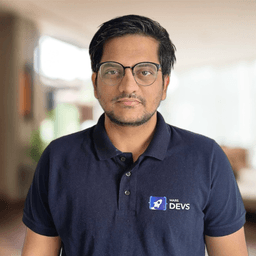
Co-Founder, MarsDevs
Vishvajit started MarsDevs in 2019 to help founders turn ideas into production-grade software. With deep expertise in AI, cloud architecture, and product engineering, he has led the delivery of 80+ software products for clients in 12+ countries.
Get more insights like this
Join founders, CTOs, and engineering leaders who receive our engineering insights weekly. No spam, just actionable technical content.


