TL;DR
Most startups should start monolith. Compare microservices vs monolith with costs, team thresholds, and a stage-based decision framework from 80+ builds.
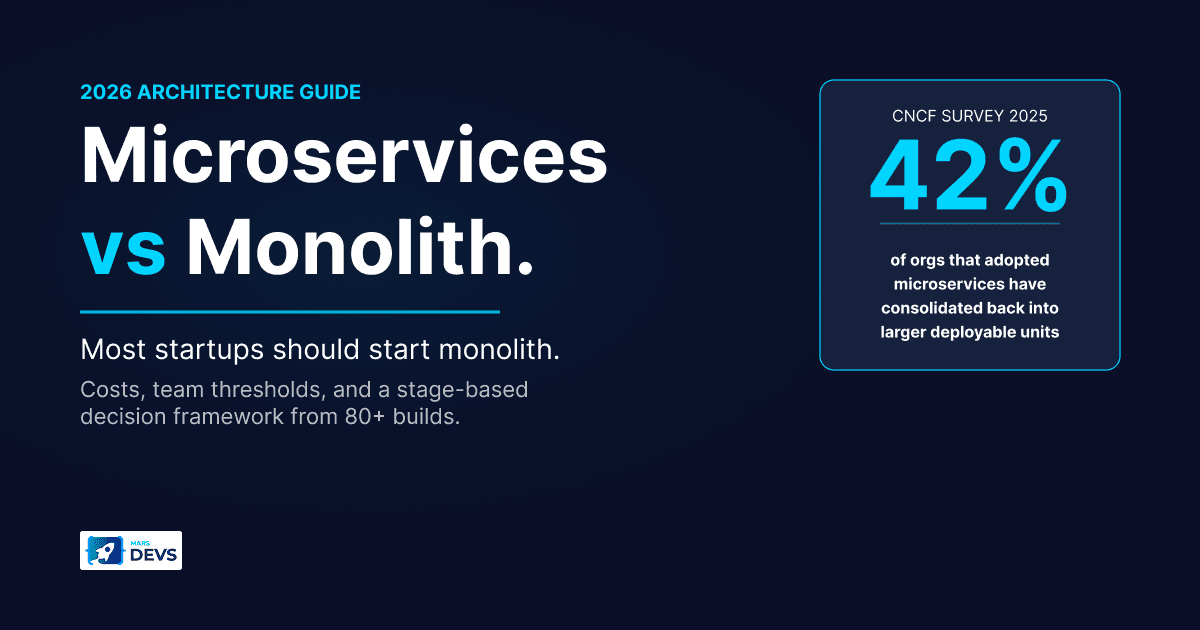
TL;DR: Most startups should start with a monolith or modular monolith and only move to microservices when organizational complexity forces the shift. A 2025 CNCF survey found that 42% of organizations that adopted microservices have consolidated services back into larger deployable units. Microservices solve team scaling problems, not early-stage product problems. Ship your MVP as a monolith, prove product-market fit, then extract services when you have the traffic, team size, and operational maturity to justify the overhead.

You just raised your seed round. Your CTO says "we need microservices from day one." Your advisor says "just build a monolith." Your lead developer sent you a blog post about how Netflix uses 700+ microservices. Everyone has an opinion. Nobody agrees.
Here's the thing: the microservices vs monolith debate has shifted dramatically. Microservices architecture is a software design pattern where an application is built as a collection of small, independently deployable services, each running its own process and communicating through APIs. Monolith architecture is the opposite: a single deployable application where all code lives in one codebase. The "microservices by default" mindset that dominated 2018-2022 is fading fast. Amazon Prime Video cut infrastructure costs by 90% by consolidating microservices. Shopify handles 32 million requests per minute on a modular monolith. Architecture should follow your stage, not your ambition.
Software architecture is the structural design of your application: how code is organized, how components communicate, and how the system gets deployed and scaled. MarsDevs is a product engineering company that has shipped 80+ products across 12 countries. We've seen founders burn through six figures on premature microservices more times than we can count.
This guide breaks down monolith vs microservices in 2026, introduces the modular monolith as the practical middle ground, and gives you a decision framework based on where your startup actually is today. Not where you hope it'll be in three years.
A monolith is a single deployable application where all your code lives in one codebase. User authentication, payment processing, notification system, and business logic all run in the same process, share the same database, and deploy together.
That sounds limiting. It's not (at least not at first).
Speed of development is the biggest advantage. One codebase. One deployment pipeline. One database. Your team of 3-5 developers can move fast without worrying about service discovery, API versioning, or distributed tracing.
Here's what a monolith gives you:
A well-built monolith running on a $200/month cloud instance can handle significant traffic. Microservices with equivalent functionality can cost $750-$1,000/month or more once you add API gateways, centralized logging, and per-service infrastructure. For a startup watching every dollar of runway, that difference matters.
The problems start when your team and traffic grow:
These are real problems. They're also problems you want to have, because they mean your startup is succeeding. If you're a 5-person team worried about deployment bottlenecks for 20 developers, you're solving a problem you don't have yet. Build first. Optimize later.
We've seen this pattern too many times. A founder comes to us after a failed first build where an agency over-architected their MVP. They burned $50-100K on microservices infrastructure when a simple monolith would have gotten them to launch in half the time and a third of the budget.

Microservices split your application into small, independently deployable services. Each service owns its data (the database-per-service pattern), runs its own process, and communicates with other services through APIs or message queues.
Netflix runs 700+ microservices. Uber has thousands. But here's what those headlines leave out: Netflix has over 10,000 engineers. Uber's platform engineering team alone is larger than most startups.
Before you get the benefits, you need the infrastructure. Microservices require container orchestration (Kubernetes is an open-source platform that automates the deployment, scaling, and management of containerized applications), an API gateway for routing external requests to the correct backend service, distributed tracing for tracking requests across service boundaries to debug failures, a service mesh for secure service-to-service communication, centralized logging across all services, and CI/CD pipelines for each service.
That's not a weekend project. Teams typically need 3-6 months just to become productive with Kubernetes tooling.
| Capability | What It Does | Typical Monthly Cost |
|---|---|---|
| Container orchestration (Kubernetes) | Manages service deployment and scaling | $200-500 (managed) |
| API gateway | Routes external requests to correct services | $100-300 |
| Distributed tracing (Jaeger, Datadog) | Tracks requests across service boundaries | $150-500 |
| Service mesh (Istio, Linkerd) | Handles service-to-service communication | $100-200 |
| Centralized logging (ELK, Datadog) | Aggregates logs from all services | $200-1,000 |
That's $750-$2,500/month in infrastructure before you write a single line of business logic. For a startup burning runway, that's money you should be spending on product development and user acquisition instead.
Microservices solve specific problems at specific scales:
If none of those describe your startup today, you don't need microservices today.
And here's where it gets interesting. The modular monolith has emerged as the dominant architecture recommendation for startups in 2026. A modular monolith is a single deployable application structured with strict internal module boundaries based on domain logic. It gives you the organizational benefits of microservices (clear service boundaries, team ownership, independent modules) without the operational overhead (distributed systems complexity, network latency, infrastructure costs).
Each module has its own directory, its own data access layer, and communicates with other modules through well-defined internal APIs. But it all deploys as one unit.
Think of it as microservices inside a monolith. Your code is organized by business domain:
/app
  /modules
    /payments      (owns payment logic + payment tables)
    /users         (owns auth + user tables)
    /notifications (owns email/push logic)
    /orders        (owns order processing)
  /shared          (common utilities, no business logic)
Each module:
The critical difference from a traditional monolith: modules don't reach into each other's internals. If the orders module needs user data, it calls the users module's public interface. Not the users table directly.
Shopify runs one of the largest e-commerce platforms on Earth as a modular monolith. Their core application has 2.8 million lines of Ruby code, handles 32 million requests per minute at peak, and processes 30TB of data every minute. On Black Friday 2024, their system handled 284 million requests per minute at the edge.
They didn't break into microservices. They modularized their monolith using strict domain boundaries and deployed isolated clusters (called "Pods") for different tenants. The result: internet-scale performance without distributed systems complexity.
| Factor | Modular Monolith | Microservices |
|---|---|---|
| Deployment complexity | Single pipeline | One per service |
| Infrastructure cost | $200-500/month | $2,000-5,000/month |
| Team size threshold | 3-50 developers | 10-100+ developers |
| Debugging | Single process, standard tools | Distributed tracing required |
| Scaling | Vertical + pod-based horizontal | Per-service horizontal |
| Technology flexibility | Single stack | Polyglot capable |
| Migration path | Extract modules to services later | Already distributed |
| Time to production | Weeks | Months |
| Developer velocity (small team) | High | Low (infrastructure overhead) |
For most startups building their first product, the modular monolith gives you 80% of the architectural benefits at 20% of the cost and complexity.

Stop asking "microservices or monolith?" Start asking "what stage is my startup at?"
Architecture: Monolith or Modular Monolith
Your only job is shipping fast and learning from users. Every hour spent on infrastructure is an hour not spent on product. You need a well-scoped MVP that gets to market in weeks, not months.
At MarsDevs, when founders come to us at this stage, we build modular monoliths by default. Clean module boundaries from day one, but a single deployment target. We can ship a working SaaS product in 6-8 weeks while keeping the door open for future extraction.
Decision factors:
Architecture: Modular Monolith with Selective Extraction
You've found product-market fit. Users are growing. Your engineering team is scaling. Some modules are getting heavy. This is when you start extracting specific services, but only the ones that justify it.
Extract a module to a microservice when:
Decision factors:
Architecture: Microservices (evolved from modular monolith)
Multiple teams need to ship independently. You have platform engineers who can manage distributed systems. Your traffic demands per-service scaling. At this point, microservices become an organizational solution as much as a technical one.
Decision factors:
| If you have... | Choose... |
|---|---|
| Under 5 developers | Monolith |
| 5-10 developers, single product | Modular monolith |
| 10-30 developers, clear domains | Modular monolith + 2-3 extracted services |
| 30+ developers, independent teams | Microservices (evolved, not greenfield) |
| Under $500K revenue | Monolith |
| VC-funded with tight runway | Monolith (save money for product) |
| Enterprise clients with compliance needs | Selective microservices for regulated domains |
The best microservices architectures aren't built from scratch. They evolve from monoliths through deliberate extraction. Here are the patterns that work.
The strangler fig pattern is the industry-standard approach for migrating from a monolith to microservices without a risky "big bang" rewrite. Named after a vine that gradually envelops a tree, you replace monolith functionality piece by piece while keeping the system running.
Step 1: Add a routing layer. Place an API gateway or reverse proxy in front of your monolith. Initially, all traffic goes through to the monolith unchanged.
Step 2: Identify your first extraction candidate. Pick a module with clear boundaries, high change frequency, or distinct scaling needs. Payments and notifications are common first picks.
Step 3: Build the new service alongside the monolith. The new service gets its own database (database per service) with migrated data. During transition, keep both data stores in sync.
Step 4: Shift traffic gradually. Route 5% of requests to the new service. Monitor. Increase to 25%, 50%, 100%. This takes 2-4 weeks per service.
Step 5: Decommission the old module. Once the new service handles 100% of traffic for a stabilization period, remove the corresponding code from the monolith.
We've run this pattern on multiple client projects at MarsDevs. The key insight from those builds: each extraction should take 2-6 weeks, not months. If it's taking longer, your module boundaries aren't clean enough.
Amazon Prime Video's video quality monitoring team moved from a microservices architecture to a consolidated service and cut infrastructure costs by 90%. Their distributed setup used AWS Step Functions for orchestration and S3 for intermediate storage between services. The network overhead and storage costs were massive for a high-throughput video analysis workload.
By consolidating into a single service with in-memory data transfer, they eliminated the serialization overhead and S3 storage costs entirely. The lesson: microservices aren't always the answer, even at Amazon scale.
Twilio Segment consolidated approximately 140 microservices into a single application after the operational burden became unsustainable. Debugging across that many services, managing deployments, and handling cascading failures outweighed the benefits of independent scaling. Sometimes the "modern" approach is the wrong one.
These reverse migrations don't mean microservices are bad. They mean premature microservices are expensive. Start simple. Extract when the pain justifies the deployment complexity.
The startups that ship fastest and iterate most effectively start with a monolith or modular monolith. The ones that stall often chose microservices too early, spending their first 3-4 months building infrastructure instead of product.
One fintech client came to us after spending 5 months and $120K with another agency building a microservices architecture for a product that had zero users. We rebuilt their core product as a modular monolith in 7 weeks. They launched, got their first 500 users, and only then did we extract their payment processing into a separate service when PCI compliance requirements demanded it.
That's the right order: ship, validate, then architect for scale. If you're a non-technical founder trying to figure out whether your last engineering team made the right calls, this pattern is your sanity check.

Founders always ask "how much and how long?" Here's a realistic breakdown based on what we've seen across our 80+ product builds.
| Factor | Monolith | Modular Monolith | Microservices |
|---|---|---|---|
| MVP build time | 4-8 weeks | 6-10 weeks | 12-24 weeks |
| Monthly infrastructure | $100-500 | $200-1,000 | $2,000-10,000 |
| Team size required | 2-5 developers | 3-8 developers | 8-20+ developers |
| DevOps overhead | Minimal | Moderate | High (dedicated team) |
| Time to first deploy | Days | 1-2 weeks | 4-8 weeks |
| Developer hourly rate (MarsDevs) | $15-25/hr | $15-25/hr | $15-25/hr |
MarsDevs provides senior engineering teams for founders who need to ship fast without compromising quality. Whether you're building a monolith MVP or planning a modular architecture for scale, our engineers bring production experience across all three patterns.
No. Most startups should start with a monolith or modular monolith. Microservices add deployment complexity, infrastructure cost ($2,000-10,000/month vs $200-500/month for a monolith), and operational overhead that early-stage startups don't need. A 2025 CNCF survey found that 42% of organizations that adopted microservices have consolidated services back into larger units. Focus on shipping your product and proving market fit first. Microservices solve scaling problems you likely don't have yet.
A modular monolith is a single deployable application organized into strictly separated internal modules, each owning its own data and exposing a public API to other modules. It combines the simplicity of monolith deployment with the organizational clarity of microservices. Shopify runs one of the world's largest e-commerce platforms on a modular monolith that handles 32 million requests per minute. This architecture lets you extract modules into independent services later when you actually need to.
Migrate when you have at least 10-15 developers, clear domain boundaries in your product, and components with genuinely different scaling or deployment requirements. The strangler fig pattern lets you extract services incrementally without rewriting your application. Plan 2-6 weeks per service extraction. If your monolith is working and your team is small, there's no architectural reason to migrate just because other companies did.
Most industry practitioners recommend a minimum of 10-15 developers before microservices provide net positive value. Below that threshold, the operational overhead of managing distributed systems (deployment pipelines, monitoring, debugging) reduces team productivity by 20-40%. You also need 2-4 dedicated platform engineers to manage the infrastructure, which is impractical for teams under 15 people.
Monoliths are significantly cheaper at every scale under enterprise level. A monolith runs on $200-500/month in cloud infrastructure. Equivalent microservices cost $2,000-10,000/month when you factor in container orchestration, API gateways, distributed tracing, and centralized logging. At enterprise scale (50+ developers), monoliths cost roughly $15,000/month versus $40,000-65,000/month for microservices, including infrastructure and platform engineering staff.
Yes. Your AI and ML workloads don't dictate your application architecture. You can call AI APIs (OpenAI, Anthropic, Google) from a monolith just as easily as from a microservice. If you need heavy ML model training or inference at scale, extract just that component into a separate service while keeping everything else in the monolith. This selective extraction is exactly what the modular monolith enables. We build AI-powered features into monolithic applications regularly at MarsDevs, from RAG pipelines to computer vision modules, without requiring a full microservices setup.
The strangler fig pattern is the industry-standard approach for migrating from a monolith to microservices without a risky full rewrite. Named after a vine that gradually envelops a tree, you place an API gateway in front of your monolith, build new services alongside it, shift traffic gradually (5% to 25% to 100%), and decommission old modules once the new service is stable. Each extraction typically takes 2-6 weeks.
A monolith MVP typically takes 4-8 weeks to build with a team of 2-5 developers. A modular monolith takes 6-10 weeks with 3-8 developers. A microservices-based MVP takes 12-24 weeks with 8-20+ developers because of the infrastructure setup required (Kubernetes, API gateways, distributed tracing, CI/CD per service). For startups racing to prove product-market fit, the monolith gets you to market 2-4x faster. At MarsDevs, we've shipped 80+ MVPs and most take 6-8 weeks when scoped aggressively.
Kubernetes is an open-source container orchestration platform that automates the deployment, scaling, and management of containerized applications. Most early-stage startups do not need Kubernetes. It adds significant operational complexity, and teams typically need 3-6 months just to become productive with Kubernetes tooling. A managed Kubernetes cluster costs $200-500/month before you add application workloads. Start with simpler deployment options and adopt Kubernetes when you have a platform engineering team to manage it.
Partially, yes. Amazon Prime Video's monitoring team moved from microservices to a consolidated service and cut infrastructure costs by 90%. Shopify runs one of the largest e-commerce platforms as a modular monolith handling 32 million requests per minute. Twilio Segment consolidated approximately 140 microservices into a single application. These reverse migrations don't mean microservices are bad. They mean premature microservices are expensive, and the right architecture depends on your specific scale and team needs.
The best architecture for your startup is the one that lets you ship, learn, and iterate fastest at your current stage. For 90% of startups, that means starting with a monolith or modular monolith and evolving toward microservices only when team size, traffic, and organizational complexity demand it.
Every month you spend building microservices infrastructure is a month you're not building product. Every dollar you spend on Kubernetes is a dollar not spent on user acquisition. Get your architecture right for today and design it so tomorrow's migration is straightforward.
Founded in 2019, MarsDevs has shipped 80+ products across 12 countries for startups and scale-ups. We've built monoliths that scaled to millions of users and migrated monoliths to microservices when the time was right.
Need help choosing the right architecture for your startup? Book a free strategy call with our engineering team. We'll review your requirements and recommend the fastest path to production. We take on 4 new projects per month, so claim an engagement slot before it fills up.

Co-Founder, MarsDevs
Vishvajit started MarsDevs in 2019 to help founders turn ideas into production-grade software. With deep expertise in AI, cloud architecture, and product engineering, he has led the delivery of 80+ software products for clients in 12+ countries.
Get more insights like this
Join founders, CTOs, and engineering leaders who receive our engineering insights weekly. No spam, just actionable technical content.


