TL;DR
LangGraph is the production standard for complex workflows. CrewAI is fastest to prototype. AutoGen is in maintenance mode. Here is how to choose.

Your CTO just told you the product needs AI agents. Not a chatbot. Agents that reason, coordinate, and execute multi-step workflows on their own. You start researching frameworks and hit a wall immediately: LangGraph, CrewAI, and AutoGen all claim to solve the same problem.
Each has 40,000+ GitHub stars. Each has vocal advocates. Pick the wrong one and you are rewriting your agent layer six months from now.
We have built AI agent systems with all three frameworks in production environments. This comparison comes from shipping real products, not from reading docs and summarizing features.
AI agent frameworks are software libraries that provide scaffolding for building autonomous AI systems. These systems handle multi-step reasoning, tool use, and coordination between multiple specialized agents. LangGraph, CrewAI, and AutoGen take three fundamentally different approaches to this problem: graph-based state machines, role-based teams, and conversational agent patterns.
Here is what actually matters when choosing between them.

| Feature | LangGraph | CrewAI | AutoGen |
|---|---|---|---|
| Architecture | Graph-based state machines | Role-based agent teams | Conversational multi-agent |
| GitHub Stars | 44,600+ | 45,900+ | 36,800+ |
| Learning Curve | Steep (2-3 weeks) | Gentle (2-3 days) | Moderate (1 week) |
| Time to First Agent | 3-5 days | 1-2 days | 2-3 days |
| Production Readiness | High | High | Low (maintenance mode) |
| Observability | LangSmith (best in class) | Built-in event emitter | Basic logging |
| Human-in-the-Loop | Native support | Supported | Supported |
| State Management | Built-in checkpointing | Session-based | Conversation history |
| Active Development | Yes (v1.0 GA) | Yes (v1.12) | Maintenance mode only |
| Best For | Complex stateful workflows | Fast team-based automation | Legacy projects only |
Bold-text summary for quick scanning:
LangGraph is a graph-based state machine framework for building stateful, multi-agent AI systems. The LangChain team built it so every agent, decision point, and tool call becomes a node in a directed graph with shared state. You pick this framework when you need to know exactly what your AI agents are doing at every step.
LangGraph models your agent workflow as a directed graph. Nodes handle computation steps (LLM calls, tool executions, human approvals). Edges define the flow between them. State persists across the entire graph through built-in checkpointing.
This architecture gives you something the other frameworks do not: replay. When a run fails at step 7 of a 12-step workflow, you replay from step 6 with modified inputs directly from the LangSmith UI. We have seen this cut debugging time from half a day to under 30 minutes on a fintech compliance pipeline we shipped last quarter.
from langgraph.graph import StateGraph, START, END
from typing import TypedDict

class AgentState(TypedDict):
    messages: list
    research_data: str
    final_report: str

def researcher(state: AgentState) -> AgentState:
    # Agent that gathers data
    ...

def writer(state: AgentState) -> AgentState:
    # Agent that produces the report
    ...

graph = StateGraph(AgentState)
graph.add_node("researcher", researcher)
graph.add_node("writer", writer)
graph.add_edge(START, "researcher")
graph.add_edge("researcher", "writer")
graph.add_edge("writer", END)

app = graph.compile()
result = app.invoke({"messages": ["Analyze Q1 sales data"]})
MarsDevs is a product engineering company that builds AI-powered applications for startups. We have used LangGraph for complex, stateful agent systems where observability and control flow matter more than speed of initial setup.
Need help deciding if LangGraph fits your architecture? Talk to our engineering team. We have deployed it in production for compliance, fintech, and data pipeline use cases.
CrewAI is a role-based AI agent framework that deploys agent teams for collaborative task execution. crewAI Inc. designed it so you define agents by their role, goal, and backstory, assign tasks, and let CrewAI handle the orchestration. The framework hit 45,900+ GitHub stars because it makes simple cases trivially simple.
CrewAI treats agents like team members with job descriptions. A "Researcher" agent has a defined role, a set of tools, and a goal. A "Writer" agent takes the researcher's output and produces content. You configure this in YAML or Python, and the framework handles delegation, memory, and execution order.
This role-based approach maps directly to how non-technical founders think about work. "I need a researcher and a writer" makes more sense than "I need a directed graph with conditional edges." If you are a founder evaluating your first AI build, that difference matters.
from crewai import Agent, Task, Crew

researcher = Agent(
    role="Senior Research Analyst",
    goal="Find comprehensive data on the topic",
    backstory="Expert analyst with 10 years of experience",
    tools=[search_tool, scrape_tool]
)

writer = Agent(
    role="Technical Writer",
    goal="Create a clear, actionable report",
    backstory="Skilled at translating complex data into insights"
)

research_task = Task(
    description="Research Q1 sales trends",
    agent=researcher,
    expected_output="Detailed research summary"
)

writing_task = Task(
    description="Write executive summary from research",
    agent=writer,
    expected_output="One-page executive brief"
)

crew = Crew(agents=[researcher, writer], tasks=[research_task, writing_task])
result = crew.kickoff()
The difference is visible. CrewAI reads like a job assignment. LangGraph reads like a system architecture diagram. Neither is wrong. They serve different needs, and the right choice depends on your product requirements and timeline.
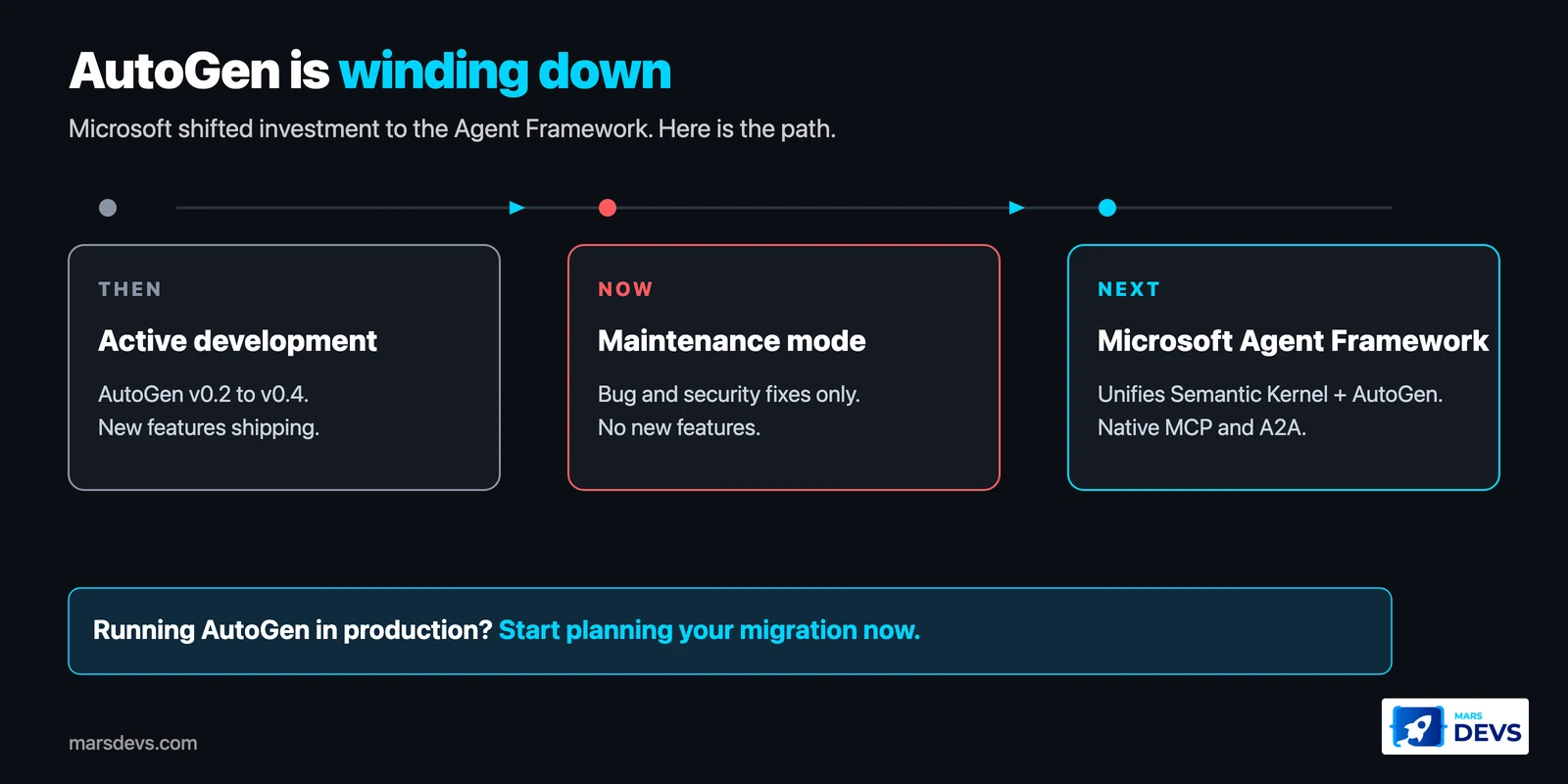
AutoGen is a conversational multi-agent framework originally built by Microsoft. Microsoft shifted AutoGen to maintenance mode in favor of the broader Microsoft Agent Framework. AutoGen receives bug fixes and security patches but no new features. Microsoft targets Agent Framework 1.0 GA by end of Q1 2026 with stable APIs and enterprise readiness certification.
AutoGen pioneered conversational multi-agent patterns. Agents communicate through structured conversations, with each agent taking turns responding, delegating, or executing tools. For multi-party debates, consensus-building, and sequential dialogues, AutoGen's conversation patterns offered the most diversity of any framework.
If you already run AutoGen in production, start planning a migration now. If you are evaluating frameworks for a new AI project, choose LangGraph or CrewAI instead.
The core architectural difference between these frameworks determines which problems they solve well.
LangGraph: Graph-based workflows. A graph-based workflow models your agent system as a state machine. Each node performs one operation. Edges define transitions. State flows through the graph and persists via checkpoints. You get deterministic execution paths, replay capability, and fine-grained observability. This fits complex, stateful pipelines where you need to guarantee specific execution orders.
CrewAI: Role-based agents. A role-based agent system treats your workflow as a team. Each agent has a role and a goal. Tasks define what needs to happen. The framework handles delegation and sequencing. You get rapid prototyping, readable configuration, and an intuitive model. This fits business workflow automation where speed of deployment matters more than granular control.
AutoGen: Conversational agents. A conversational agent system works like a group chat. Agents communicate through structured conversations, negotiating and coordinating through message passing. This fits deliberation-heavy tasks only if you are maintaining legacy code. Do not start new projects on AutoGen.
For production AI systems, performance is not optional. Here is how each framework handles scale.
LangGraph scales through infrastructure. The LangGraph Platform provides managed deployment with horizontal scaling, cron job support, and long-running background tasks. Node caching reduces redundant computation. Deferred nodes handle map-reduce patterns efficiently. LinkedIn and Uber run LangGraph in production at enterprise scale.
CrewAI scales through parallelism. Version 1.12 runs independent tasks simultaneously by default. Improved memory systems with vector database integration allow agents to remember past interactions across sessions. CrewAI reports 12 million daily agent executions across its platform. For most startup and mid-market use cases, that throughput is more than sufficient.
AutoGen scales poorly for new requirements. No new performance features are being added. What exists works, but the ceiling is fixed.
Your team's ramp-up time is a real cost. A framework that takes three weeks to learn costs three weeks of engineering salary before you ship anything. If you are watching your runway, that matters.
CrewAI wins on ease of use. A developer with Python experience can build a working multi-agent system in an afternoon. The role-based model maps to business logic naturally. YAML configuration means non-engineers can read and even modify agent definitions.
LangGraph requires investment. The graph abstraction is powerful but unfamiliar. Most developers need 2-3 weeks to internalize the state machine model, understand checkpointing, and use LangSmith effectively. Once past that curve, productivity is high. The upfront cost is real though.
AutoGen sits in the middle. The conversational model is intuitive for developers familiar with chat-based AI. Setup takes roughly a week. But investing time in a framework with no future is not a smart bet.
Building your first agent system and want to skip the trial-and-error phase? Book a free strategy call. We can help you avoid 6-12 months of mistakes.
Production means more than "it works on my laptop." It means observability, debugging, error recovery, and monitoring at scale.
LangGraph is the most production-ready AI agent framework in 2026. LangSmith provides step-by-step traces with token counts per node. Failed runs can be replayed with modified inputs. Human-in-the-loop interrupts work natively. Built-in checkpointing means interrupted workflows resume without data loss. Pre/post model hooks add guardrails and context management.
CrewAI is production-ready for standard workflows. The new event emitter system (v1.12) improves observability significantly. HITL support works across providers. For workflows involving 2-6 agents with clear task boundaries, CrewAI performs reliably in production. Complex workflows with heavy branching may need more manual instrumentation.
AutoGen is production-safe but stagnant. Existing deployments continue working. Microsoft committed to no breaking changes. But you will not get new production features, improved debugging, or better observability.
| Cost Factor | LangGraph | CrewAI |
|---|---|---|
| Framework License | MIT (free) | Apache 2.0 (free) |
| Managed Platform | $0.001/node + $39/seat/mo (LangSmith) | Free tier: 50 exec/mo. Pro: $25/mo |
| Enterprise Tier | Custom pricing | Up to $120,000/year (Ultra) |
| Engineering Ramp-Up | 2-3 weeks | 2-3 days |
| Maintenance Overhead | Higher (graph complexity) | Lower (simpler abstractions) |
| Total Year 1 Cost (small team) | $5,000-15,000 | $1,500-5,000 |
For early-stage startups watching every dollar, CrewAI's lower ramp-up time and simpler pricing model reduce total cost of ownership. For funded companies building complex agent infrastructure, LangGraph's investment pays off through better debuggability and control.
Use LangGraph when:
Use CrewAI when:
Avoid AutoGen for new projects. Use it only if you have an existing AutoGen deployment that is stable and migration is not yet feasible.
What about OpenAI Swarm? OpenAI replaced Swarm with the production-ready Agents SDK in early 2026. OpenAI Swarm was an experimental multi-agent framework that served as an educational reference design. Swarm is now deprecated for production use. If you are considering OpenAI's ecosystem, evaluate the Agents SDK instead.
We have deployed agent systems with both LangGraph and CrewAI across client projects. Our recommendation depends on the problem.
For a fintech client that needed a multi-step compliance review agent (document ingestion, policy matching, risk scoring, human approval, report generation), we used LangGraph. Checkpointing meant interrupted reviews picked up exactly where they left off. LangSmith traces gave the compliance team full visibility into every decision the agents made. That level of auditability was a regulatory requirement, not a nice-to-have.
For a SaaS client that needed automated content workflows (research, draft, edit, publish), we used CrewAI. The role-based model mapped perfectly to their existing editorial process. They had agents running in production within five days. The founder could read the YAML config and understand what each agent was doing without writing a single line of code.
The pattern is consistent: LangGraph for complex, stateful, compliance-sensitive systems. CrewAI for fast, role-based, business-workflow automation. We pick the right tool for the job, not the one with the most hype.
Founded in 2019, MarsDevs has shipped 80+ products across 12 countries for startups and scale-ups. MarsDevs provides senior engineering teams for founders who need to ship AI products fast without compromising on quality.
Building with AI agents? Book a free architecture session and we will help you choose the right framework for your specific use case. We take on 4 new projects per month, so claim a slot before they fill up.

CrewAI is the best AI agent framework for beginners. Its role-based model is intuitive, setup takes hours instead of weeks, and YAML configuration keeps complexity low. A developer with basic Python skills can have a working multi-agent system running in an afternoon. Start with CrewAI to learn the concepts, then evaluate LangGraph when your requirements outgrow it.
AutoGen receives bug fixes and security patches only. Microsoft shifted it to maintenance mode in favor of the Microsoft Agent Framework, which targets 1.0 GA by end of Q1 2026. Existing AutoGen deployments are safe with no planned breaking changes, but no new features will be added. Plan your migration if you are currently using AutoGen.
Yes, though it requires custom integration work. Some teams use CrewAI for rapid prototyping and then migrate performance-critical workflows to LangGraph. Others run CrewAI agents for simpler tasks alongside LangGraph for complex stateful pipelines. With CrewAI's A2A protocol support, cross-framework communication is becoming more practical in 2026.
LangGraph is the most production-ready AI agent framework in 2026. LangSmith provides the best observability tooling available, with step-by-step traces, token tracking, and run replay. Built-in checkpointing handles state persistence. Human-in-the-loop support works natively. CrewAI is also production-ready for standard workflows, but LangGraph offers superior debugging and control for complex systems.
OpenAI deprecated Swarm as a production framework and replaced it with the OpenAI Agents SDK in early 2026. Swarm remains available as an educational reference design for understanding multi-agent concepts. For production work in OpenAI's ecosystem, use the Agents SDK, which adds built-in guardrails, tracing dashboards, and persistent memory.
Start by mapping your current agent roles and workflows to the target framework's abstractions. LangGraph to CrewAI migration means converting graph nodes to role-based agents and tasks. CrewAI to LangGraph migration means defining explicit state schemas and graph edges for each workflow step. Budget 2-4 weeks for a typical migration, with 1-2 weeks of parallel testing. We recommend running both frameworks side-by-side during transition. If you need help, our engineering team has handled multiple framework migrations.
Framework costs vary significantly. LangGraph's managed platform charges $0.001 per node execution plus $39/seat/month for LangSmith Plus. CrewAI's Professional plan starts at $25/month with 100 executions included. Both offer free open-source versions. The bigger cost is usually the LLM API calls themselves. A typical multi-agent workflow with 3 agents making 2-3 LLM calls each costs $0.05-0.50 per run depending on model choice and prompt length.
LangChain is a framework for building LLM-powered applications with chains and retrieval. LangGraph extends LangChain specifically for building stateful, multi-agent systems using graph-based workflows. Think of LangChain as the foundation and LangGraph as the agent orchestration layer built on top of it. LangGraph reached 1.0 GA status and operates as a distinct framework within the LangChain ecosystem.
LangGraph provides the most precise multi-agent coordination through explicit graph-based state machines. You define exactly how agents communicate, what state they share, and which execution paths are valid. CrewAI provides simpler coordination through role delegation and task dependencies. For workflows where agent interaction patterns are predictable, CrewAI's approach is sufficient. For workflows with complex branching, conditional execution, or long-running state, LangGraph's explicit coordination is superior.
CrewAI comes closest to enabling non-technical configuration through its YAML-based agent definitions. A founder who understands their business process can define agent roles, goals, and task sequences in readable YAML files. LangGraph requires programming knowledge for all configuration. For startups where the founder wants visibility into agent behavior without writing code, CrewAI is the better choice. MarsDevs provides senior engineering teams for founders who need to ship fast without compromising quality. Talk to us if you need help setting up either framework.
Co-Founder, MarsDevs
Vishvajit started MarsDevs in 2019 to help founders turn ideas into production-grade software. With deep expertise in AI, cloud architecture, and product engineering, he has led the delivery of 80+ software products for clients in 12+ countries.
Get more comparisons like this
Join founders, CTOs, and engineering leaders who receive our engineering insights weekly. No spam, just actionable technical content.
Partner with our team to design, build, and scale your next product.
Let’s Talk