TL;DR
The post-MVP engineering org playbook by ARR stage: what breaks, who to hire, what to centralize, and in-house vs pod, from $0 to $10M+ ARR.
TL;DR: Scaling an engineering team past MVP is an org problem, not a hiring problem. The team shape that ships your MVP (2 to 4 generalists) breaks around $1M ARR, again near $5M, and again at $10M+, and each break needs different roles, not just more of the same. We have scaled teams from 3 to 30 engineers across our engagements at MarsDevs since 2019, and the pattern holds: hire for the constraint you have now (product velocity at Series A, reliability and platform at Series B), centralize deliberately, and use an embedded pod to buy a stage of maturity you have not hired for yet.
You shipped the MVP. Users are signing up. Revenue is real, if small. Now your investors want a plan for the engineering team, and the two generalists who built the whole thing are quietly drowning.
Here is the trap most founders fall into: they treat scaling as "hire more of what worked." More full-stack generalists. Same flat structure. Same "everyone owns everything" culture that felt fast at 4 people and feels like chaos at 14. The team that is perfect for finding product-market fit is the wrong team for scaling past it.
This playbook maps the engineering org by ARR stage. What breaks at each band, which roles to add when, what to centralize, and where an outside pod beats a full-time hire. It is written from lived experience, not a framework deck. MarsDevs is a product engineering partner for early- and growth-stage businesses, and we have watched these exact transitions play out across 80+ builds since 2019.
If you want the mechanics of the embedded team unit itself, read the product engineering pod first. This piece is about the whole org around it.
Here is the answer up front. The table below maps the four transitions every post-MVP company goes through, what breaks at each one, who to hire, what to centralize, and when to bring in a pod instead of a full-time hire.
| Stage | What breaks | Team shape and key hires | What to centralize | In-house vs pod |
|---|---|---|---|---|
| Pre-revenue / MVP ($0) | Nothing yet. Speed is the only metric. | 2 to 4 full-stack generalists. A technical co-founder or lead. No specialists. | Nothing. Centralizing anything now is premature. | Pod or founder-led. Buy senior generalists to ship fast without a 6-month hiring cycle. |
| ~$1M ARR / Series A | The first PM hire. Reliability. "Everyone owns everything" stops scaling. Onboarding takes weeks. | 6 to 10 engineers. First real EM or tech lead. First dedicated QA. First product manager. | Code review standards, CI/CD, on-call basics, a written definition of done. | Hybrid. Core team in-house, pod to absorb a workstream (a new surface, a platform gap) without slowing the core. |
| ~$5M ARR | The on-call rotation nobody owns. The staging environment that becomes a bottleneck. Two teams stepping on each other. Hiring outpaces onboarding. | 15 to 30 engineers across 2 to 4 teams. Engineering managers (not just leads). First platform or infra hire. Data engineer. Security owner. | On-call and incident process, platform and internal tooling, data pipeline, security and access, hiring bar. | In-house core, pod for a bounded initiative (a replatform, a new product line) so the core team keeps its context. |
| ~$10M+ ARR / Series B | Coordination cost. No platform team means every team reinvents infra. Career ladders missing. Reliability is now a revenue line. | 30+ engineers, 4+ teams. A platform team. A head of engineering or VP. Staff engineers. SRE. Engineering ops or program management. | Platform, SRE, security, developer experience, architecture review, the promotion ladder. | Mostly in-house. Pod for surge, a specialized capability (AI, mobile), or to de-risk a migration you cannot staff fast enough. |
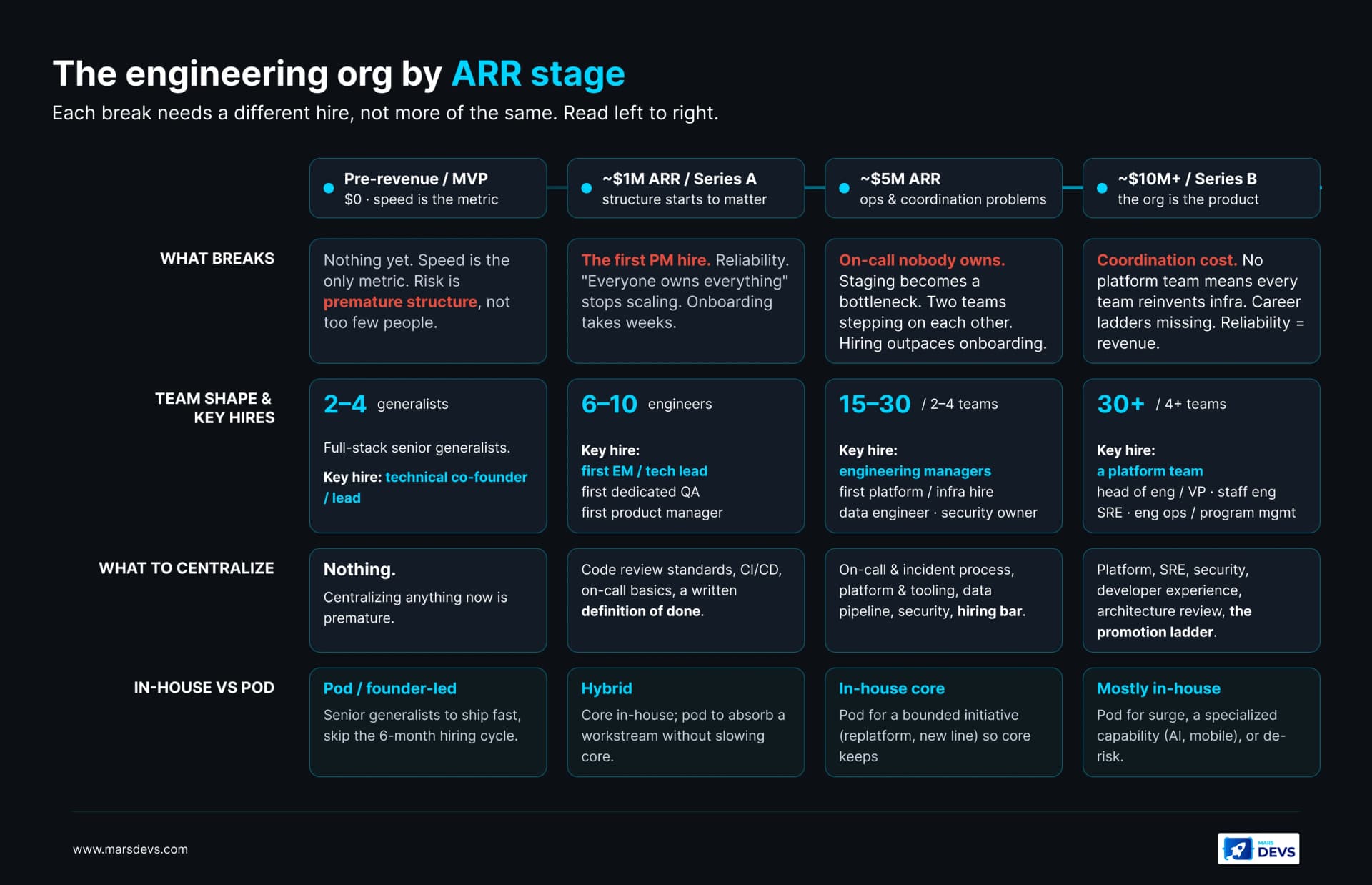
Read the table as a sequence of constraints, not a headcount plan. At each stage the binding constraint changes, and the right hire is the one that relieves the current constraint. The rest of this playbook expands each row with the failure modes we have actually watched break teams.
At the MVP stage, the correct engineering org is 2 to 4 senior generalists and no specialists, because your only job is to ship something real fast enough to learn from it. Titles do not matter. Ownership boundaries do not matter. Shipping matters.
We have shipped 80+ MVPs, and the ones that stall almost never stall on talent. They stall on premature structure. A founder hires a "backend engineer" and a "frontend engineer" and a "DevOps engineer" before there is a product, and now three people are waiting on each other to do work one strong full-stack engineer could have shipped solo.
Do not centralize anything at this stage. There is nothing to centralize. Standards, platform teams, and process are answers to problems you do not have yet.
Here is where a pod earns its keep early: you get senior engineers who have shipped MVPs before, without spending six months hiring or burning runway on full-time salaries for a team you cannot yet size correctly. If you want the full breakdown of how a small embedded team ships, the product engineering pod covers the composition and cadence.
The failure mode to avoid: building the org you think you will need at Series A while you are still pre-revenue. You will guess wrong, and you will pay for the guess in runway.
At roughly $1M ARR, the flat "everyone owns everything" model breaks, and the fix is your first real structure: 6 to 10 engineers, a first engineering manager or tech lead, a first dedicated QA, and a first product manager. This is the hardest transition most teams face, because it is the first time speed comes from process instead of raw hustle.
Three things break at Series A, and they break in a predictable order.
The first PM hire. Until now the founder was the product manager. That stops scaling the moment engineers start building the wrong thing because nobody owns the roadmap. A Series A healthtech team we worked with had shipped fast for a year with the founder as de facto PM, then watched velocity crater once three engineers needed three different answers to "what do I build next." The first PM is not a luxury at this stage. It is the thing that keeps engineering pointed at revenue.
Reliability starts to matter. Pre-Series-A, downtime annoys a few early users. Post-Series-A, downtime churns paying customers and shows up in your renewal numbers. This is when you write down a definition of done, add CI/CD if you somehow shipped the MVP without it, and set up basic on-call. Not a fancy rotation. Just: when it breaks at 2am, someone known is responsible.
Onboarding becomes a tax. At 4 engineers, onboarding is osmosis. At 10, an undocumented codebase means every new hire costs a senior engineer two weeks of context-dumping. Write the runbook. Standardize the local dev setup. The teams that skip this hit a wall around hire number eight.
What to centralize now: code review standards, CI/CD, on-call basics, and a written definition of done. That is the whole list. Resist the urge to build platform infrastructure. You do not have enough teams to justify it yet.
So, in-house or pod at Series A? The answer is usually both. Keep your core product team in-house, because that is where your domain context lives and compounds. Use a pod to absorb a bounded workstream, a new surface area or a platform gap, so your core team does not lose velocity every time a second priority appears. The pattern that works: in-house owns the roadmap, the pod owns a lane.
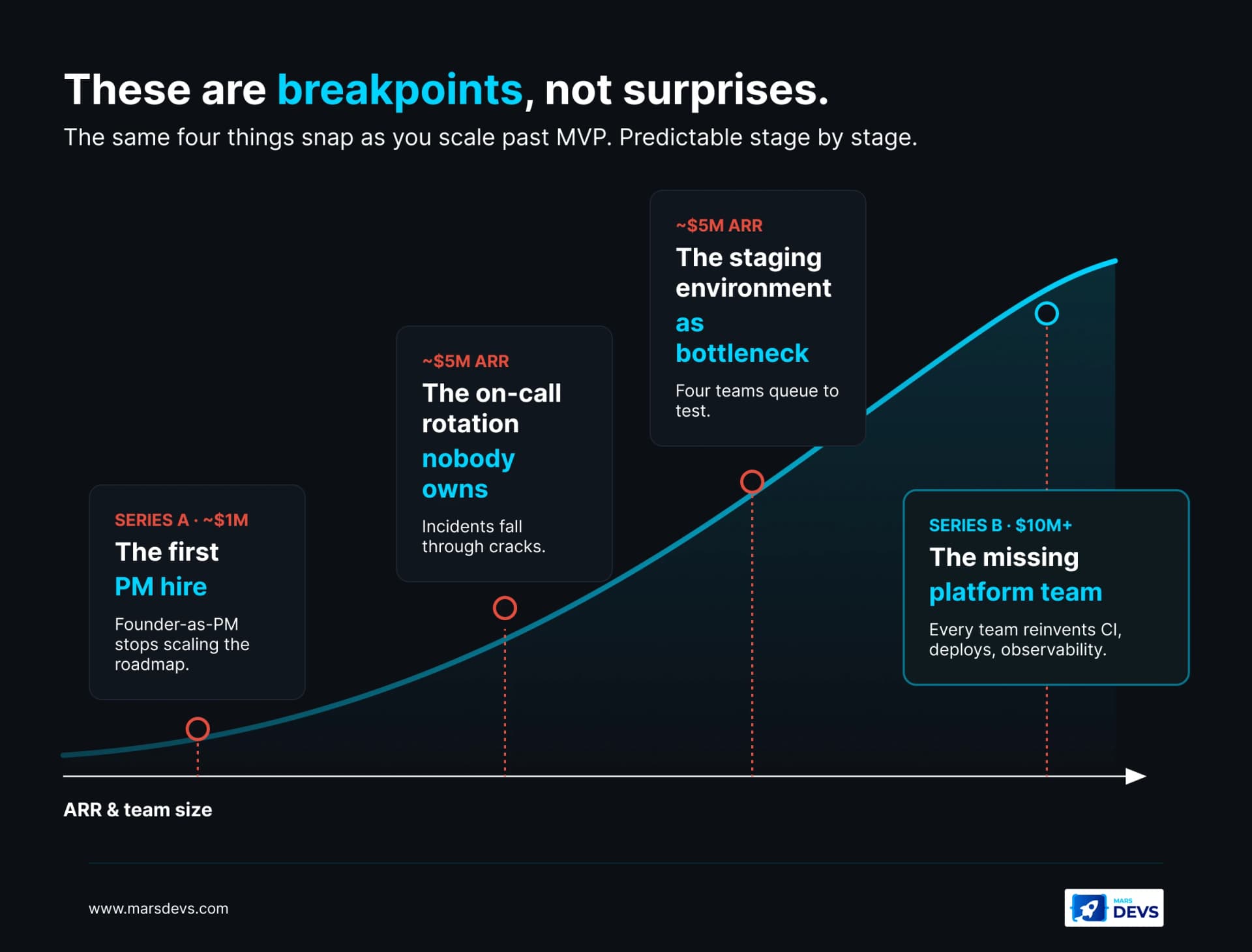
At roughly $5M ARR, the org grows to 15 to 30 engineers across 2 to 4 teams, and the things that break are no longer product problems. They are operations and coordination problems. This is where you hire your first engineering managers (real managers, not player-coaches), your first platform or infra engineer, a data engineer, and someone who owns security.
Four failure modes show up almost every time at this band.
The on-call rotation nobody owns. At Series A you had "someone is responsible." At $5M you have three teams, and every one of them assumes another team owns the pager. Incidents fall through the cracks. You need a written incident process, a real rotation with clear ownership per service, and a blameless postmortem habit. Google's SRE guidance on managing incidents is the reference we point teams to, because it is battle-tested at a scale you will never hit.
The staging environment that becomes a bottleneck. One shared staging environment worked when one team deployed. Now four teams queue behind each other to test, and the staging environment is a daily traffic jam. This is the signal to invest in platform: ephemeral environments, better CI, self-serve deploys. It is not glamorous. It is the difference between four teams shipping and four teams waiting.
Two teams stepping on each other. Without clear service or domain boundaries, two teams edit the same code and break each other weekly. This is when team topology starts to matter. The book Team Topologies by Skelton and Pais is the map we use for drawing boundaries: stream-aligned teams for product, a platform team for shared infra.
Hiring outpaces onboarding. You raised a Series B-sized round, you are hiring fast, and new engineers are not productive for months because nobody owns onboarding as a system. Assign it. Make onboarding someone's actual job, not a favor.
What to centralize at $5M: on-call and incident process, platform and internal tooling, the data pipeline, security and access, and the hiring bar. This is the stage where centralizing pays off, because you finally have enough teams that shared infrastructure beats every team reinventing it.
On in-house vs pod here: keep the core in-house and use a pod for a bounded initiative, a replatform or a new product line, so your core team keeps its context and momentum. Handing a migration to a pod means your senior engineers are not pulled off the roadmap to babysit infrastructure work. If a replatform is what is coming, the specific things that snap at this exact band are predictable, and each one has a known fix.
At $10M+ ARR, the binding constraint becomes coordination cost, and the fix is structure you have been deferring: a platform team, a head of engineering or VP, staff engineers, SRE, and engineering operations. You are now 30+ engineers across 4+ teams, and the org itself is the product you have to manage.
The defining failure mode at this stage is the missing platform team. Without one, every product team reinvents CI, deploys, observability, and infra, and you pay for that infrastructure four times over. A platform team exists to make the other teams faster. It is not overhead. It is a multiplier, and at 30+ engineers the math clearly favors it.
Reliability is now a revenue line, not a nice-to-have. At this scale an outage is a board-level conversation and a churn event. You need SRE ownership, real SLOs, and error budgets. Google's SRE workbook on implementing SLOs is the practical reference.
Career ladders become a retention problem. Your best engineers hit a ceiling with nowhere to grow, and they leave. You need a written promotion ladder with a real staff-engineer track, so technical people can advance without being forced into management. Missing ladders quietly bleed senior talent right when you can least afford it.
What to centralize at Series B: platform, SRE, security, developer experience, architecture review, and the promotion ladder. This is the full centralization stage. The org is large enough that inconsistency across teams is now the main tax on velocity.
On in-house vs pod at this scale: the org is mostly in-house by now, and it should be, because domain context and reliability ownership belong to full-time engineers. A pod still earns a slot for three specific jobs: surge capacity for a deadline you cannot hire for in time, a specialized capability you do not have in-house (AI, mobile, a niche integration), or de-risking a migration you cannot staff fast enough. The pod buys you a capability or a timeline, not headcount.
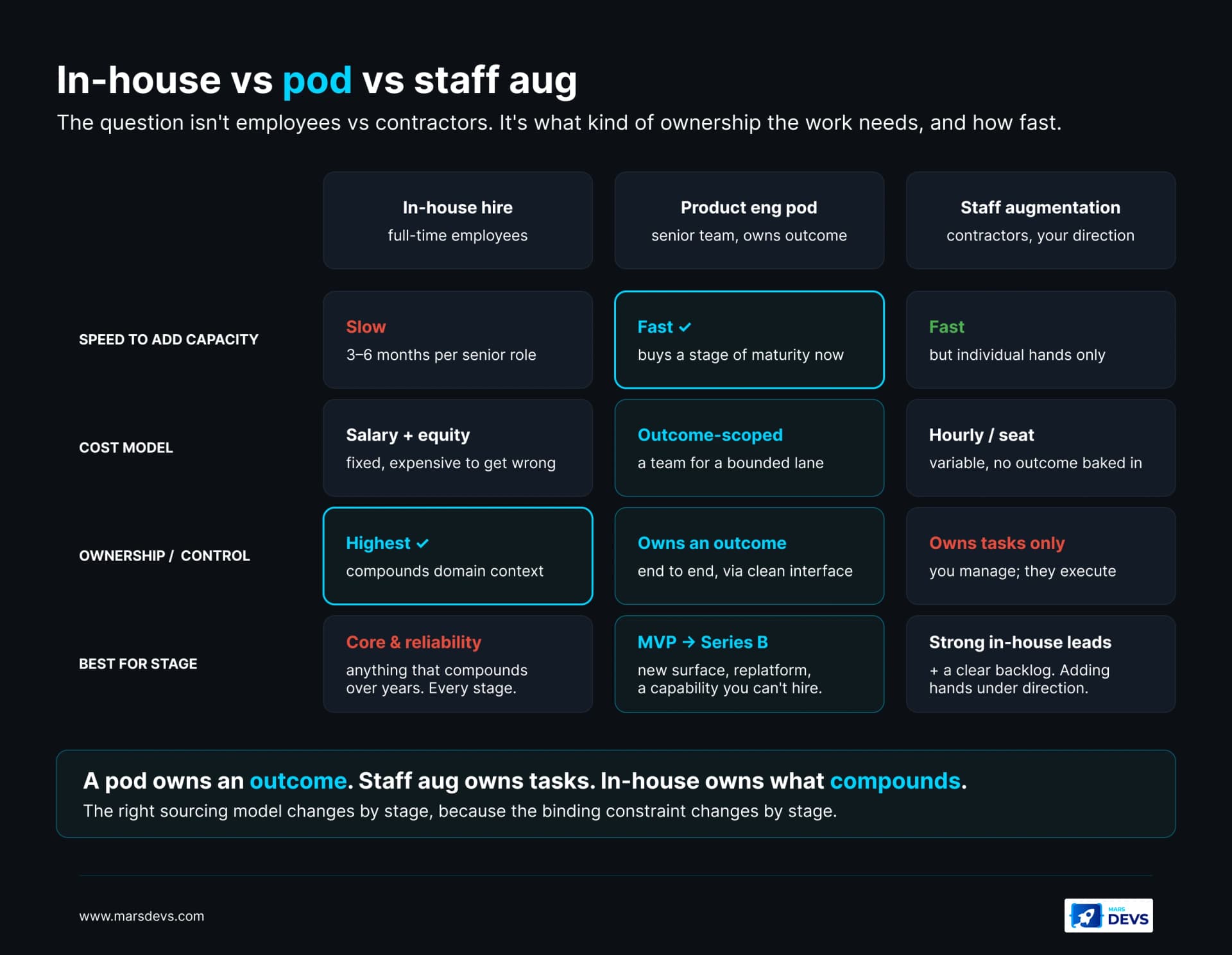
The decision is not "employees vs contractors." It is "what kind of ownership does this work need, and how fast do I need it." In-house wins for anything that compounds domain context. A pod wins for a bounded outcome you need shipped by a team that owns it end to end. Staff augmentation wins only when you have strong in-house leadership and just need more hands under your direction.
Here is the decision framing we give founders.
| Model | You get | Best for | Watch out for |
|---|---|---|---|
| In-house | Full-time engineers who own domain context long-term. | Core product, reliability, anything that compounds over years. | Slow to hire (often 3 to 6 months per senior role). Expensive to get wrong. |
| Product engineering pod | A small senior team that owns a bounded outcome end to end. | A new surface, a replatform, a capability you have not hired for, buying a stage of maturity fast. | You need a clear outcome and a clean interface to your core team. Not a fit for undefined, always-changing scope. |
| Staff augmentation | Individual contractors who work under your direction. | Adding hands when you already have strong in-house leads and a clear backlog. | Carries body-shop baggage. Little outcome ownership. You manage the work; they execute. |
The distinction that matters most: a pod owns an outcome, staff augmentation owns tasks. If you have a strong engineering lead and just need velocity, augmentation can work. If you need a lane owned by a team that has shipped this before, a pod is the better instrument. The table above is the short version of when each one fits.
The quotable version: the right sourcing model changes by stage, because the constraint changes by stage. Pre-revenue, you buy speed. At Series A, you buy a lane so the core keeps velocity. At Series B, you buy a capability or a timeline you cannot hire for in time.
The rule is simple: build in-house whatever compounds your domain advantage, and hand out whatever is bounded, specialized, or urgent. Your core product logic, your data model, and your reliability ownership stay in-house at every stage. Everything else is a candidate to hand to a partner, and the candidate list shifts as you grow.
Here is the split by stage.
The anti-pattern we see most: founders hand out the core product to save money early, then spend Series A rebuilding it because the partner had no stake in the domain. Do the opposite. Keep the compounding work close, hand out the bounded work.
We have run this exact split across our engagements, from serving as a founder's whole team pre-revenue to owning a single de-risked migration lane for a 30-engineer org. MarsDevs embeds senior engineering pods that scale software from MVP to platform, and the value at each stage is different: speed early, a protected lane in the middle, a bought capability late.
The best-run teams hire one stage ahead of the break, not one stage behind it. If you wait until the on-call rotation has already failed, or the staging bottleneck has already stalled four teams, you are paying the cost of the break plus the cost of the fix. Hiring the platform engineer just before you need them, or bringing in a pod to own a migration before it consumes your core team, turns a fire drill into a planned transition.
You cannot get ahead of every break. Runway and headcount are real constraints, and over-hiring for a stage you have not reached is its own failure mode. But you can watch for the leading signals: onboarding starting to slow, incidents falling through cracks, two teams editing the same code. Those are the tells that the next transition is close.
This is the exact moment a pod is worth more than a job posting. A full-time senior hire takes 3 to 6 months to source and onboard. A pod that has scaled teams through this transition before can own the workstream now, while you hire the permanent owner in parallel.
If you are staring at one of these breaks, or you can see it coming, scope a pod to own the transition. We run a two-week paid discovery to map exactly which stage your org is in, what is about to break, and whether the right move is a hire, a pod, or both. Talk to our engineering team and we will tell you honestly which one you need.
Most Series A companies run 6 to 10 engineers. That is enough to support your first engineering manager or tech lead, a dedicated QA, and a first product manager, without the coordination overhead that appears past 10. The exact number depends on product surface area, but the structural shift (adding a PM and an EM) matters more than the headcount.
Hire your first engineering manager around $1M ARR or 6 to 8 engineers, whichever comes first. Below that, a tech lead who still writes code is usually enough. The signal to hire a dedicated manager is when coordinating people and roadmap starts eating a senior engineer's coding time.
Keep anything that compounds your domain advantage in-house (core product, data model, reliability) and hand out bounded, specialized, or urgent work. A product engineering pod that owns an outcome beats generic outsourcing, because the pod carries end-to-end ownership. Reserve staff augmentation for when you already have strong in-house leadership.
The "everyone owns everything" model breaks first, usually around $1M ARR. The founder can no longer be the de facto product manager, reliability starts affecting paying customers, and undocumented onboarding taxes every new hire. Adding a PM, a first EM, and basic process fixes this transition.
Build a platform team around $10M+ ARR or 30+ engineers across 4+ teams. Below that, dedicated platform work is premature and pulls engineers off product. Once multiple product teams are reinventing CI, deploys, and observability, a platform team pays for itself by making every other team faster.
Use a pod when you need a bounded outcome shipped fast by a team that has done it before, and hire full-time for work that compounds over years. A full-time senior hire takes 3 to 6 months to source and onboard, so a pod is often the faster way to buy a stage of maturity while you hire the permanent owner in parallel.
Scaling engineering past MVP is a sequence of predictable breaks: the first PM at Series A, the on-call rotation nobody owns at $5M, the missing platform team at Series B. Each one has a known fix, and the teams that win are the ones that hire for the next constraint instead of adding more of the last one.
You do not have to guess which stage you are in. We have scaled teams from 3 to 30 across our engagements, and we can map your org against these breaks in a two-week paid discovery: what is about to snap, whether the right move is a hire or a pod, and how to sequence the next four hires.
Facing the transition now? Scope a pod to scale past MVP, and we will tell you straight whether you need one.
Co-Founder, MarsDevs
Vishvajit started MarsDevs in 2019 to help founders turn ideas into production-grade software. With deep expertise in AI, cloud architecture, and product engineering, he has led the delivery of 80+ software products for clients in 12+ countries.
Get more insights like this
Join founders, CTOs, and engineering leaders who receive our engineering insights weekly. No spam, just actionable technical content.


