TL;DR
GenAI expectations are down but AI spend keeps climbing. The gap is vendor lock-in. How to price optionality as a line item and four moves to control AI spend.
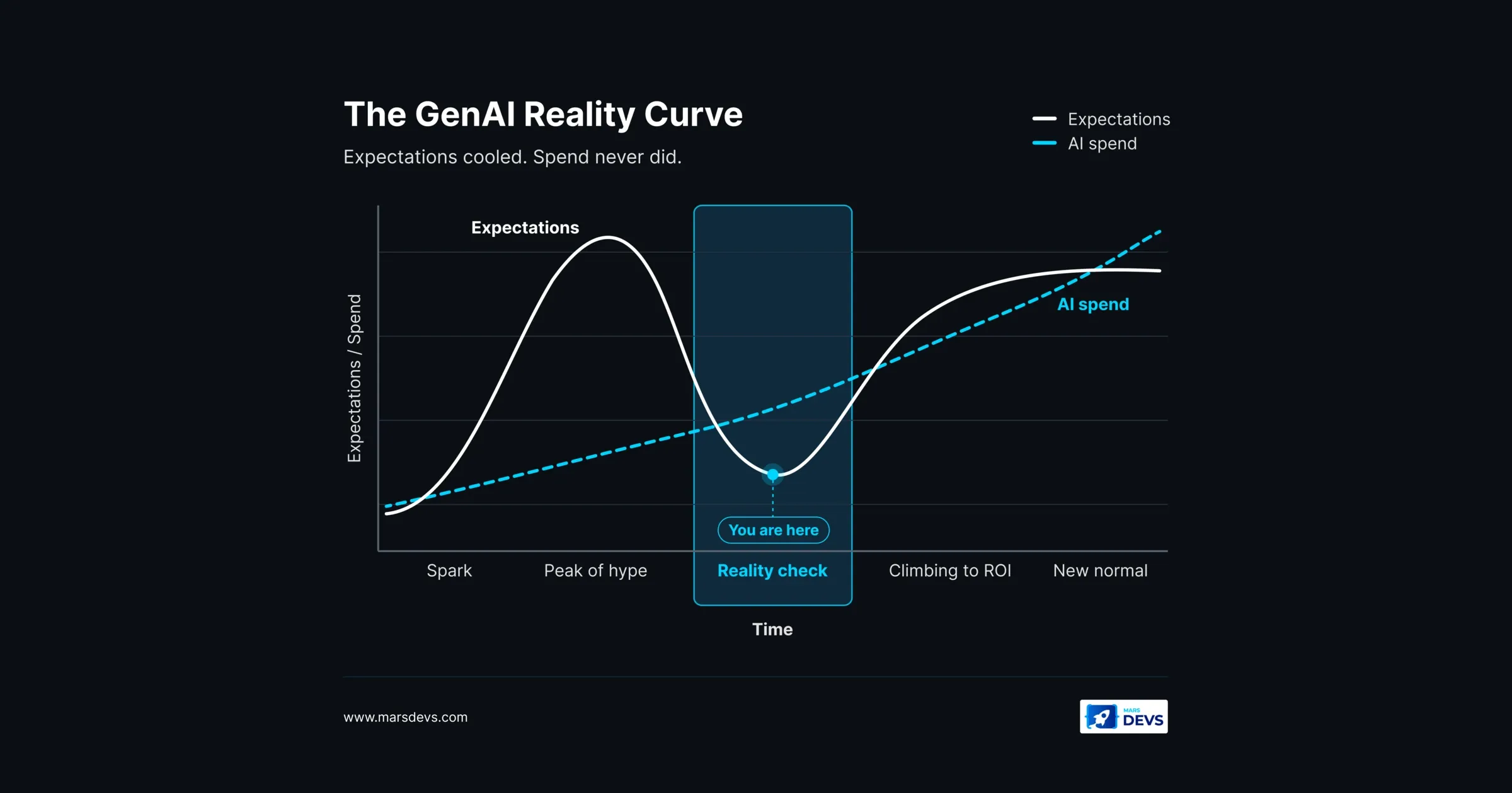
Here is the thing most 2026 AI budgets have in common: the enthusiasm has come off the boil, and the invoices have not.
Two years ago, generative AI could do no wrong in a board deck. Now the same executives who greenlit the pilots are asking harder questions. Where is the return? Why did the assistant rollout stall? Why is the model bill bigger than the pilot that justified it? The expectations have entered a reality check. The spending has kept right on rising, because the contracts are signed, the integrations are live, and the switching cost of walking any of it back is now painful.
That is not a failure of AI. It is a failure to keep your options open. The line between IT spend and AI spend has basically dissolved, and a lot of that budget is now flowing to one or two providers who are very happy to keep it that way.
We have watched this happen up close. Across 80+ products shipped since 2019, a growing share of them AI-native, the pattern is consistent. The teams that got stuck were not the ones who bet on the wrong model. They were the ones who wired a single model so deeply into the product that unwinding it meant a rebuild. The bet was fine. The lack of an exit was the problem.
Most AI vendor decisions get made on two numbers: unit cost and capability. Which model is cheaper per token, and which one is better at the task. Both matter. Neither captures the number that hurts you later, which is what it costs to change your mind.
Lock-in in a GenAI relationship is rarely a single contract clause. It accumulates in four quiet places:
None of those show up as a line called "lock-in" on the capital plan. That is exactly why they get ignored. A purchase order is easy to book. The freedom you gave up to sign it never appears on any invoice, so it never gets weighed against the discount you took to lock in.
The first move is to make that cost visible. Before you sign, ask a blunt question: if a materially better option appeared in six months, what would it cost us in time, money, and delay to move? If you cannot answer, you are not pricing the deal. You are only pricing half of it.
The open-model versus closed-model debate usually gets argued on capability and price. Reframe it as a switching-cost decision and it gets a lot more useful, because that is where the optionality actually lives.
| Dimension | Closed / proprietary model | Open-weights model |
|---|---|---|
| Headline capability | Often the frontier, first to new features | Close behind, gap narrowing each cycle |
| Unit cost | Higher, priced per token by the vendor | Lower at scale, you pay for compute you control |
| Switching cost | High. Prompts, tuning, and tooling are provider-shaped | Lower. Weights are portable; you can self-host or move clouds |
| Data control | Data flows through the vendor's boundary | You choose where inference and data live |
| Best when | The capability gap is your differentiator right now | The workload is stable, cost-sensitive, or sovereignty-bound |
| Optionality it buys | Speed to frontier features | Freedom to move, host, and negotiate |
Neither column is the right answer for the whole enterprise. The mistake is picking one globally. A frontier closed model can be exactly right for the product feature where being best this quarter is what wins you the market. An open-weights model can be exactly right for the high-volume, cost-sensitive, or data-resident workload sitting behind it. The point is to choose per workload, and to keep the expensive, locked-in option confined to the places where its capability is genuinely the differentiator.
That is the same discipline that shows up when you consolidate engineering partners: standardize the commodity, stay flexible on the differentiator, and never pay a premium for flexibility you will not use.
Everyone agrees options are good. Almost nobody puts a number on them. In the executive committee, cost and revenue talk. Flexibility gets a nod and then loses to the vendor with the clearer discount. That is how enterprises talk themselves into lock-in with their eyes open.
The fix is to treat optionality the way finance treats any other real asset: name the kinds you care about, and value them. You do not need option-pricing math or a quant to do it. You need a shared vocabulary and a habit of asking what each option is worth.
Here are the five kinds of optionality worth paying for in an AI vendor relationship:
| Option | What it means | What it is worth when |
|---|---|---|
| Switch | Move to a different model or provider without a rebuild | New models ship every quarter and the frontier keeps moving |
| Exit | Walk away from the relationship quickly and cheaply | A pilot underperforms or a provider's roadmap drifts from yours |
| Scale | Ramp usage up or down fast without a cliff in pricing | Demand is spiky or genuinely uncertain |
| Stage | Commit in phases instead of all at once | The use case is unproven and you want to buy information first |
| Hedge | Run a fallback provider for the same capability | Uptime, rate limits, or a single point of failure would hurt |
When conditions are calm and predictable, these are worth little, and you should not overpay for them. When conditions are volatile, and AI in 2026 is nothing if not volatile, they can be worth more than the unit-cost saving you would get by locking in. That is the whole trade: the more uncertain the road, the more a cheap exit is worth.
A word of caution, because flexibility is not free. Being flexible everywhere is its own trap. It raises cost and complexity, and you cannot buy insurance against every eventuality. Decide where you will be flexible and where you will be ruthlessly standard, and connect that to strategy. Be flexible on the differentiators that win you the market. Standardize the commodity plumbing and stop paying for options there.
When someone claims a vendor move is "too expensive," ask them to itemize it. Half the time the number is a feeling, not a ledger. Write it down and the decision gets honest fast.
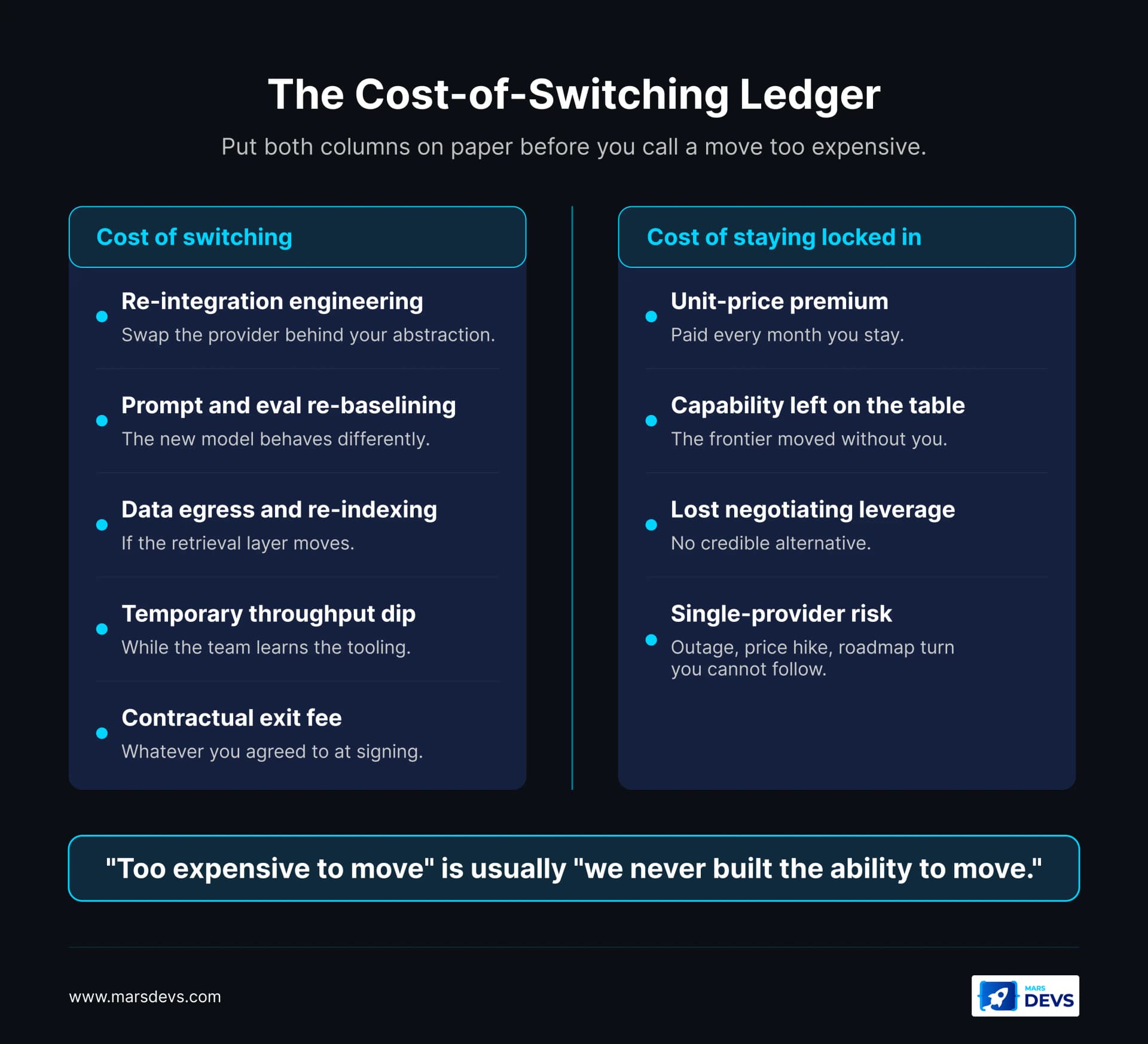
A real switching cost has a small number of honest components. Re-integration engineering to swap the provider behind your abstraction. Prompt and eval re-baselining, because the new model behaves differently. Data egress and re-indexing if your retrieval layer moves. A one-time dip in throughput while the team learns the new tooling. And any contractual exit fee you agreed to when you signed.
Set that against the cost of not switching: the premium you keep paying on unit price, the capability you are leaving on the table, the negotiating leverage you gave up, and the risk that your single provider has an outage, a price hike, or a roadmap turn you cannot follow. When both sides are on paper, the "too expensive to move" claim usually turns out to be "we never built the ability to move." Which is a design choice you can reverse.
You can price optionality with a napkin. The trick is to compare the expected value of a flexible path against a locked-in one across the futures you think are plausible, rather than betting everything on the single future you find most likely.
Take a simple, illustrative case. Say you are choosing between two providers for a customer-facing AI feature.
Now add the one thing every AI decision has, which is uncertainty. Suppose there is a real chance, call it even odds, that a materially better model arrives inside your planning window. If you locked into A, moving is costly and slow, so the upside case is muted, say the value drops to $40M when you cannot easily adopt the better model. If you chose B and built for switching, moving is cheap and fast, so the same future is worth more, say $60M because you can capture most of the upside.
Run the expectation across both futures. A is worth roughly (0.5 x $80M) + (0.5 x $40M) = $60M. B is worth roughly (0.5 x $70M) + (0.5 x $60M) = $65M. The "obviously cheaper" locked-in choice is now the worse one, and the gap is the value of the option to switch. In this toy example, that flexibility is worth about $5M, and it was invisible until someone priced it.
The numbers here are made up to show the mechanic, not a forecast. The method is what travels: sketch two or three plausible futures, estimate a rough value and likelihood for each, and let the flexible path show its worth in the futures where being able to move actually pays. It is a decision tree you can draw in a meeting, and it is close enough to be right where it counts. Precision to the dollar is not the point. Making optionality a peer of cost and revenue is.
If your GenAI spend is climbing while the value plateaus, these are the moves that bend the curve back.
Put an abstraction layer between your product and any single model. If swapping a provider is a config change and a re-run of your eval suite instead of a rewrite, you have bought the switch option for the price of some engineering discipline. This is the single highest-impact move, and it is an architecture decision you make once, not a contract you renegotiate forever.
Standardize the commodity, stay flexible on the differentiator. Pick one or two models for the boring, high-volume plumbing and stop shopping there. Reserve your optionality budget for the one or two places where being on the frontier this quarter is what wins the market.
Price optionality in every vendor decision. Add one line to every AI procurement review: what would it cost us, in time and money, to leave in six months? Make the answer a required field. A deal you cannot exit is not cheaper, it is riskier, and the review should say so out loud.
Own your evals and your data. Your evaluation suite and your data are the two assets that make switching cheap. Keep the golden set, the scoring harness, and the retrieval layer under your control, not the vendor's. When those are yours, every other option gets cheaper to exercise. It is the same instinct behind treating AI literacy, not tooling, as the real bottleneck: the durable capability lives in your team and your assets, not in a seat license.
We build AI products for founders and enterprises who cannot afford to get locked in and then watch the frontier move without them. Every AI-native product we ship goes out with a provider abstraction, an eval suite the client owns, and a retrieval layer that is portable by default. Not because we distrust any one model, but because the only safe assumption in 2026 is that the best model today is not the best model a year from now.
That is optionality built into the architecture instead of argued about in a contract. It is cheaper to build in from day one than to retrofit after the lock-in has set. If your AI spend is rising faster than the value you can point to, the question is not which model to buy next. It is how much it would cost you to change your mind, and whether you can still afford the answer.
Building an AI product you do not want to be trapped inside? Talk to our engineering team. We have shipped 80+ products across 12 countries, and we design for the swap from the first commit.
AI vendor lock-in is the accumulated cost of being unable to leave a generative AI provider cheaply. It builds up in four places: prompts and tuning shaped to one model, data gravity in the vendor's ecosystem, committed-spend contract terms, and team expertise in one provider's tooling. None of it appears as a line item, which is why it is usually underpriced when the deal gets signed.
Because the spending is locked in while the enthusiasm is not. Contracts are signed, integrations are live, and unwinding any of it carries a switching cost that is painful enough that teams keep paying. The expectations reset faster than the commitments do, which opens a gap between what enterprises spend on AI and what they feel they are getting back.
Choose per workload, not globally. Closed frontier models are worth their higher cost and switching cost where being best this quarter is your differentiator. Open-weights models are usually the better call for high-volume, cost-sensitive, or data-resident workloads, because they are cheaper at scale and far cheaper to move. The mistake is standardizing on one for the entire enterprise.
Sketch two or three plausible futures, estimate a rough value and likelihood for each, and compare the expected value of a flexible path against a locked-in one. The flexible path earns its premium in the futures where a better option appears and you can actually move to it. You do not need option-pricing math. A decision tree you can draw in a meeting is close enough to make optionality a peer of cost and revenue.
Put an abstraction layer between your product and any single model, so switching providers is a config change and a re-run of your eval suite rather than a rewrite. Pair it with owning your evals and your data. Those three assets, the abstraction, the eval suite, and the data, are what make every other option cheap to exercise.
When conditions are stable, only marginally. When conditions are volatile, and AI in 2026 is highly volatile, the flexibility can be worth more than the unit-cost saving you would get from locking in. The discipline is to be flexible on the differentiators that win the market and ruthlessly standard on the commodity plumbing, so you are not paying for optionality where it earns nothing.

Co-Founder, MarsDevs
Vishvajit started MarsDevs in 2019 to help founders turn ideas into production-grade software. With deep expertise in AI, cloud architecture, and product engineering, he has led the delivery of 80+ software products for clients in 12+ countries.
Get more insights like this
Join founders, CTOs, and engineering leaders who receive our engineering insights weekly. No spam, just actionable technical content.


