
As Phil Nickinson exclaims, “Your mobile device has quickly become the easiest portal into your digital self.” Mobile applications are the hottest trends today. You are spending much effort & time on it. But what happens once it's finished? How do you know whether it's working or if you're optimizing for your users correctly?
The short answer is that you define KPIs and then track them using an analytics tool. You won't be able to measure ROI, know what to do if your app isn't effective, or know where to spend your efforts if you need analytics.
In this MarsDevs blog, we aim to help you identify the metrics you should measure to ensure your mobile app is optimized!
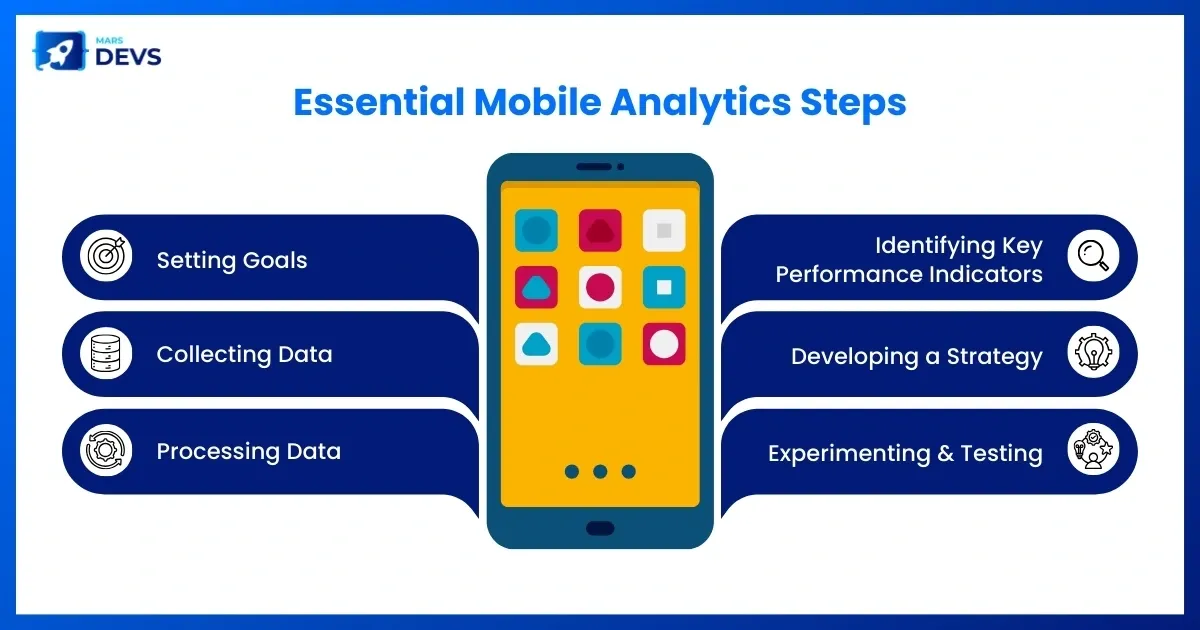
Mobile app analytics is a mechanism for tracking and evaluating user activity on a mobile app. The app's developer or publisher may apply mobile app analytics software to improve or assess their product.
An effective mobile application analytics tool will allow users to measure how many people have downloaded the mobile app, where they are located, how frequently they use it, which features are liked and disliked the most, what advertising they click on, and what encourages them to purchase.
App developers use the analytics data to alter and improve their apps. It might involve introducing new features to current features depending on user preferences.
An efficient mobile app analytics approach can help app publishers determine which elements of an application require development, what is functioning effectively, and how to best market the application via different portals like social media campaigns, digital advertising, etc.
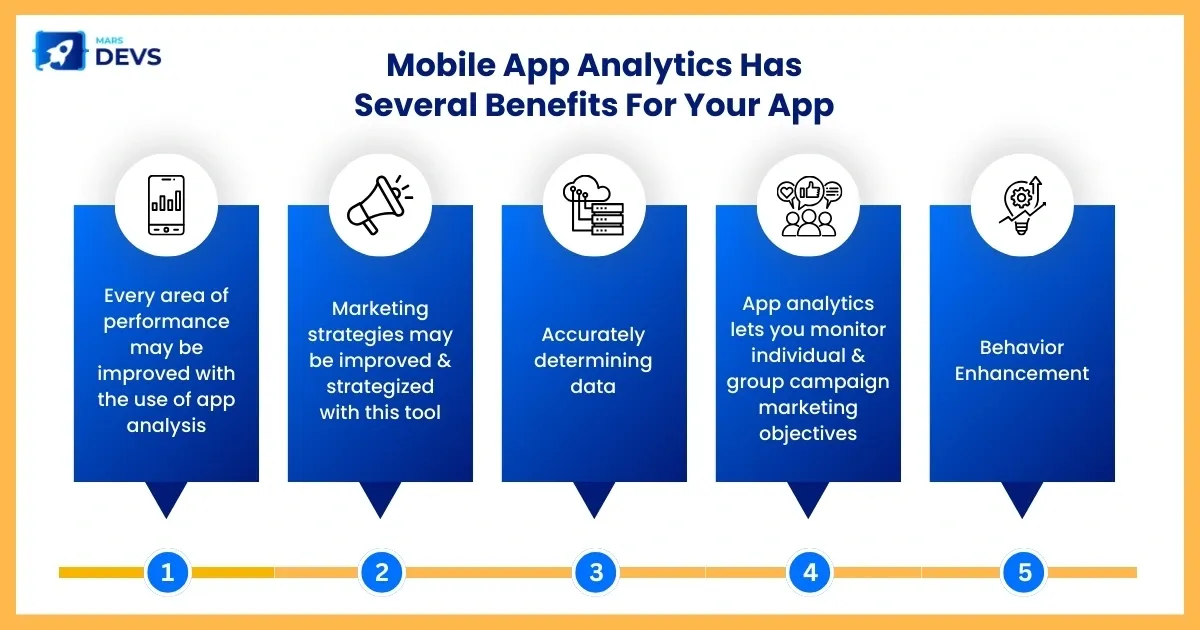
The mobile app analytics platform is a powerful tool that has the potential to revolutionize your company environment. But what are they necessary? As Mitch Lowe says, “Use analytics to make decisions. I often assume you may require a precise answer before deciding, and he taught me to use analytics directionally and never worry whether they are 100% sure. Just try to get them to point you in the right direction.”
With mobile app metrics, businesses can know whether their applications are working or failing. Without specific data, businesses must rely on broad measures such as total revenue or downloads. These high-level signs might mask the reality that the program is losing money or customers quicker than it is gaining them.
Companies can identify and address these issues using app metrics. Use an app analytics software to track the stats of your mobile app. This program collects user data whenever they perform activities such as logins or purchases and summarizes it on a dashboard.
It enables app developers to ask more questions, test theories, and make better product and marketing decisions. While there are several metrics to monitor, it is advisable to concentrate on the 4 to 5 key performance indicators (KPIs) that are most directly related to the goals of your app.
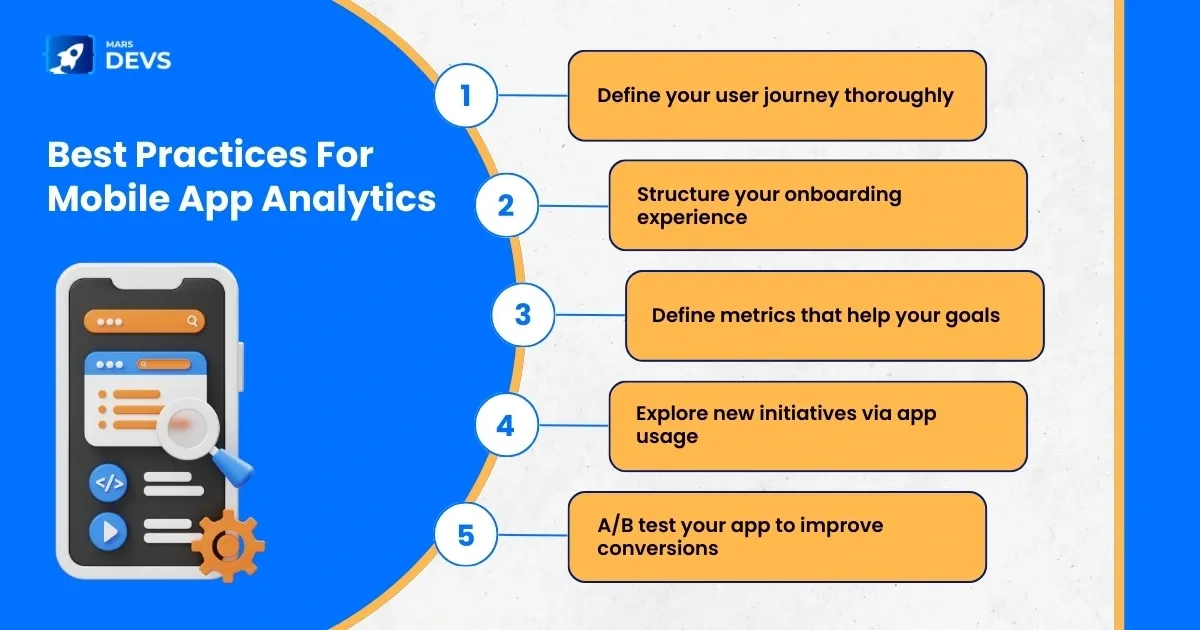
Choosing the correct Key Performance Indicators (KPIs) is critical for several reasons:
Alignment with business objectives - KPIs should be related to the strategic goals and objectives of the enterprise. By picking the proper KPIs, businesses can ensure that their efforts and resources are focused on monitoring and improving the elements that genuinely matter for success.
Measuring relevant metrics - By selecting the correct KPIs, firms can gauge the most important indicators that indicate performance and advancement in crucial areas.
Performance assessment and benchmarking - Key performance indicators (KPIs) serve as standards for assessing performance over time. They give a tangible measure of progress and allow firms to compare their performance to predefined objectives or industry standards.
Prioritization and concentration - A compact collection of well-defined KPIs allows firms to concentrate their attention and resources on the most critical parts of their business.
Accountability and communication - KPIs are used to communicate inside a company. Businesses may guarantee that everyone knows what is being measured and why it is essential by choosing and clearly defining KPIs.
So, which KPIs to choose? When it comes to monitoring development and performance, three types of Key Performance Indicators (KPIs) are commonly utilized in a growth-driven approach:
1. Acquisition KPIs
These KPIs are designed to assess the efficacy of your app's user acquisition activities. They give information on how many people find and download your app. It ranges from app downloads, Cost per Acquisition (CPA), conversions, and more.
2. Activation and Engagement KPIs
These KPIs are concerned with determining user engagement and the success of your application in providing value to users. They assist you in determining how effectively your app performs regarding user onboarding, retention, and general engagement. Some of them include Session Duration, Retention Rate, and others.
3. Revenue and Monetization KPIs
These KPIs measure your app's financial performance and revenue generation. They assist you in understanding the efficacy of your monetization techniques as well as the overall profitability of your app. Some common ones include Conversion Rate, Lifetime Value (LTV), and Ad revenues.

Co-Founder, MarsDevs
Vishvajit started MarsDevs in 2019 to help founders turn ideas into production-grade software. With deep expertise in AI, cloud architecture, and product engineering, he has led the delivery of 80+ software products for clients in 12+ countries.
Get more insights like this
Join founders, CTOs, and engineering leaders who receive our engineering insights weekly. No spam, just actionable technical content.


